Russia’s Su-57 aircraft will begin receiving the new Product 177 engine in the coming years, the CEO of the United Aircraft Corporation (UAC) told news agency TASS.
“Today, the Su-57 fully meets the requirements for a fifth-generation fighter. The next-stage engine is Product 177. We should talk about equipping the Su-57 fighter with it, not as a step necessary for the Su-57, but rather as additional capabilities that we will receive. We believe this will happen in the coming years,” Vadim Badekha noted.
As EurAsian Times reported last December, Russia flew the Su-57 with the new Product 177 engine, which reportedly operated normally and reliably during the first flight.
“The first test flight marked the beginning of joint work with colleagues from the UAC for flight tests of the Su-57 with the latest engine. During the flight, the new engine worked normally and showed reliable operation as part of the Su-57 aircraft,” the Rostec press service noted.
The Product 177 engine has greatly enhanced technical features compared with previous-generation power plants. The engine enabled the incorporation of the latest technologies, materials, and innovative design solutions, according to the General Designer–Director of the A. Lyulka Design Bureau, a branch of PJSC UEC-UMPO of the United Engine Corporation, Evgeny Marchukov.
The Product 177 has been created for use in fifth-generation aviation systems. It features a maximum thrust of 16,000 kilograms-force (kgf). Additionally, it has lower fuel consumption across all flight modes and a longer service life.
Currently, the Su-57 fighters are widely reported to be powered by AL-51F engines.
Rostec calls the Product 177 a fifth-generation aeroengine. Under Rostec classification, a fifth-generation engine features a turbine inlet temperature of 1,750 K, 3D cooling techniques, advanced superalloys, and ceramic coatings.
A fourth-generation engine features a turbine inlet temperature of ~1,600 K, single-crystal turbine blades, and advanced coatings (thermal barrier coatings—TBCs).
The Product 177 engine was possibly developed to replace the AL-51F1 / Product 30 engine, incorporating technological improvements since the initial flight of the Product 30 engine on a Su-57 in 2017.
Therefore, it is an advanced variant of the AL-51F engine, with higher thrust and improved fuel efficiency.
Based on technical disclosures such as thrust rating, the Product 177 engine is a closely related variant of Product 30 and is dimensionally identical to the AL-51F engine. Product 177 may be an alternative powerplant for the export variant of the Su-57, with some of the AL-51F1’s advanced features held back.
Notably, on December 22 last year, the UAC disclosed it was boosting its production capacity to increase the supply of Su-57 jets to Russian troops and to promote these aircraft for export.
“United Aircraft Corporation is currently implementing a program to expand production capacity. This will increase the volume of deliveries of the fighter to the troops, as well as actively offer the Su-57 in the export version for foreign customers,” the report says.
Su-57 Gets F-35-Like DAS Capabilities
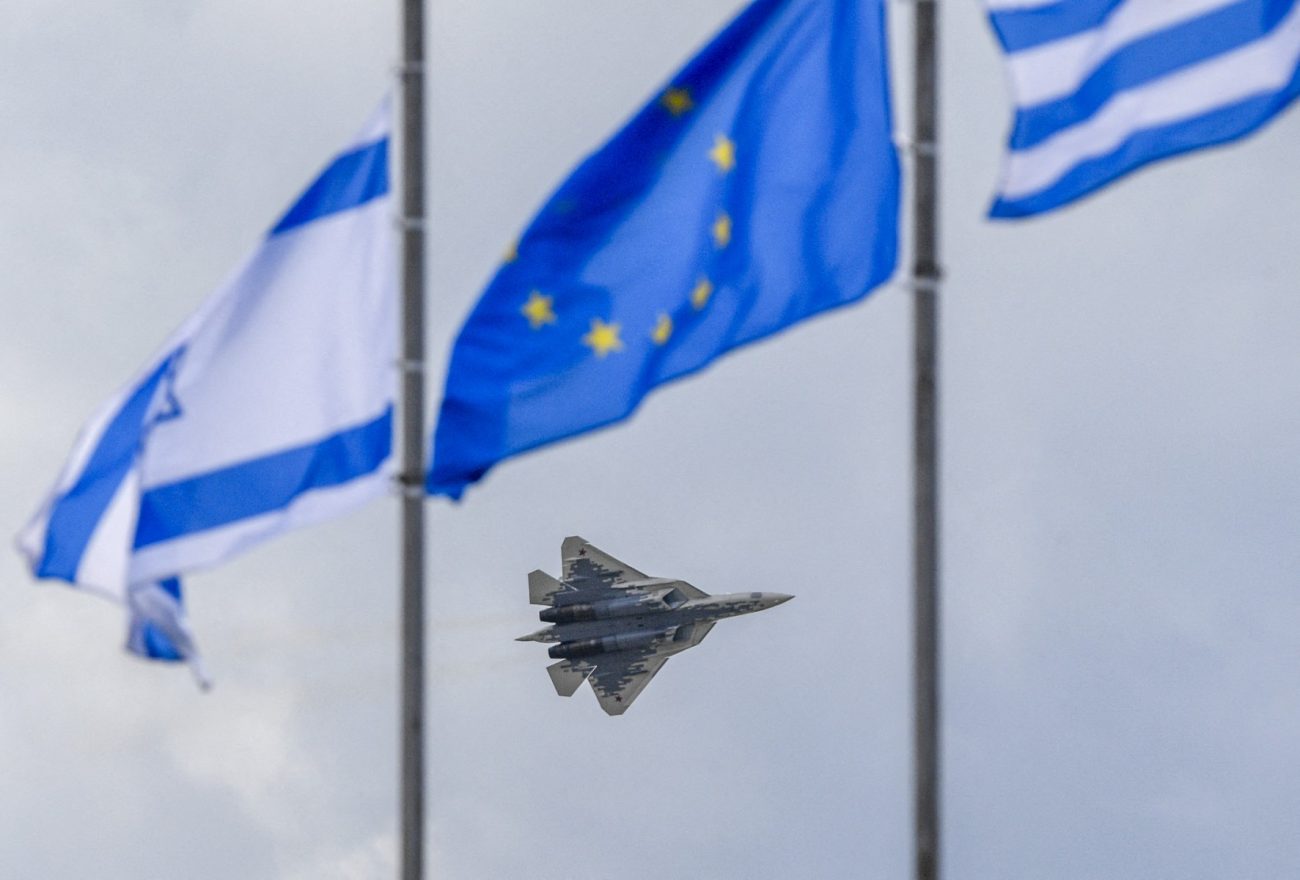
Early this year, the Russian Aerospace Forces (VKS) inducted a new batch of Su-57 jets featuring a “new technical profile.” The new, upgraded version of Russia’s fifth-generation fighter comprises improved onboard systems and a new weapons configuration that enormously expands the jet’s combat role.
“To fulfill the targets set by the Russian Defense Ministry for the supply of highly sought-after weapons and military equipment to the troops, crews of the Russian Aerospace Forces have accepted the Su-57 aircraft in their new technical configuration,” the Rostec press service quoted a Su-57 pilot as saying.
Rostec did not specify which particular weapons systems had been upgraded, but stressed that they would enhance the aircraft’s combat profile.
“The aircraft has already proven itself during the special military operation (Ukraine War). The new technical configuration will provide for the expansion of the range of missions for which this aircraft type is deployed. The advanced capabilities incorporated into the aircraft armament system make it possible to use new types of aircraft weapons,” the pilot added.
Rostec’s post also underscored that the aircraft is regularly deployed to the battlefield in Ukraine. The announcement came nearly two months after the UAC confirmed it had tested the Su-57 with a new Izdliye 177 engine.
Vadim Badekha, CEO of UAC, said earlier that the platform continues to evolve. “The fifth-generation Su-57 aircraft system is the best aircraft in its class, but we’re not resting on our laurels. The fighter has undergone a tremendous evolution, and its improvement continues today – the aircraft’s weapons and systems capabilities are being upgraded.”
“This fighter allows us to solve the most important tasks today, demonstrating efficiency and excellent maneuverability and combat capabilities,” he added.
Deadlier Su-57?
Analysis of higher-resolution images released by UAC and examined by OSINT analyst George N. reveals visible changes to the 101KS electro-optical complex, which supports self-protection and missile warning functions.
The 101KS complex is an electro-optical targeting system that provides the Su-57 with all-weather surveillance and passive infrared detection. The 101KS complements the radar by detecting and tracking targets in the infrared and visible spectra. It can detect heat signatures of missiles and aircraft and conduct passive situational monitoring.
/Su-57/
Quickly made a few pics on my phone to showcase some of the changes (not all of them!)
These pics do not have any watermark or insignia, feel free to copy, steal, reproduce, post as your own, ect, I don’t really care for copyright. https://t.co/vwLvw1YJzL pic.twitter.com/eErY7bjUey
— George N. (@GeorgeN28581) February 9, 2026
This allows the aircraft to function sans active emissions, enhancing survivability in contested settings. However, the modifications visible on the new aircraft suggest a significant evolution compared to the system’s initial configurations.
In particular, the prominent incorporation of additional optics and revised apertures—presumably operating across multiple spectral bands, including visible, mid- and long-wave infrared (IIR), and possibly ultraviolet (UV)—points to a substantial expansion of passive observation capabilities.
According to Aviacionline, unlike the simpler earlier version, which was primarily focused on detecting incoming missiles, this new configuration appears aimed at generating a continuous multispectral image of the aircraft’s surroundings, with coverage approaching 360 degrees.
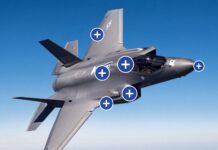
The imagery suggests that the 101KS would no longer function solely as a defensive sensor, but rather as a key element of situational awareness, aligned with the philosophy of the AN/AAQ-37 Distributed Aperture System (DAS) carried by the F-35.
If confirmed, this would mean the Su-57 is moving toward a distributed, passive surveillance capability capable of detecting and tracking airborne threats without relying solely on radar.s
The F-35’s AN/AAQ-37 Electro-Optical Distributed Aperture System (DAS) consists of six infrared sensors distributed around the aircraft, providing 360-degree (spherical) situational awareness and long-range detection. DAS enhances the F-35’s survivability and operational effectiveness by warning the pilot of incoming aircraft and missile threats, providing day/night vision, and supporting the navigation function of the F-35 Lightning II’s forward-looking infrared sensor.
However, there is no official confirmation yet of the Su-57’s DAS-like capability.
- With technical Inputs from Vijainder K Thakur, Ex-IAF Fighter Pilot