Lithuania, a NATO frontline state that shares a direct border with Russia and Belarus, has signaled its willingness to host US nuclear weapons as part of NATO’s nuclear-sharing arrangements.
Lithuania’s Minister of National Defense, Robertas Kaunas, said his country was in talks with the United States over a potential hosting of nuclear weapons on its territory, Politico has reported.
“Lithuania is certainly not standing on the sidelines,” he said, referring to concerns about potential security gaps in NATO’s security amid a potential drawdown of US military presence, as indicated by Washington.
The statement comes after a Financial Times report claimed that the US was contemplating expanding the deployment of its nuclear weapons to additional countries and resurrecting security guarantees amid a reduction in conventional military presence in Europe.
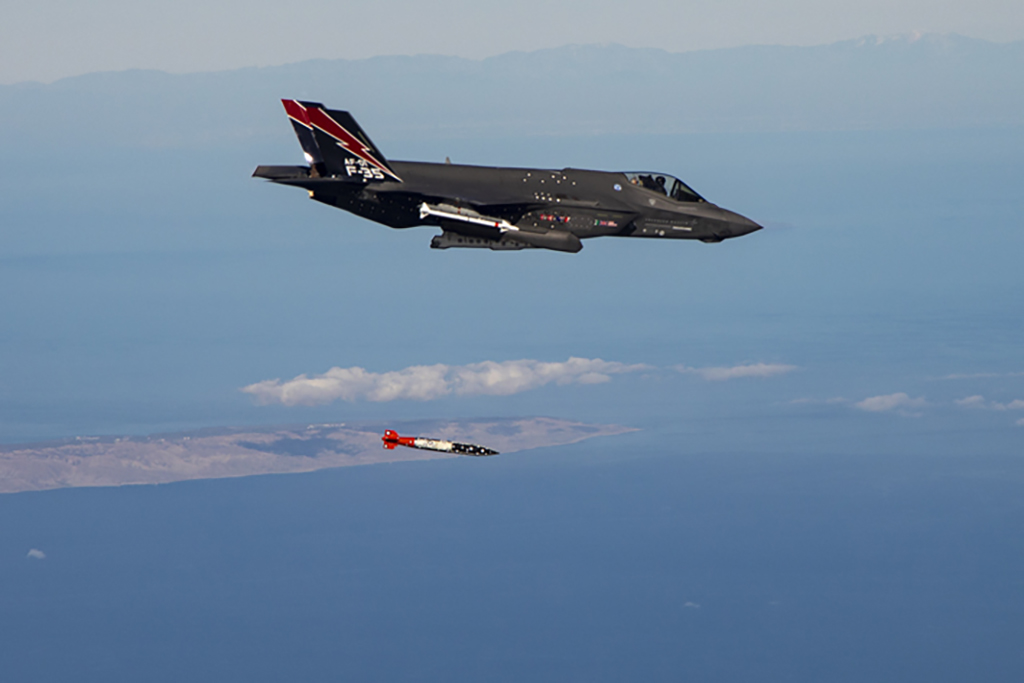
Currently, only a few countries host the American B61-12 bomb as part of NATO’s nuclear sharing program, including the UK, Germany, Italy, the Netherlands, Belgium, and Turkey.
These are US-owned weapons, kept under US custody and control, but hosted at air bases in Europe for potential delivery by allied dual-capable aircraft in a crisis where their use is authorized by the United States and the NATO alliance.
The FT report stated that deploying nukes to additional NATO countries is meant to assuage concerns about the US commitment to the alliance, as it reduces the US military presence in Europe. The report noted that some Baltic states and Poland were interested in hosting weapons due to the increasing security threat posed by Russia.
This is particularly relevant for Lithuania, as some 1,000 American soldiers are withdrawing from the Baltic country after completing a deployment rotation, and the arrival of their replacement remains uncertain.
“The next rotation is currently under review … because the number of (U.S. troops) in Europe is changing, this naturally leads to a review of regional stance,” Kaunas stated.
A negative US decision could leave Lithuania without a US armored battalion on its soil for the first time since 2020. The uncertainty has visibly left Lithuania concerned, particularly since there have been nearly constant US force rotations in the country.
Lithuania sees nuclear hosting as a way to keep a strong American skin in the game and maintain credible deterrence even in the absence of conventional troops. While the Baltic country’s constitution forbids the deployment of nuclear weapons within its borders, the Lithuanian President Gitanas Nausėda has reportedly proposed amending this fundamental legislation due to current security threats.

Currently, these plans seem very premature, given that the US has not formally acknowledged any plans to expand nuclear coverage.
The US has historically been cautious about moving nuclear weapons further east, fearing it would be too escalatory.
Russia could most likely view this as a major provocation — placing US nuclear weapons on its immediate border. Moscow has already issued strong warnings about NATO nuclear expansion eastward, and President Vladimir Putin has even threatened the use of nukes in the past. Moreover, this could complicate future arms control discussions and contribute to further nuclear saber-rattling.
Moreover, hosting B61 bombs requires highly secure underground vaults, dual-capable aircraft such as the F-35, pilot training, and strict US custody arrangements. This means Lithuania would need to invest in nuclear-capable delivery systems and specialized training, which could be a time-consuming process.
Lithuania Faces Russian Threat
Lithuania is one of the most exposed NATO countries because of its geography. It directly borders Russia’s Kaliningrad exclave, a heavily militarised Russian territory and a key Russian ally, and Belarus.
Additionally, it faces vulnerability in the Suwalki Gap— the narrow strip of land connecting Lithuania or Poland to the rest of NATO. If Russia seized the Suwalki Gap in the event of an escalation, the three Baltic States (Lithuania, Estonia, and Latvia) could be isolated from the rest of NATO.
Lithuania, like the other Baltic states, has remained on edge after several undersea cables in the Baltic were sabotaged in 2024.
Lithuanian intelligence and officials assess that a full-scale conventional invasion is currently a low probability, while hybrid and unconventional threats are growing. For example, Russian drones have been found to be violating the country’s airspace on multiple occasions, and Lithuania’s president and prime minister were rushed to underground bunkers amid one such incident that occurred last month.
Lithuanian officials have warned that Russia could rebuild the capability to threaten the Baltics in 3–5 years if the war in Ukraine ends or freezes on favorable terms.
Additionally, Russia is expanding units near NATO borders, including in Kaliningrad, and its economy is now geared toward war production.
Lithuanian intelligence recently concluded in its annual assessment of security risks that Russia is increasing military units at the NATO border, providing them with combat experience in Ukraine, and warned that it could use these combat-hardened troops in a clash with NATO after the war. “Russia would likely create not only a 30-50 percent larger army than it had before the war but also a relatively modern one. Strategic reserves of weapons and ammunition would be fully restored. Russia would be ready for a conventional military conflict with NATO,” the intelligence report said.
To combat the sustained threat posed by Russia, Lithuania has embarked on a steady military modernization and is determined to bolster its armed forces. For example, the country previously approved defense spending of 5.38% of GDP, one of the highest in Europe.
Further, it is strengthening combat readiness in the event of an exigency. Lithuania has taken some tough measures, such as reinstating conscription, building up reserves, and adopting a “total defense” approach that includes civilian resistance.
“Lithuania’s move toward conscription demonstrates once again that Russia is still a driving force behind military planning and foreign policy formulation in the Baltic region. In a way that is simply unimaginable in many Western European countries and North America, Lithuania still sees Russia as an existential threat, Carnegia stated in a previous article.
To bolster its security, Lithuania decided last year to host a permanent German military brigade. Germany’s 45th Panzer Brigade (Armored Brigade 45), with a strength of 4,800–5,000 troops, is scheduled to be fully operational by 2027. It includes a heavy armored brigade with Leopard 2 tanks, Puma infantry fighting vehicles, artillery, and support units.
Moreover, it regularly participates in military exercises with NATO allies and has purchased a host of offensive and defensive weapon systems, including German Leopard-2A8 main battle tanks, Swedish CV90 Mk IV infantry fighting vehicles, and the HIMARS, NASAMS Air Defense, UH-60M Black Hawk helicopters, JLTV Light Tactical Vehicle, and Javelin ant-tank missiles from the United States, among other things.
The alacrity to host US nukes is probably part of the same desperation to enhance preparedness against a potential Russian aggression, or perhaps, to deter a Russian aggression altogether.
- Contact the author at sakshi.tiwari13 (at) outlook.com
- Follow EurAsian Times on Google News