The United States Marine Corps (USMC) bid a heartfelt farewell to the legendary AV-8B Harrier II on June 3, marking the end of an era for the iconic “jump jet” that revolutionized Marine close air support and served as a cornerstone of the force for over four decades.
The last operational Harrier II squadron—Marine Attack Squadron 223 (VMA-223) “Bulldogs”—officially bid farewell to the aircraft in a “Sundown Ceremony” on June 3, at USMC Air Station Cherry Point in North Carolina.
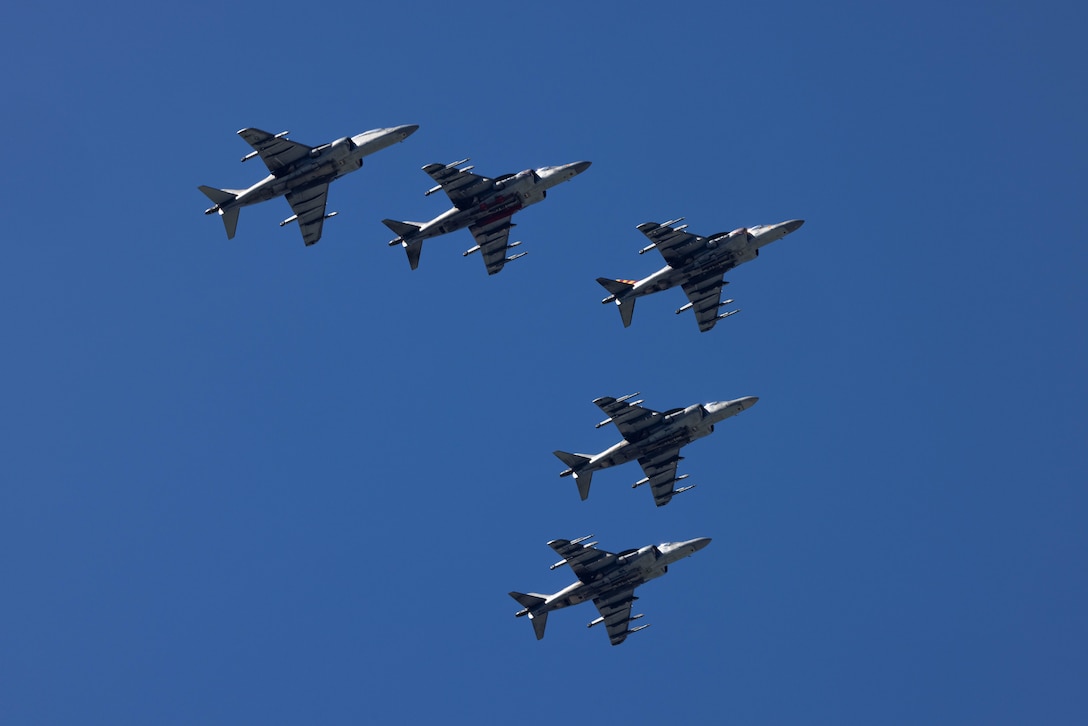
The outgoing Harriers stunned onlookers for one last time as they landed simultaneously after conducting a five-ship formation flyover. The five jets, including four single-seaters and a twin-seater, also received a water cannon salute to honor their legacy.
Though the exact number of jets that retired on June 3 is unknown, the VMA-223 likely had eight to twelve jets in flyable condition during the twilight of their service life.
“Today marks the final flight of the Marine Corps’ AV-8B Harrier at Cherry Point, North Carolina. For over 40 years, the Harrier served as the @USMC’s premier close-air-support platform around the globe. In a new role, the Harrier will continue to inspire the next generation of leaders about the importance of American airpower & innovation. Semper Fi,” North Carolina Senator Ted Budd said in a post on X.
The ceremony concluded, but tributes have since continued to pour in for the Harriers, with emotional aviation enthusiasts describing their retirement as the “end of an era.” All Marine units that flew this legacy aircraft are transitioning to the fifth-generation F-35 Lightning II jet, setting into motion an all-new era for Marine aviation.
“Bittersweet day as we watched the USMC Harrier close its chapter on Marine Corps Aviation. While this chapter closes, we still have efforts to get several of these Harriers into museums or static displays in the coming months and years. Semper Fidelis,” wrote a former US Marine on X. Meanwhile, a former Harrier pilot posted a photo of his “Harrier watch” to mark the day, adding, “An absolute beast of a bird (when she’s working). And it’s time for her to retire. I’m also glad that she got a proper replacement with the F-35B.”
A popular Arizona-based plane spotter, who goes by the name “KIWA Spotter” on X, paid their tributes to the aircraft, saying: “Today marks the end of the Marine Corps use of the Harrier, the plane that got me interested in plane spotting. They used to visit KIWA almost every weekend, and without hearing the constant screeching of that Rolls-Royce Pegasus, I wouldn’t be involved in this great hobby.”
While the Harrier II jets will never see combat again, they are expected to fly, albeit only to museums and storage facilities. Typically, retired military aircraft, such as the Harrier, are delivered to the Air Force’s 309th Aerospace Maintenance and Regeneration Group at Davis-Monthan Air Force Base in Arizona, also known as the “boneyard.”
The iconic AV-8B Harrier II will be officially deactivated sometime in September 2026.
The Harriers Leave A Decorated Legacy Behind
The AV-8B Harrier II was the second-generation Harrier, an upgraded version of the AV-8A Harrier developed by Hawker Siddeley Aviation of the United Kingdom. It remains etched in public memory as the most distinctive-looking aircraft and the world’s first operational vertical- and short-takeoff-and-landing (V/STOL) fighter jet.
The USMC’s history with the Harrier dates back to the Cold War era, when the USMC acquired the AV-8A “jump jet” and became the first American operator of the type.
This single-engine, subsonic V/STOL attack aircraft provided the USMC with a game-changing capability to operate from narrow decks aboard amphibious ships, forward austere facilities, or even unprepared fields. It eliminated a key limitation as it could hover like a helicopter and then “jump” vertically from a standstill using its vectored thrust system, unlike conventional jets that need long runways to accelerate and lift off.
The AV-8B Harrier II was built by McDonnell Douglas (later Boeing) with significant upgrades, including a larger composite wing, a more powerful Rolls-Royce Pegasus engine with vectored thrust nozzles, increased fuel capacity, and improved avionics. It doubled the range and payload of its predecessor while maintaining the signature V/STOL prowess.
In fact, later AV-8B+ aircraft variants were equipped with the same AN/APG-65 radar system as the F/A-18 Hornet, enhancing their precision-strike and air-to-air capabilities.

The Harrier II could take off from roadways, damaged airfields, improvised locations, and even the decks of relatively small ships using swiveling engine nozzles. This was a revolutionary capability during the Cold War when planners feared that conventional runways would be among the first targets destroyed in a major conflict.
The Harrier II’s design and capability aligned with the USMC’s approach, which emphasized rapid deployment, self-sufficiency, maneuver warfare, and the ability to operate as a Marine Air-Ground Task Force (MAGTF) from the sea or austere environments.
The Harrier II participated in a host of conflicts, demonstrating its expeditionary ability.
The Harrier II made its combat debut just five years after its induction in the USMC, when the US launched “Operation Desert Storm” over Iraq’s invasion of Kuwait in 1991 under Saddam Hussein.
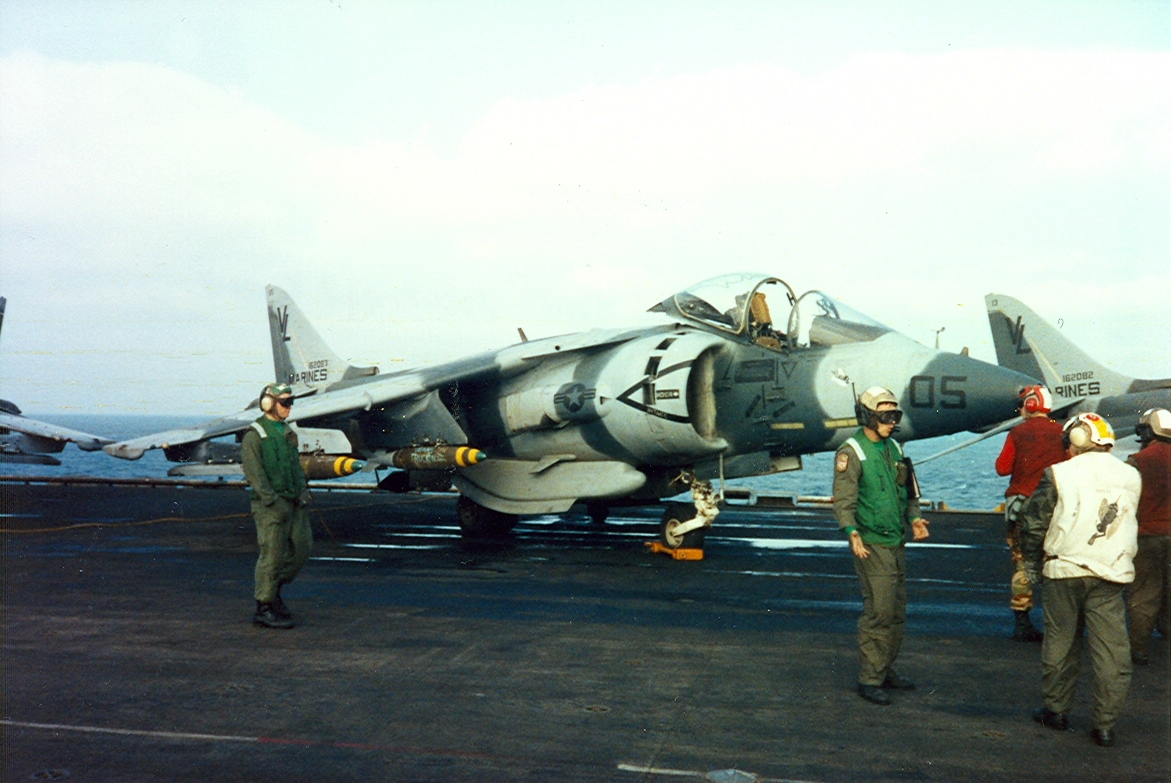
At the time, the AV-8B Harrier II operated from both amphibious ships in the Persian Gulf and forward land bases, and flew over 3,380 sorties with a mission-capable rate above 90%, earning a distinct reputation in aerial warfare. It provided close air support for ground troops, armed reconnaissance, battlefield interdiction, and attacks on Iraqi artillery, armor, command posts, and supply lines.
While five AV-8Bs were lost to surface-to-air missiles, Gen. Norman Schwarzkopf, the former Commander of the US Central Command, hailed the Harrier II as one of the war’s key weapons for the US’s responsiveness and forward basing.
After the Gulf War ended, the Harriers were tasked with patrolling and imposing no-fly zones over Iraq. The jets launched from ships and bases in Kuwait and were frequently tasked with reconnaissance and strike missions.
The AV-8B Harrier II saw its second major combat operation during NATO’s “Operation Allied Force”, a US-led bombing campaign against the Federal Republic of Yugoslavia in response to the alleged ethnic cleansing in Kosovo in 1999.
The Harrier II carried out armed reconnaissance, close air support (CAS), battlefield interdiction, and strikes on Serbian military sites in Kosovo and other parts of Serbia.
The jets demonstrated a distinct expeditionary edge by operating only from amphibious assault ships, launching from the sea, and returning to floating decks. Even though the USAF, US Navy, and coalition aircraft from land bases conducted the majority of bombing runs, the Marine Harriers provided a versatile, sea-based attack capability that could surge quickly and operate independently.
The Harrier II were called upon again when the United States announced the “War on Terror” following the 9/11 attacks in 2001. They became a workhorse in counterinsurgency operations thanks to their precision-guided munitions, targeting pods, and ability to loiter near ground forces
The Harrier II went to Afghanistan with the Marines, where the jets were deployed extensively, often from forward operating bases in rugged terrain. They provided persistent CAS, convoy escort, and armed overwatch for Marines and coalition forces, and were surprisingly effective in mountainous regions where time was of the greatest essence. They also proved crucial to Operation Iraqi Freedom in 2003.
A few years later, the aircraft supported combat operations in Libya in 2011 as part of Operation Odyssey Dawn, and in Iraq and Syria under Operation Inherent Resolve, which ran from 2014 to 2019.
The Harrier’s advantages during these battles included quick deployment, austere operations, short turnaround times, superior integration with Marine ground forces as forward air controllers, and adaptability to a variety of weaponry.
However, it is pertinent to note that the Harrier was already over 20 years old by the mid-1990s. And while the aircraft performed admirably and brought unforeseen capabilities to marine aviation, the USMC’s forward-looking planners and officers hoped for an aircraft with stealth, sensor fusion, greater range, better survivability, and network-centric warfare capabilities that the AV-8B could not realistically receive through upgrades.
This is when plans were conceived to replace the Harrier with the Joint Strike Fighter, the F-35.
The JSF program offered a single aircraft family that could meet the needs of the Air Force, Navy, and Marines while reducing long-term costs.
The F-35B had the same short takeoff and vertical landing capabilities as the Harrier. Additionally, it combined that adaptability with stealth technology, sensor fusion, potent electronic warfare capabilities, and the ability to function as an intelligence-gathering node throughout the battlespace. It enabled Marine aviation officials to significantly enhance combat capabilities while maintaining the Harrier II’s expeditionary advantages.
Subsequently, Marine Harrier II squadrons began transitioning to the F-35B in 2016; pilots moved to the new platform, maintainers received new training, and aircraft were retired.
The last two Marine pilots to complete AV-8B qualification training in 2024 were the last pilots to be officially recognized by the Corps as Harrier II pilots, signaling that the end of the Harrier II’s service life was just around the corner.
The Harriers completed their final combat deployment when a detachment from Marine Attack Squadron VMA-223 “Bulldogs” operated from the USS Iwo Jima (LHD-7) as part of the 22nd Marine Expeditionary Unit. Deployed to the Caribbean in late 2025 amid a major military buildup, the squadron supported operations that culminated in Operation Absolute Resolve — the January 2026 mission that resulted in the capture and extraction of former Venezuelan President Nicolás Maduro and his wife, Cilia Flores.
- Contact the author at sakshi.tiwari13 (at) outlook.com
- Follow EurAsian Times on Google News