The twin-seat variant of the Russian Su-57 stealth fighter may have entered testing amid an intensified export pitch to India. The FighterBomber Telegram channel, considered a reliable source of developments related to the Russian military aviation, claimed that Russia had begun taxi trials of the twin-seater Su-57 variant, in a post on May 16.
Subsequently, the channel published an image of the said two-seater variant on May 17, claiming it was the actual fighter undergoing taxi trials.
“Today, as part of the tests, the new two-seater modification of the Su-57 performed a rollover. We’ll see if it will be called Su-57D or Su-57UB. Alternatively, it could be called Su-57ED,” read the post by Russian military aviation blogger Ilya Tumanov on the Fighterbomber Telegram channel.
The EurAsian Times could not independently verify these claims, and the image could not be geolocated because the aircraft’s background has been blurred, likely for secrecy. However, the image has since gone viral on social media, with several observers and aviation trackers expressing confidence that the claims are authentic.

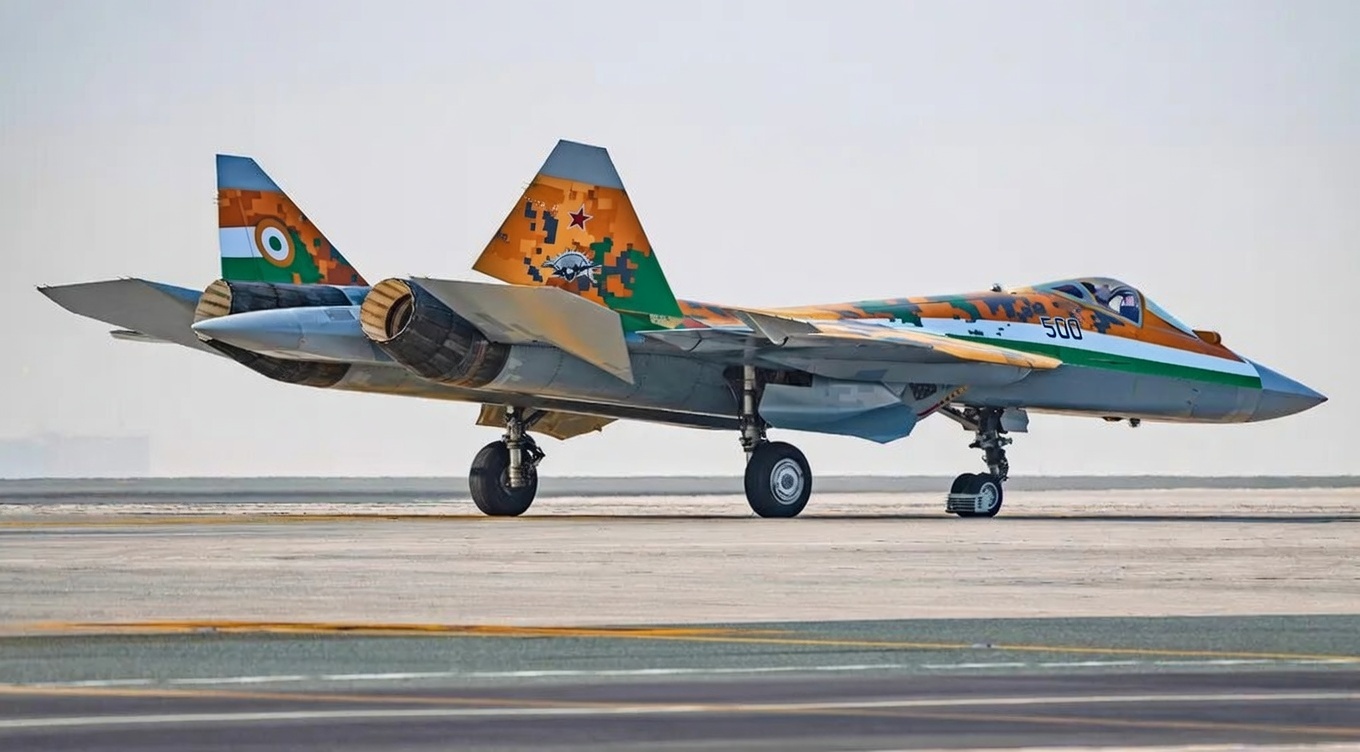
As seen in the photos, the alleged twin-seat Su-57 has an elongated forward fuselage with a tandem two-seat cockpit that bears an uncanny resemblance to the Su-30’s cockpit. Some observers have pointed this out as a reason for their suspicion about the claims.
There are no major externally visible differences between the aircraft in the image and the standard single-seat Su-57. However, renowned military aviation researcher Andreas Rupprecht noted that the aircraft bears the bort number “055 Blue.”
This is the same as the one previously used by the fifth flying Su-57 prototype, T-50-5, which was later rebuilt as T-50-5R after being damaged. Rupprecht, like others, suspects that the twin-seater aircraft could have been constructed by modifying the existing T-50-5R airframe.
It is pertinent to note that the new tail logo depicts the Su-57 alongside the S-70 Okhotnik drone, probably suggesting its intended role as a crewed fighter operating alongside loyal wingman drones in a manned-unmanned teaming (MUMT) configuration.
In 2023, the United Aircraft Corporation (UAC) patented a “multifunctional two-seat low-observable tactical aircraft,” which was said to be a two-seat variant of the Su-57 at the time, according to sources cited by Izvestia. “The two-seater ‘Sukhoi’ will be produced in three versions: training and combat, shock – with an operator responsible for the use of weapons, and – for the first time in the world – as the leader of a group of heavy drones,” the report had noted.
As of now, the UAC has not released any images of the twin-seat Su-57 or officially confirmed its development and trials. Nonetheless, if the reports are true, Russia may have just unofficially unveiled the world’s second twin-seat fifth-generation stealth fighter, after China’s J-20S.
Interestingly, the appearance of the twin-seat Su-57 comes at a time when Russia is aggressively pushing its stealth fighter for export to India. In fact, the latest claims have been perceived as a fresh attempt at luring India, which was initially drawn to the idea of operating a tandem-seat stealth fighter jet.
Luring India With a Two-Seater Su-57?
Russia has been aggressively pitching the Su-57 for export to India for more than a year. Last year, it offered a “golden deal” to India, including the supply of ready-made aircraft, the production of the Su-57 in India, and assistance with the Indian indigenous fifth-generation fighter, the AMCA (Advanced Medium Combat Aircraft).
The offer was subsequently modified by the Russian state arms exporter, Rosoboronexport, which said it could leverage the existing Su-30 MKI infrastructure to support local production of the Su-57 in India. Russia further sweetened the deal by offering full licensed production, technology transfer, and a “potential two-seat variant.”
The new two-seat offer was pitched as designed for greater operational flexibility, including pilot training, complex mission management, and manned-unmanned teaming between the fighter and drone-like loyal wingmen. The acquisition would also entail integrating Indian-origin weapons and subsystems, Russian officials said.
While the Indian Air Force (IAF) has so far remained reluctant to accept the Russian offer, experts believe that the two-seater offer is likely to have greater appeal, as India and Russia originally intended to collaborate on the development of the Fifth Generation Fighter Aircraft (FGFA), which was to be a two-seat Su-57 derivative.
In a previous EurAsian Times article, IAF veteran and military commentator Squadron Leader Vijainder K. Thakur (retd) made a case for a dual-seat variant of the Su-57 as the most suitable option for the service.
“I doubt the IAF will go for the Su-57 outright. The IAF’s requirement isn’t just for a stealth fighter—it is specifically for a dual-seat, twin-engine stealth fighter,” Thakur resolutely said in his argument.
He highlighted a host of advantages of operating a two-seat Su-57, such as the ease of pilot training and enhanced mission management, noting that a second crew member would ease the operational workload by managing complex systems, data fusion, and electronic warfare operations, among other tasks. Additionally, Thakur surmised that the dual-seat variant would provide a unique drone-mothership capability, as the second pilot could control the loyal wingman drones.
There is potential for a two-seater Su-57 to act as an airborne command center for mixed aircraft groups. According to the Russian patent, the two-seater Su-57 can serve as an airborne command center for mixed aircraft groups, which may be ideal for integrating the IAF’s Su-30MKIs, Rafales, and future indigenous drones into a combat network.
The IAF operates a large fleet of Su-30MKI two-seaters, which means Indian pilots and crews are highly experienced with the pilot-plus-Weapons System Officer (WSO) model for heavy, long-range strike roles. Therefore, IAF experts believe that a two-seat Su-57 would allow smoother transition, better training, and similar mission flexibility.
Thakur earlier highlighted that India abandoned the aspirational FGFA program due to two major shortcomings: the lack of crucial fifth-generation features such as supercruise, and its unproven operational capability. However, the Su-57 has come a long way since. For one, aircraft have been deployed in combat, even if assuming a limited role in the ongoing Ukraine war. Second, concerns about the absence of supercruise capability are also being addressed.
On their part, both the IAF and the Indian Ministry of Defense (MoD) have remained nonchalant in the face of Russian Su-57 offers over the past year, an approach that military experts have attributed to the failure of the FGFA partnership.
“As far as Su-57 is concerned, I just want to say that we have to weigh all the options, and we in the defense ministry and in the Indian Air Force have a very set process of induction of any weapon system, and that process will be followed. So what comes will depend on what meets the requirement and what is best for us,” the IAF chief, Air Chief Marshal A.P. Singh, said in October 2025.
In fact, despite the Su-57 offer, the MoD pressed ahead with finalizing the purchase of the Dassault Aviation Rafale multi-role aircraft, which is now in an advanced stage.
Earlier, it appeared that India was done with the Su-57 offer for good, particularly after the MoD endorsed the purchase of the Rafale and expressed interest in joining a foreign sixth-generation fighter program. However, the Chairman and Managing Director of the state-run Hindustan Aeronautics Limited (HAL), Dr D.K. Sunil, disclosed last month that quotations from Russia on the investment required to produce the jets locally in India were awaited.
This, in a way, established that India was neither committing to nor rejecting the offer. A large section of the Indian defense and strategic community believes the IAF should acquire a few Su-57s to bridge the gap with its adversaries until the indigenous AMCA is ready.
“This is what the IAF wanted to begin with. It is what the IAF will get now!” Thakur said about the Su-57 twin-seat variant.
- Contact the author at sakshi.tiwari13 (at) outlook.com
- Follow EurAsian Times on Google News