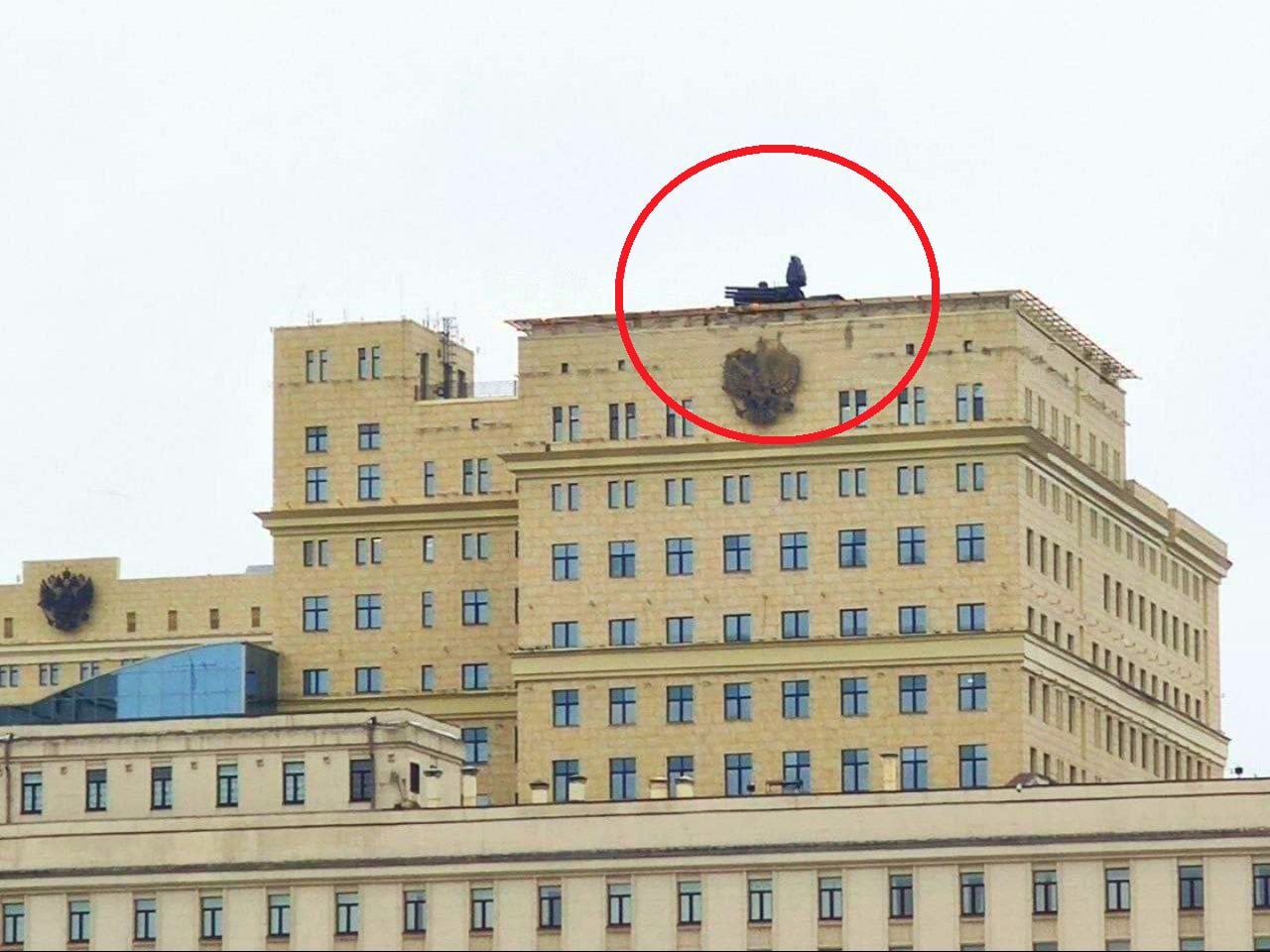
Russia has adopted some extra measures to protect the buildings in Moscow from frequent long-range drone attacks, such as the installation of specialized counter-drone Pantsir air defense systems atop skyscraper rooftops.
A video of a Russian Mi-26 military transport helicopter carrying a Pantsir-SMD-E to the rooftop of a building went viral this week, sparking curiosity and intrigue among observers.
The move is likely meant as a preparation against anticipated Ukrainian drone strikes on the capital, particularly since the Pantsir-SMD-E seen in the video is a tailored counter-drone missile defense system based on the combat-hardened Pantsir-S1. The building has reportedly been identified as Nordstar Tower business center, a 42-story building located near Moscow, close to the Kremlin.
It is hard to say why the Nordstar Towers were chosen to host the Pantsir, or how many buildings in the vicinity of or across from Moscow have had Pantsir-SMD-E installed on their roofs. However, OSINT analyst Mark Krutov has reportedly counted at least 100 of them across Moscow, several of them installed atop dedicated towers.
Russia: Pantsir-SMD-E air defense system installed by Mi-26 on the roof of the Nordstar Tower commercial office space skyscraper in Moscow.
The roof of this 170m skyscraper is now a legitimate military target for Ukraine.
Address: Begovaya Ulitsa 3. pic.twitter.com/nJU6KN2m1f— Igor Sushko (@igorsushko) May 28, 2026
The visuals of Russia’s key air defense system atop a rooftop have evoked déjà vu among observers, recalling January 2023, when the system was first spotted on the roofs of defense and administrative buildings in Moscow.
At the time, these air defense systems were set up within the administrative structure in Moscow and the National Defense Management Center of the Russian Defense Ministry, as previously reported by the EurAsian Times. Subsequently, the system was photographed on the rooftop of a building near President Vladimir Putin’s residence.
The measure comes amid an expansion in Ukraine’s long-range drone attacks against Russia’s oil and gas facilities. On May 17, for instance, Ukraine launched over 1,300 long-range drones in a massive swarm over two days, including on production facilities, oil refineries, semiconductor plants, and air defense systems. Some of the drones made it to the capital, Moscow, killing about four people and wounding many others in attacks.
Ukraine significantly ramped up deep strikes, surpassing Russia in monthly long-range drone launches at some points during this month. The drones have targeted energy facilities in Ryazan, Moscow, Saratov, Volgograd, Novokuybyshevsk, Tuapse, and Bashkortostan, as well as military targets, including aircraft repair plants, airbases, and drone- or missile-production and storage sites.
In a recent interview, Ukrainian Foreign Minister Andriy Sybiha warned Russians that they were no longer secure anywhere in their large nation due to Ukraine’s enhanced drone capabilities and range. “We proved how effective we could be. In Russia, there is no safe place. We could attack them from up to 2,000 kilometers away. Putin had to allow the parade to be conducted on the 9th of May,” he stated, referring to the watered-down Victory Day celebrations in Russia this year amid long-range Ukrainian attacks.

Notably, Pantsir systems deployed on rooftops could act as a dense, short-to medium-range “umbrella”, serving as a last-line, point-defense layer against Ukrainian drones in urban areas like Moscow.
For one, placing the system high up reduces ground clutter, buildings, and terrain obstructions, giving better detection of low-flying drones that try to hug the ground or use urban terrain for cover. Moreover, installing them atop buildings gives the missiles and sensors clearer lines of sight over a wider area of the city and surrounding areas.
Although it doesn’t eliminate the possibility of interceptors going off course or debris from destroyed drones causing harm or injury to unsuspecting civilians, installing the system on a building certainly offers a safer firing site. In addition, this rooftop perch provides a significantly greater variety of firing angles and a longer reaction time.
The Pantsir system, widely used by the Russian Armed Forces, has long been a key component of Russia’s layered air defense shield, which also includes the S-400 for long-term use. It combines both missile and gun systems to provide a multi-layered defense shield and can intercept various airborne threats, including aircraft, drones, and missiles.
While the tailored Pantsir SMD-E is based on the traditional Pantsir, it carries a few modifications. For example, instead of using the usual dual 30-mm autocannons, the Pantsir SMD-E variant can be outfitted with 48 TKB-1055 mini-missiles or 12 57E6 short-range missiles to counter incoming threats such as drones.
The SMD-E’s turret has two integrated radars: a fire-control radar for guiding command-guided missiles and a target-detection and tracking radar. The system reportedly tracks 40 targets at once.

The system was developed amid a proliferation in drone attacks from Ukraine during the course of the grinding war, and the Russian military officially debuted these systems only last year. The 57E6 missile can hit targets at a range of about 20 kilometers, whereas the TKB-1055’s declared maximum range is a little over 6 kilometers.
This Pantsir variant is better suited to tall buildings due to its reduced mass and volume, according to a Defense Express report.
However, there are some disadvantages to deploying a highly optimized Pantsir counter-drone system on rooftops.
For example, a single Pantsir could be overwhelmed by large numbers of drones coming from multiple directions, as seen in past instances, and it could be very difficult for the system to intercept very small or very low-flying drones.
While we have limited insights on the performance of these cutting-edge systems, it could be said that these rooftop guardians are meant to raise the cost and difficulty of Ukrainian deep strikes by providing localized, rapid-response interception, especially against drones that evade longer-range systems like the S-400.
Moreover, the shift to missile-heavy, high-capacity variants shows Russia adapting specifically to the drone threat.
Pantsir AD System
The Pantsir anti-aircraft missile-gun system has proven to be an integral part of Russia’s defense strategy in shielding key military, government, and industrial facilities from drone attacks.
Initially, the Pantsir S-1s, from which the Pantsir SMD-Es are derived, were intended to defend critical assets such as airfields, missile silos, command posts, and communication arrays. However, the system was repurposed as a short-range defence for Russian ground forces after the fall of the USSR.
The Pantsir-S1 can intercept a wide range of airborne threats, including fixed-wing aircraft, helicopters, drones, and missiles. The system combines both missile and gun systems to provide a multi-layered defense shield, offering additional protection for higher-tier air defense systems, such as the S-400.
However, the specialized SMD-E variant only uses missiles for counter-drone operations.
The Pantsir typically offers point and area defense against motorized or mechanized formations up to regimental strength, as well as against both military and civilian objectives. It is effective against low- to extremely low-altitude threats, such as drones, which are currently the most prevalent and invasive threat in modern warfare.
With a speed of about 1,000 meters per second, the Pantsir S-1 also defends against high-speed missiles and stealth aircraft, at least in theory.
“The Pantsir detection systems allow operators to calculate both cruise and ballistic missiles, helicopters, aircraft, or MLRS shells of the Soviet and Western type, as well as household drones 30x30cm in size, which the intelligence of the Armed Forces of Ukraine (AFU) often used for reconnaissance of the area, as well as kamikaze drones,” the Russian Ministry of Defense had earlier stated.
The Pantsir fire control system (FCS) operates in the Ultra High Frequency and Emergency High Frequency (UHF and EHF) wavebands, using a dual-waveband tracking radar and a target acquisition radar. The FCS uses an electro-optic channel that combines radar with an infrared direction finder and a long-wave thermal imager. Additionally, it features automatic target tracking and digital signal processing.
The Pantsir S1 can simultaneously engage two targets thanks to its two separate guidance channels: radar and electro-optic.
The Pantsir S-1 system has been used in some high-profile situations, including in Syria, where it made headlines in 2022 when it fired at a US MQ-9 Reaper drone. However, experts believe that although it has seen success in specific scenarios, Pantsir’s performance has been inconsistent in contested environments.
Despite that, the Pantsir and its many variants are well integrated into the layered Russian air defense network and continue to be modified.
At the same time, though, it is important to remember that the deliberate focus on using the Pantsir-SMD-E for the point defense of critical infrastructure against drone threats reflects the intense danger posed by Ukraine’s drone attacks.
- Contact the author at sakshi.tiwari13 (at) outlook.com
- Follow EurAsian Times on Google News