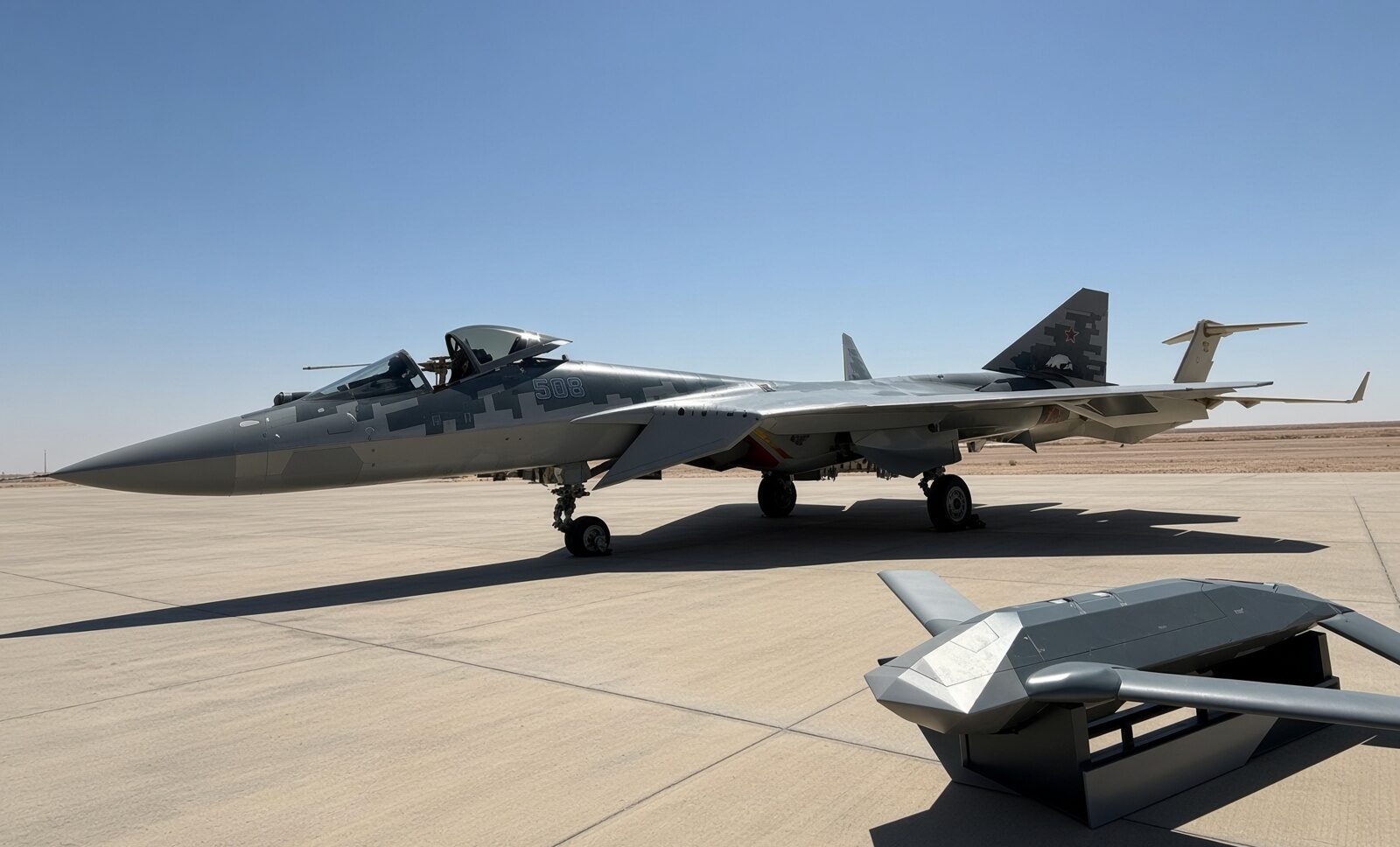
Russia is using Egypt’s El Alamein International Airshow, which opened on 8 September 2026, to promote the Su-57E as a fifth-generation aircraft. The jet is on the ground and in the flying display.
What Rostec actually premiered are air-launched S-71 family munitions—S-71M Monokhrom and S-71K Kovyór—plus at least one smaller unnamed weapon. UAC describes the first as a warhead-delivery platform and the second as an aviation bomb.
Ukrainian intelligence says the Kovyór has already been used in combat as a low-cost ~300 km cruise weapon.
Algeria is widely reported as the first export operator, after two jets were delivered to an unnamed customer in late 2025. India remains the prize Moscow wants and has not been able to close so far.
Earlier, News Agency Tass said: “Rostec State Corporation will hold the world premiere of multifunctional stealth drones designed to be launched from the fifth-generation Su-57 fighter jet. The drones will be presented at the El Alamein International Airshow 2026. “The drones are equipped with different types of wings.”
The S-71 drone features a trapezoidal fuselage, folding wings, and an inverted V-shaped tail, as the EurAsian Times previously explained.
The S-71K functions primarily as an air-to-surface guided munition with modular warheads and guidance that may include electro-optical or semi-active laser homing. Meanwhile, the S-71M is a more autonomous system that can search for, detect, and engage moving targets using electro-optical sensors and onboard data, with an operator optionally remaining in the loop for validation or final guidance.
Images of Russian aircraft, including the Su-57 prototype (T-50-9) and Yak-130M, and air-launched munitions displayed in the static exhibition area at the El Alamein International Airshow. https://t.co/4JVLMHpRA0 pic.twitter.com/Vjf0HQTxyz
— H. Memarian (@HEMemarian) September 7, 2026
The S-71M, for one, can also be carried externally or housed in the weapons bay of a Su-57 or S-70 Okhotnik UAV.
“The classification of S-71M as an air-launched UAV, not a cruise missile, suggests that the drone’s advanced autonomous capabilities allow it to return to its launch point or another designated location after completing its mission,” as an Indian Air Force (IAF) veteran and avid Russia watcher, Squadron Leader Vijainder K. Thakur (retd), wrote for the EurAsian Times earlier.
The display at the Egyptian air show is notable because it presents the Su-57 not only as a fighter jet but as a launch platform for stealth drones. This expands attack options and standoff range while reducing the need to expose the aircraft to heavily defended areas.
A Rostec representative emphasized that drones now serve as both sensors and primary means of engagement in modern conflicts.
“Rostec specialists have created a family of versatile platforms designed for use with fifth-generation fighter jets and capable of performing a wide range of tasks. During the world premiere in Egypt, we will present these new products alongside the Russian fifth-generation Su-57E fighter jet,” the representative was quoted as saying.
Although Russia has not publicly stated whether it intends to offer the Su-57 specifically to Egypt or other Middle Eastern countries, it has repeatedly indicated openness to joint production arrangements with interested partners.
India Uninterested But Offered Su-57 Again
In their recent meeting at the Shanghai Cooperation Organization (SCO) summit in the Kyrgyz capital of Bishkek, Russian President Vladimir Putin and Indian Prime Minister Narendra Modi reportedly discussed the potential acquisition of the Su-57 stealth fighter and the S-500 air defense systems, according to multiple reports in Indian media.
If true, this would be yet another attempt made by Moscow to convince India to buy the Su-57, since it was displayed at Aero India 2025.
Russia initially offered a “golden deal” that included supplying off-the-shelf aircraft, producing the Su-57 in India, and helping develop India’s fifth-generation Advanced Medium Combat Aircraft (AMCA).
In June 2026, Russian President Vladimir Putin himself renewed the pitch, citing the former FGFA (Fifth-Generation Fighter Aircraft) collaboration between the two allies and calling it the world’s best fifth-generation aircraft, as the EurAsian Times reported at the time.
He said Russia was ready to work with India “without any issues or limitations.”
Despite what appears to be an enticing offer, at least in theory, India has refused to commit to the Su-57.
This could be partly attributed to the failed collaboration on the FGFA program, from which India withdrew amid shortfalls in stealth performance, engine capability, and insufficient access to design data and source code.
After months of staying nonchalant, India made its disinterest in the aircraft clear in July 2026, when Defense Secretary Rajesh Kumar Singh said that India has no plans to acquire a “new version of the Sukhois” and is instead considering upgrading its existing Sukhoi fleet.

When asked why Moscow has been unrelenting in its Su-57 offer to India, the IAF veteran and former test pilot Air Marshal Anil Chopra told the EurAsian Times, “Russia has no traditional buyers left, especially since China developed its own combat aircraft and stopped buying them from Moscow. India is the only large defense importer that can make a big purchase; it is natural that they are trying their luck.”
India’s Su-57 purchase will inject billions into Russia’s sanctions-hit economy and could greatly boost its marketing efforts for stealth fighters, as the EurAsian Times explained in a previous report. Moreover, this could have a domino effect on other countries seeking advanced fighters but denied access to US alternatives like the F-35 because of political restrictions or prohibitive costs.
When asked whether India needs the Su-57 at this point, Air Marshal Chopra said, “India realizes its own fifth-generation AMCA program may be delayed, just like the Tejas Mk2 has been. Coupled with Pakistan’s procurement of the Chinese J-35A, this could be very concerning for the Indian Air Force. “India does not have many options.
The AMCA will take time, the US may not give its F-35 to India since it operates the S-400, and the European countries are already developing sixth-generation fighters,” he added.
As EurAsian Times previously reported, defense observers and veterans predict that AMCA’s first flight may slip to 2032 or later, as private manufacturers may not meet tight deadlines. This would leave the IAF with a major stealth gap vis-à-vis its adversaries — China has two stealth fighters (J-20 and J-35) and is exporting the J-35 to Pakistan.
Facing dwindling squadron strength, the IAF is inching closer to signing a deal for 114 Rafale fighter jets, 94 of which will be produced locally. However, it will not help close the growing technological gap between India and its adversaries, which is why several veterans have consistently advocated a limited off-the-shelf purchase of Russian stealth fighters to bridge the gap until the AMCA is ready for induction.
Russia also unveiled and offered the twin-seater Su-57 to India, which is believed to have greater appeal since the FGFA program was centered on a two-seat jet.
When asked whether India could have finally made up its mind against the Su-57, Air Marshal Chopra said that the Defense Secretary’s statement carries weight but was not issued at the highest political level, leaving open the possibility that New Delhi is managing public messaging with an eye toward relations with the US and Western partners.
“It is hard to say at this stage, but one must remember that the statement against Sukhois was made by the Defense Secretary and not at the political level. The Government of India may be refraining from expressing interest in the Su-57 to avoid provoking the United States and the West… that is a possibility.”
- Contact the author at sakshi.tiwari13 (at) outlook.com
- Follow EurAsian Times on Google News