For years, Washington has treated a nuclear detonation in orbit as a remote nightmare. In 2024, it became an official concern.
U.S. officials said Russia was developing a nuclear anti-satellite weapon that, if placed in orbit and detonated, could disable large numbers of satellites and make parts of low Earth orbit hazardous for years.
“The Space Age will end when Russia launches its nuclear anti-satellite weapon into orbit,” said Rep. Mike Turner at CSIS in 2024.
Earlier, Chief of Space Operations of the U.S. Space Force General B. Chance Saltzman warned that the day such a weapon reached orbit, no one could assume space would be usable the next day.
However, despite these apocalyptic predictions and the grave threat a nuclear detonation poses, there is very little practical data on how to detect and confirm the threat, respond to such a situation, neutralize the threat, and recover from detonation.
Now, US analysts have conducted a simulation to study precisely that: what happens if Russia detonates a nuclear warhead in space.
The American Foreign Policy Council (AFPC) published the simulation results in a report.
Day Zero – What Happens If Russia Detonates A Nuclear Warhead in Space
In the simulation, a fictional Russian satellite, Kosmos-2567, carries out a nuclear detonation with a yield ranging from 500 kilotons to 2 megatons at an altitude of about 400 km, causing widespread destruction of U.S. satellite infrastructure.
However, the effect of a nuclear weapon detonation in space depends greatly on where it is detonated.
Most of the satellites around Earth are in four distinct orbits:
(A) Low Earth Orbit (Up to 2,000 km)
(B) Medium Earth Orbit (2,000 to 20,000 km)
(C) Highly Elliptical Orbit (LEO to up to 40,000 km)
(D) Geosynchronous Earth Orbit (Around 36,000 km)
If an adversary detonates a weapon in LEO, all satellites within the blast radius would be directly affected – and, depending on proximity to Earth, there could be additional atmospheric effects.
Notably, most of the commercial satellites, including the over 10,000 Starlink satellites, are in this orbit.
If the weapon is detonated far out in geostationary orbit (GEO), it is likely to affect only the satellites in its immediate vicinity. This is because the intensity of the weapon’s prompt radiation falls off rapidly with distance, and as its fission products expand in a sphere, most are radiated to empty space. If open-source estimates are accurate, the operational kill radius of such a weapon might be only 8 kilometers.
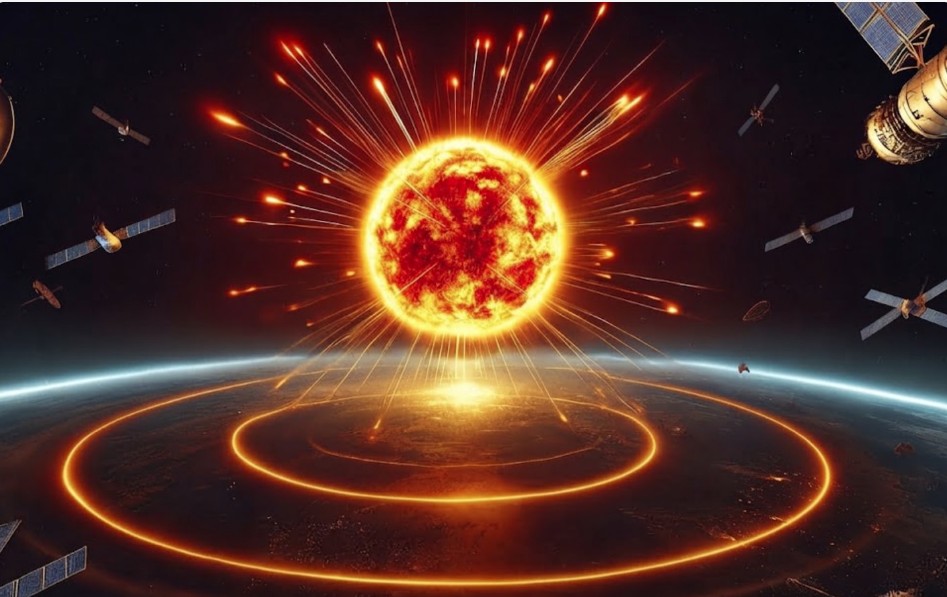
Detonation in MEO, where our GPS satellites are, would likely have a similar effect, with mostly local damage, given that, except for occasional conjunctions, most satellites are thousands to tens of thousands of kilometers apart.
Therefore, the most significant damage will happen if the nuclear device is detonated in LEO.
It could instantly knock out over 2000 satellites and even trigger a Kessler syndrome, where once satellites start colliding, each collision creates more space debris and increases the chances of further collisions.
The radiation will also impact the space station.
According to the study, within a week, it is “highly probable that all LEO-based satellite internet (Starlink, OneWeb, Kuiper) will have catastrophically failed permanently.”
“Over 80 percent of all satellites are in LEO, and most of them will have failed, including 89 percent of weather satellites and 98 percent of remote sensing satellites.”
City planners, farmers, logistics and delivery companies (Amazon, FedEx, UPS) will no longer have access to satellite data. GPS satellites near the end of their service life might fail early, degrading satellite-based navigation in Google Maps, Apple Maps, Waze, Uber, Lyft, etc., for airlines, container ships and cruise ships, for package tracking by online retailers, and for the precision of military bombs.
The radiation from a high-altitude nuclear detonation (HAND) or high-altitude nuclear explosion (HANE) in LEO will travel outward in all directions, including downward toward Earth, where the radiation will be absorbed in the atmosphere.
Further, LEO will become unusable for years.
Meanwhile, the US President Donald Trump’s ambitious space-based missile defense shield, the Golden Dome project, will also be based in LEO.
Worryingly, the authors suggest that Moscow could use a space-based nuclear threat against Starlink to force Washington or SpaceX to limit their support for Ukraine.
Furthermore, according to the report, the U.S. lacks the means to mitigate the consequences of a nuclear explosion in orbit.
The study suggests that theoretically, Golden Dome space interceptors could target and destroy such a nuclear weapon on its way to orbit or in orbit before detonation; however, the US currently lacks such a capability.
The study recommends that the U.S. Space Command, in coordination with the Department of Defense, should launch a program to counter space-based nuclear threats within a year.
The options for countering space-based nuclear threats include cyber capabilities, lasers, electronic warfare, jamming, and kinetic interception. The study also recommends that the Golden Dome project should develop some capabilities to counter such threats.
Another option could be deorbiting large commercial satellite constellations in the event of a nuclear detonation threat.
Notably, the threat of a nuclear detonation in space is nothing new and goes back over six decades.
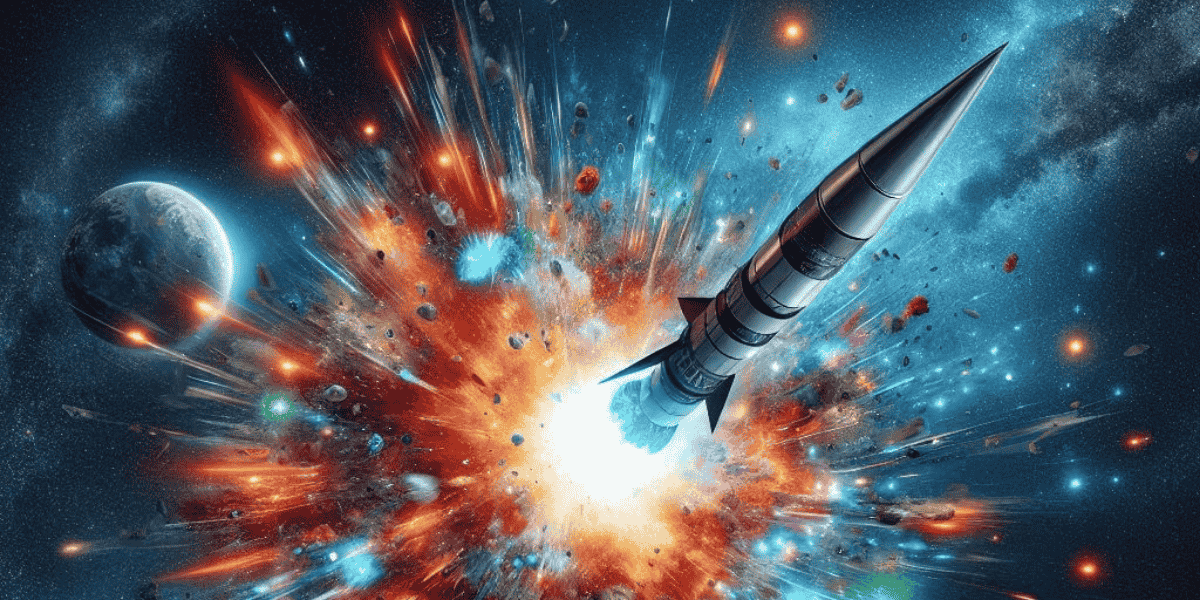
Nuclear Explosions in Space
Ironically, the idea of nuclear detonation in space is nothing new.
Many people in this generation may have forgotten, but between 1958 and 1962, there was not one but over a dozen nuclear explosions in space.
These explosions were not part of some space nuclear war; instead, they were controlled explosions conducted by the US and the Soviet Union to study this question precisely: what happens if a nuclear bomb goes off in space?
For example, the U.S. conducted Operation Argus in 1958, a series of high-altitude nuclear tests used to gain an understanding of nuclear effects on military communication systems and to learn more about Earth’s radiation belts.
Another nuclear detonation was carried out over Hawaii on the night of July 8, 1962. The explosion was conducted 250 miles above Earth’s surface, at an altitude in low-Earth orbit of most modern-day satellites.
The operation was called Starfish Prime. It had a yield of 1.4 megatons. The blast generated a power surge over the Pacific Ocean that knocked out about 300 streetlights on the island of Oahu. At the time, only 24 satellites were in LEO, and at least eight (one-third of all satellites) were damaged.
That night, Hawaii residents saw auroras in the sky, as bright as daylight, fading into green, yellow, and then orange.
This was the last significant nuclear blast in space, as in 1967, the US and the Soviet Union signed the Outer Space Treaty, forbidding putting weapons of mass destruction in orbit.
“States shall not place nuclear weapons or other weapons of mass destruction in orbit or on celestial bodies or station them in outer space in any other manner; the Moon and other celestial bodies shall be used exclusively for peaceful purposes,” the 1967 treaty said.
However, now, more than 60 years after that nuclear blast in space, the dangers of nuclear war in space are once again real.
In 2024, President Joe Biden’s administration said a suspected Russian testbed satellite for a nuclear weapon had been in orbit for two years.
The satellite in question is Cosmos 2553, launched in February 2022, which has been publicly linked to nuclear anti-satellite (ASAT) weapon development programs.
U.S. officials assessed that Cosmos 2553’s purpose, though not itself a weapon, is to aid Russia’s development of a nuclear anti-satellite weapon that would be “capable of destroying entire satellite networks, such as SpaceX’s vast Starlink internet system that Ukrainian troops have been using.”
US officials have been warning for some time that Washington is ignoring the threat of nuclear weapons in space posed by adversary states, such as Russia, China, and North Korea.
In March, the chairman of the Senate Armed Services Committee, Sen. Roger Wicker, warned that the US was ignoring emerging threats in the nuclear and space domains, which could encourage adversaries, such as Russia and China, to take hostile action in space.
“It’s no secret that I believe this NDS falls short in several areas,” Wicker told U.S. Strategic and Space Command leaders. “I am particularly concerned that the current strategy does not address space and nuclear threats with anywhere near the urgency they deserve.”
Similarly, Adm. Richard Correll, the head of U.S. Strategic Command, said, “Russia has indicated, and has been publicly acknowledged, that they’re working on a nuclear capability that could be placed in space. We have to account for it in terms of our architecture and what we can do about it. The department’s very focused on that.”
Following these public warnings, the US has, even if belatedly, started taking these threats seriously.
In April, the U.S. Space Command (USSPACECOM) held its first-ever Apollo Insight Commercial Integration wargame series, which addressed the threat of weapons of mass destruction in space.
The nuclear detonation simulation tests by the American Foreign Policy Council will further add to this growing body of literature that treats the nuclear arms race in space not as a future threat but as something that has already started.
Notably, the AFPC paper also recommends practical steps the US should take to counter these threats.
Clearly, space is the next domain of an emerging arms and nuclear race between the superpowers, and this threat can no longer be ignored.
- Sumit Ahlawat has over a decade of experience in news media. He has worked with Press Trust of India, Times Now, Zee News, Economic Times, and Microsoft News. He holds a Master’s Degree in International Media and Modern History from the University of Sheffield, UK.
- He can be reached at ahlawat.sumit85 (at) gmail.com