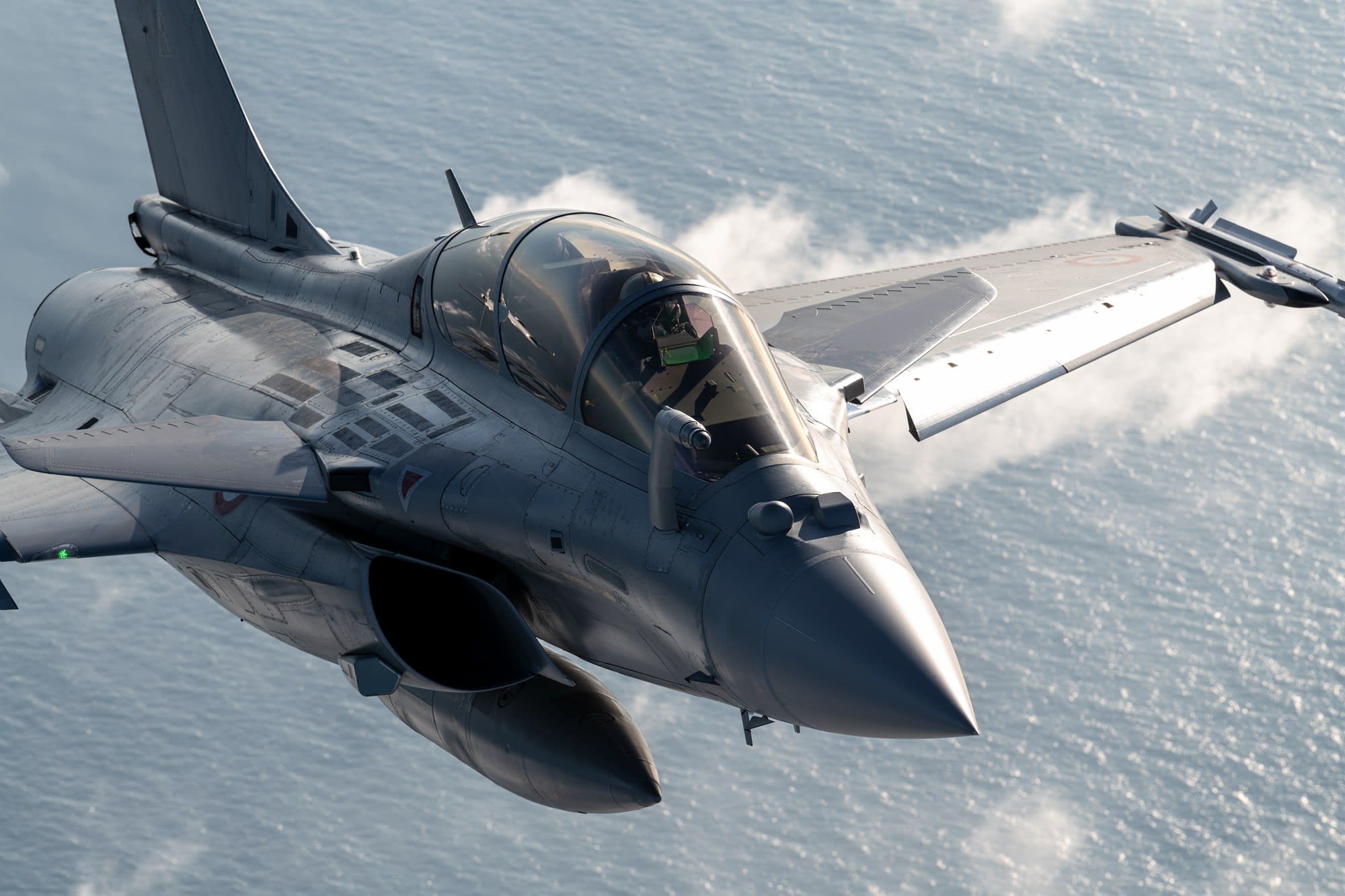
In a clear signal that France is preparing the Rafale for a data-saturated, high-tempo battlespace, Dassault Aviation has successfully flight-tested two new sovereign artificial intelligence algorithms on its flagship fighter jet.
Dassault Aviation announced the flight-test of two new sovereign AI algorithms on the Rafale fighter jet in an official press statement released on September 22, 2026.
The company’s engineers developed one algorithm, while the other was developed in collaboration with Thales/cortAIx.
Although Dassault stopped short of providing specific details about the two AI algorithms and their potential role within the aircraft, it framed the tests as part of a broader effort to embed controlled and supervised AI in the cockpit as a decision-support tool for human crews.
“The development of these new functions is part of a broader initiative to integrate controlled and supervised AI into the cockpit, serving the human crew. They have reached a level of maturity that makes them eligible for future Rafale upgrades,” it noted.
Furthermore, it underlined the distinctive engineering challenges of military aviation: “This capability requires mastering several key challenges specific to military aviation: ensuring the availability and quality of operational data (real or simulated), leveraging and synergizing domain expertise, and optimizing resource efficiency on an embedded platform subject to stringent constraints,” the statement added.
Notably, the recent flight testing came months after Dassault and Thales signed the strategic partnership agreement in November 2025, which reportedly focuses on controlled and supervised AI for both crewed and uncrewed military aircraft, covering observation, situation analysis, decision-making, mission planning, and control, etc.
Separately, Thales has already advanced AI capabilities for the TALIOS targeting pod. In 2024, the company indicated that an AI-assisted feature designed to detect and pre-select objects of interest for the pilot would enter service with the Rafale F4.3 standard in 2026.
France’s Dassault is bolstering the Rafale’s combat capability with AI even as it prepares for the next generation of fighter jets or potential upgrades after the collapse of the FCAS (Future Combat Air System) amid unresolvable differences with Germany.
In fact, Dassault’s statement clearly says the AI will be part of future upgrades, meaning it will be integrated into the F5 variant currently under development.
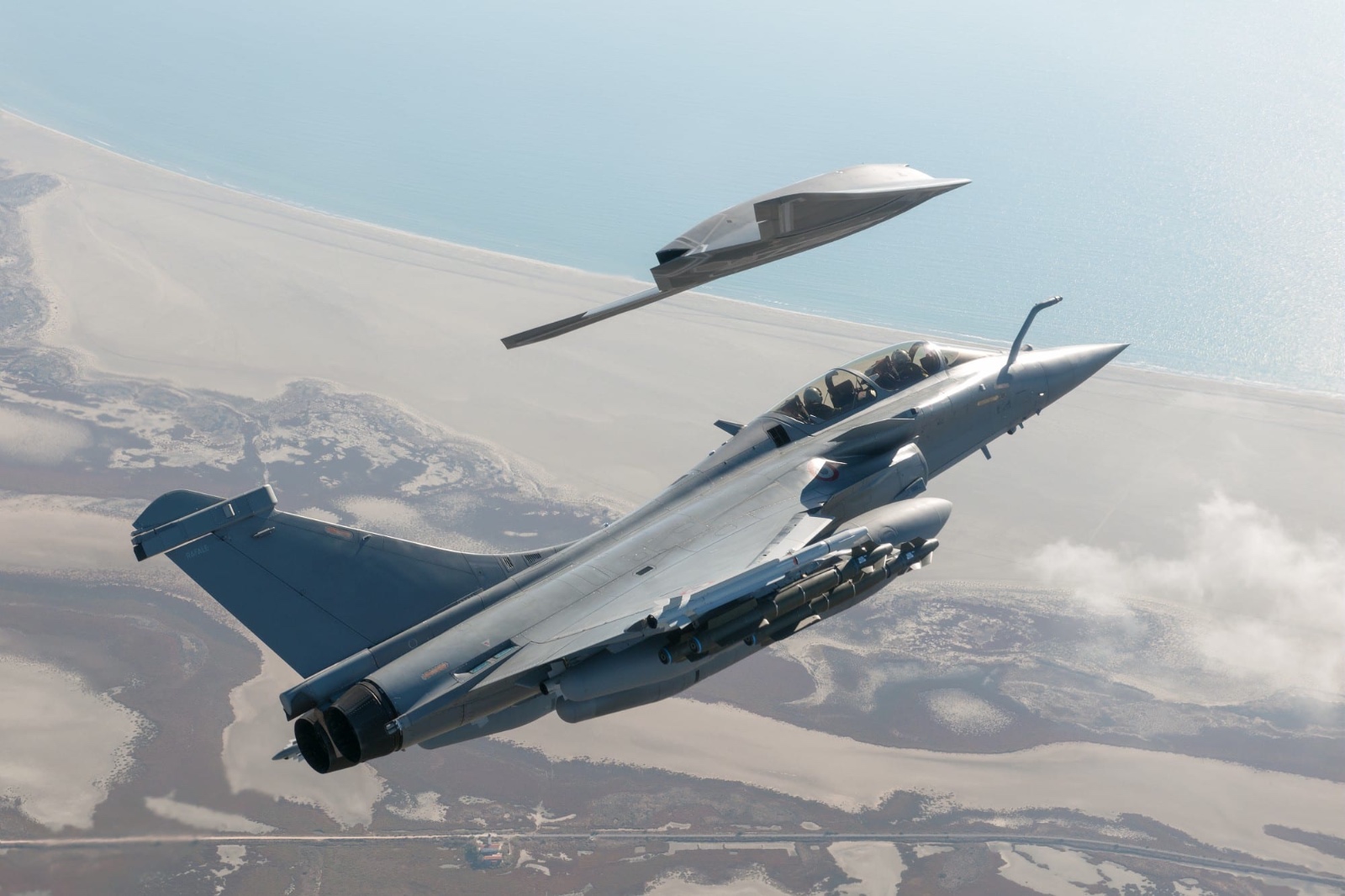
The F5 is designed for manned-unmanned teaming. The Rafale will act as a command node coordinating stealth “loyal wingman” drones, as the EurAsian Times previously reported. Artificial Intelligence would be essential to manage these unmanned assets, deconflict missions, share sensor data, and handle electronic warfare or strike tasks under human supervision without overwhelming the pilot.
Dassault is also collaborating with a French defense start-up, Hharmattan AI, to develop embedded AI for the Rafale F5 and Dassault’s unmanned combat air system. The partnership focuses on uncrewed aircraft control, which is essential to the Rafale’s upgrade.
Earlier this month, the Direction générale de l’armement (DGA), France’s defense procurement agency, announced that it granted preliminary development contracts for several key Rafale standard components. This includes the Thales RBE2-XG radar, which will have more computing capacity to enable greater AI integration.
“This new radar will benefit from a substantial increase in power, and consequently in detection range, as well as improvements in the identification of targets with an extremely low radar cross-section (RCS). Its computing capabilities will also be enhanced to facilitate the integration of artificial intelligence,” the DGA had stated.
AI integration will keep the Rafale competitive in an increasingly networked, data-saturated battlespace, extend its relevance through the F5 upgrade path, and position France to field effective manned-unmanned teams while retaining human control and technological sovereignty. Moreover, it could be further integrated into the sixth-generation fighter jet that Dassault purportedly plans to build on its own.
Artificial Intelligence For Combat Of The Future
France’s efforts align with a wider global pattern: arms companies worldwide are rapidly adopting artificial intelligence to help pilots make faster decisions and coordinate with unmanned “wingman” drones intended to fly alongside traditional jets.
This is considered a crucial requirement because futuristic battlespaces are expected to be saturated with massive, multi-source data streams, including radar, infrared search-and-track (IRST), electronic warfare (EW) sensors, datalinks from other manned and unmanned aircraft, satellites, and ground stations, as well as off-board intelligence and real-time threat assessments. In this scenario, human pilots would face cognitive overload trying to process all this data in combat, where decisions often need to happen in seconds.
Artificial Intelligence is being largely adopted to address this by filtering noise, fusing sensor data into a coherent picture, recommending or executing maneuvers, identifying targets, and managing collaborative combat aircraft.
“AI is integrated into the very decision-making architecture of the aircraft. The fighter supports human pilots through AI copilots that process threat data, prioritize targets, and even control weapons and drones autonomously. This frees the human pilot to make strategic decisions while AI manages tactical execution,” Indian Air Force veteran and popular military commentator Group Captain MJ Augustine Vinod (retd) explained in a previous EurAsian Times article. More broadly, AI doesn’t merely assist—it predicts, analyzes, and executes combat logic far faster than any human could.
AI could help pilots manage sensors, threat libraries, and jamming responses, and provide real-time target prioritization and attack recommendations. Further, it could also assist with intelligent mission planning and re-tasking, among other things.
Rather than replacing the pilot, AI acts as a force multiplier, letting humans focus on command-level decisions while machines manage the chaos.
AI is increasingly becoming a primary component of next-generation fighter programs such as the American F-47 and the GCAP (Global Combat Air Program) pursued by the UK, Japan, and Italy. However, several aviation giants are upgrading their existing 4th- and 4.5th-generation airframes with AI to bolster combat capability and prepare their aircraft for the future, until the next generation becomes available.
Last year, Sweden’s Saab conducted combat testing of a Gripen E loaded with an artificial intelligence (AI) agent, “Centaur,” against a fighter pilot. During live flights, Centaur took control of the aircraft to autonomously execute complex Beyond Visual Range (BVR) combat maneuvers using the jet’s own sensors, tracked targets, and cued the pilot to fire.
BAE Systems has been testing AI pilot aids for the Eurofighter Typhoon, including Avioniq’s Rattlesnake system to provide real-time, AI-driven threat assessment and decision support—primarily calculating safe flight envelopes and dynamic boundaries against enemy missiles in BVR environments to improve survivability and reduce pilot workload.
US F-16 variants— combat-coded aircraft under programs like VENOM and the X-62 VISTA testbed—have extensively tested AI agents for autonomous maneuvering, intercepts, and dogfighting, often with a human pilot as backup or supervisor. Meanwhile, the F-35 has tested AI for combat identification and target suggestion under Project Overwatch, marking the first time a tactical AI independently proposed targets to a pilot in flight.
Similarly, both China and Russia are integrating AI on their two-seat fifth-generation fighter jets, the J-20S and the Su-57D, respectively. AI is expected to help the rear-seat operator process complex information and control multiple drones in real time.
The rationale for these efforts is common: in high-intensity conflict against peer adversaries with similar systems, human-only operations will increasingly be at a disadvantage. By flight-testing artificial intelligence algorithms and updating them to the F5 roadmap, Dassault has ensured the Rafale’s combat readiness well into the future.
- Contact the author at sakshi.tiwari13 (at) outlook.com
- Follow EurAsian Times on Google News