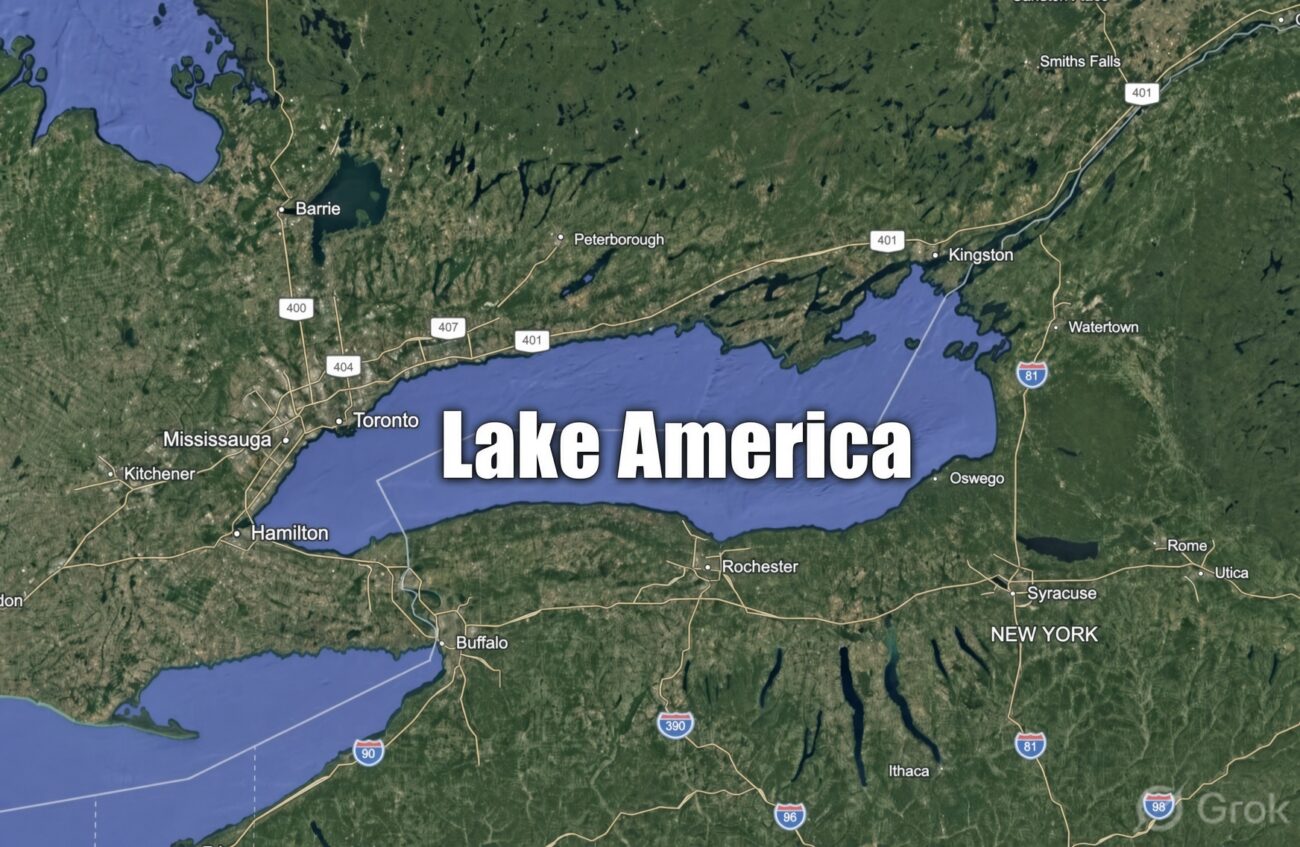
On Sunday, US officials celebrated Google Maps’ latest update on social media. White House Communications Director Steven Cheung posted, “It’s official! LAKE AMERICA on Google Maps.”
The change emanates from Donald Trump’s August 27 executive order renaming Lake Ontario “Lake America” for US federal use amid an escalating trade dispute with Canada. Google said on Saturday that the U.S. Geographic Names Information System (GNIS) had formally adopted the new designation.
“Since we update Google Maps to reflect name changes in official government sources, which is GNIS for the U.S., people using Maps in the U.S. will see ‘Lake America,’ those in Canada will continue to see ‘Lake Ontario,’ and those outside the U.S. and Canada will see both names,” the company stated.
The dual labeling follows Google’s longstanding policy for shared waters whose official names differ by country—the same approach it used after the Gulf of Mexico became the Gulf of America. Canadian leaders, including Prime Minister Mark Carney and Ontario Premier Doug Ford, have rejected the rename, saying the lake will remain Lake Ontario.
How Long Will Lake America Stay?
Colonialism and imperialism have a habit of rewriting the geography of places to fit their self-image.
Take, for instance, Zimbabwe, which the British called Rhodesia, named after Cecil Rhodes, a British mining magnate and politician in southern Africa who served as Prime Minister of the Cape Colony from 1890 to 1896.
In 1980, the country renamed itself Zimbabwe.
Similarly, its capital, Harare, was earlier called Salisbury.
Ghana was named the Gold Coast.
In Asia, the Dutch named the Indonesian capital Jakarta – Batavia – after an ancient Germanic tribe called Batavi, which the Dutch considered to be their historical ancestors.
In the 17th century, when the Dutch ruled the southern tip of Manhattan Island, they named it ‘Nieuw Amsterdam’ after the capital of the Netherlands. When the British seized control, they named it New York, after the English city of York.
India’s financial capital, Mumbai, was named Bombaim by the Portuguese, after Bom Bahia, meaning ‘good bay’. The British anglicized it as Bombay. In 1995, the name was changed to Mumbai, after the local goddess Mumbadevi.
However, the decolonization of the 20th century ended this process, and many places reverted to their local names.
So Ceylon became Sri Lanka, Batavia became Jakarta again, and ‘Van Diemen’s Land’ became Tasmania.
US President Donald Trump, however, in ‘Making America Great Again,’ is on a renaming spree that smacks of 18th-century imperialism – where names in use for hundreds of years were changed with a stroke of a pen.
After changing the name of the Gulf of Mexico to the Gulf of America, Trump is at it again – this time renaming Lake Ontario to Lake America.
The move comes after trade talks between the US and Canada collapsed last week, and the US imposed new 50% tariffs on US$20 billion worth of Canadian goods. Canada promised to implement “dollar for dollar” counter-tariffs next month.
Lake Ontario to Lake America
On August 27, the White House released a statement renaming Lake Ontario to Lake America.
Notably, the statement acknowledges that the renaming is part of a process to honor ‘American Greatness.’
An executive order released in January 2025, titled – RESTORING NAMES THAT HONOR AMERICAN GREATNESS – said: “It is in the national interest to promote the extraordinary heritage of our Nation and ensure future generations of American citizens celebrate the legacy of our American heroes.”
“The naming of our national treasures, including breathtaking natural wonders and historic works of art, should honor the contributions of visionary and patriotic Americans in our Nation’s rich past.”
One of the first steps taken was renaming Alaska’s Denali mountain to Mount McKinley.
The Koyukon Athabascan people called the mountain Deenaalee or Denali, meaning “the high one” or “the great one.” In 1896, a prospector named it Mount McKinley after then-presidential candidate William McKinley. The name became official in 1917.
Nearly a century later, in 2015, the Obama administration renamed the peak Denali, a name Alaskans had historically championed and that originated from Alaska’s Athabascan people.
After one decade, in 2025, Trump restored the name to Mount McKinley.
“In 1917, the country officially honored President McKinley through the naming of North America’s highest peak. Yet after nearly a century, President Obama’s administration, in 2015, stripped the McKinley name from federal nomenclature, an affront to President McKinley’s life, his achievements, and his sacrifice. This order honors President McKinley for giving his life for our great Nation and dutifully recognizes his historic legacy of protecting America’s interests,” it said.
However, since the mountain is the U.S.’s sovereign territory, the President is well within his rights to change its name.
But it becomes problematic when Trump unilaterally renames natural and geographic features and water bodies that it shares with other countries.
What’s In A Name?
“What’s in a name? That which we call a rose by any other name would smell as sweet,” argued Juliet in the famous lines from Shakespeare’s play Romeo and Juliet.
In geopolitics, however, names are everything.
Geographic nomenclature, whether for rivers, mountains, gulfs, or oceans, is rarely neutral. It shapes perceptions of territory, sovereignty, and spheres of influence.
For instance, why should the Persian Gulf not be called the Arabian Gulf, since the gulf is bordered by Persia on the east and Arab countries such as Saudi Arabia, the UAE, Qatar, Kuwait, and Iraq on the west?
South Korea has always argued that the so-called ‘Sea of Japan’ is a colonial-era imposition and should instead be called the East Sea, a more neutral term.
Similarly, the Philippines calls the ‘South China Sea’ the ‘West Philippine Sea’ to make the point that it has equal stakes in the region and that the waters do not exclusively belong to China, as Beijing often claims.
Names of water bodies, hills, and oceans, strangely, reflect and strengthen ideas of sovereignty and ownership, precisely why they’re often contested.
While renaming Lake Ontario, the US President’s executive order said: “The United States is the greatest protector of the Great Lakes, including the body of water currently known as Lake Ontario. Without the security and investment provided by the United States, this freshwater system would not be open for shipping, recreation, and responsible use to the same extent as it is today.”
Making the case for renaming it Lake America, it said, “The United States Coast Guard supplies 9 of the 11 ice-breaking vessels on the Great Lakes, securing commercial shipping lanes free of charge. The United States has invested nearly $4 billion in protecting the Great Lakes freshwater ecosystem in the last decade, while Canada has invested far less in similar initiatives over the same period.”
The order further underscores the lake’s commercial and historical importance to the US.
“The body of water currently known as Lake Ontario is a tremendous asset to the United States and part of our Nation’s heritage.”
Trump went further. Later, while speaking to the media, he even suggested that the US should next change the name of an Ocean.
“If you think about it, we have a gulf, and we have a lake; now all we need is an ocean,” Trump said. “So maybe we’ll have to change the name of the Atlantic and/or the Pacific.”
In response, Canadian Prime Minister Mark Carney said: “Things must be called by their name, and this lake is called Lake Ontario – today and forever.”
According to the Canadian government, ” The word ‘Ontario’ comes from the Iroquois word ‘kanadario,’ meaning ‘sparkling water’. The province is well named, since lakes and rivers make up one-fifth of its area.”
“In 1641, ‘Ontario’ described the land along the north shore of the easternmost part of the Great Lakes.
“Later, the southern part of the province was referred to as ‘Old Ontario’. The name ‘Ontario’ was adapted for the new era that began in 1867, when the area became a province,” it added.
According to the Center for Great Lakes Literacy (CGLL), Lake Ontario’s name comes from the native Iroquois tribe’s word “Ontarí’io,” meaning “lake of shining waters.”
“The name Lake Ontario comes from the Wendat word Ontari’io, which, appropriately, means ‘the lake is beautiful, the lake is big,'” Carney wrote on the social platform X.
Carney also noted that the name Lake Ontario could be traced back more than 400 years, adding that the name preceded the formation of both Canada and the United States.
“The name is more than 400 years old, predating both the Confederation of Canada and the Declaration of Independence of the United States of America.”
He blamed America’s internal politics for these moves. We know that America is changing. Their trading relationships, their foreign policies, their national monuments, their hydronyms. Canadians also know that naming reality means calling it Lake Ontario – then, now and always.”
Trump’s order only applies to the U.S. government. Canada is not required to adopt the new name.
Notably, no universally recognized international body sets the names of international waters.
Trump’s unilateral renaming of waters the United States shares with other countries is reminiscent of 17th- and 18th-century colonial practice, when a decree, sometimes from a distant capital, sometimes from a local official, was enough to alter names on maps and in official correspondence.
That, however, does not guarantee that the names will be universally accepted.
For instance, Mexico still calls the Gulf of Mexico by that name, despite Trump’s 2025 order rechristening it the Gulf of America for U.S. federal use.
Google Maps users in the US see “Gulf of America,” while those in Mexico see the “Gulf of Mexico”; users elsewhere see both.
The change is therefore aimed mainly at a domestic audience. It may satisfy MAGA supporters, but it does little to change the name’s international usage.
- Sumit Ahlawat has over a decade of experience in news media. He has worked with Press Trust of India, Times Now, Zee News, Economic Times, and Microsoft News. He holds a Master’s Degree in International Media and Modern History from the University of Sheffield, UK.
- He can be reached at ahlawat.sumit85 (at) gmail.com