Saab’s Gripen-F fighter jet, the twin-seat version of its most advanced JAS 39 Gripen, has completed its maiden flight. With this milestone, Saab joins the group of manufacturers offering a modern twin-seat combat aircraft.
The Gripen F conducted its first flight on August 28, 2026, taking off from Linköping airfield at 09:40 local time and remaining airborne for about 40 minutes, Saab announced in a statement. “This inaugural sortie successfully verified the functionality of the aircraft core systems and its initial flight performance,” it stated.
The inaugural sortie was flown by Saab chief test pilot Jakob Högberg and Brazilian Air Force test pilot Lt. Col. Aviator Abdon de Rezende Vasconcelos.
Saab claims that the main goal of the flight was to confirm the aircraft’s primary systems and initial flying characteristics.
The aircraft will now undergo a more comprehensive testing procedure that will involve gradually expanding its permitted flight envelope. Moreover, the effort will subsequently include the aircraft’s speed, altitude, G-loading, and angle-of-attack limitations, as well as the tactical capabilities and equipment, particularly related to the rear cockpit, the manufacturer noted.
The maiden flight took place more than two months after the two-seater Gripen-F was officially unveiled on June 2, 2026, at a ceremony in Linköping, Sweden, as EurAsian Times reported at the time.
Notably, Brazil actively participated in co-developing the two-seat model as the first customer for the Gripen-E, enabling direct industrial involvement and a long-term partnership. Brazil signed a contract with Saab in 2014 for 36 aircraft—28 single-seat Gripen E fighters and 8 Gripen F fighters.
The deal included noteworthy technology transfer, local production in Brazil by Embraer, and support packages.
Through a comprehensive transfer-of-technology (ToT) program, Brazil has strengthened the advanced design and development capabilities of its national industrial base while training hundreds of engineers and technicians.
“Gripen F is the result of the strategic partnership between Brazil and Sweden, as well as the extensive technology transfer carried out under the Brazilian Gripen Program. More than 350 Brazilian engineers, technicians and pilots have participated in training activities related to the development, production, flight testing and maintenance of the aircraft,” Saab emphasized.
“This first flight represents an important step forward for both Saab and the Brazilian Air Force,” Lars Tossman, head of Saab business area Aeronautics, said about the first flight. “Seeing Gripen F take to the skies is particularly significant for all the Swedish and Brazilian teams whose years of engineering work have helped turn this aircraft into a reality.”
After the test campaign is complete, the Gripen F will undergo acceptance procedures before being delivered to Brazil. “Designed for an era of rapid transformation, Gripen F delivers world-class performance, sensors, and revolutionary architecture, mirroring Gripen E,” Saab had earlier said in an official statement at the time of its unveiling.
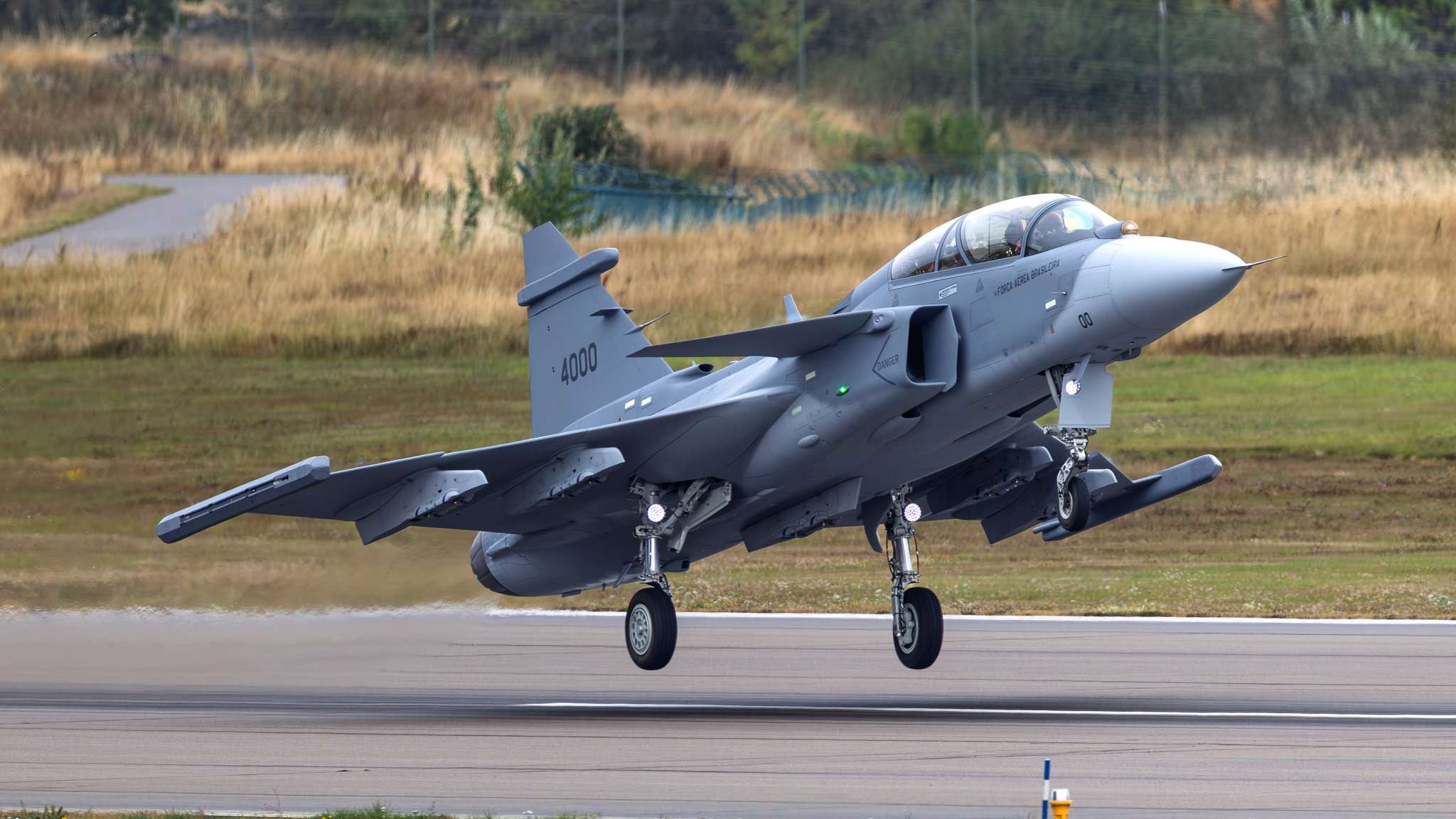
The Gripen-F’s maiden flight comes as Gripen-E enjoys a strong year on the export market.
After losing several contests to heavyweights such as Lockheed Martin’s F-35 Lightning II and Dassault Aviation’s Rafale, the aircraft has secured nearly $10 billion in new export orders. This is a major win for the fighter, considering it faced a decade-long drought in the export market after Brazil’s 2014 deal.
The aircraft made its official comeback in 2025, with Thailand ordering 4 jets and Colombia ordering another 17. More recently, in June 2026, war-ravaged Ukraine signed a deal with Saab to purchase 16 Gripen-E fighters. The aircraft, along with spare parts and associated equipment, will be delivered between 2029 and 2030, the company stated at the time.
Currently, Saab is re-pitching the Gripen-E/F to Canada as the country reviews its purchase of F-35A Lightning II stealth fighters amid tensions with Washington. Meanwhile, countries such as Portugal, the Philippines, and Peru have expressed interest in the aircraft, although formal negotiations have not gotten underway, at least publicly.
Swedish Defense Minister Pål Jonson earlier indicated that the Air Force was considering purchasing the Gripen-F to expand training capacity, although a purchase has yet to be finalized.
Nonetheless, the development and first flight of the Gripen-F marks the aircraft’s entry into a club of manufacturers increasingly turning towards twin-seat jets.
Two of the major European contemporaries of the Gripen—the Rafale and the Eurofighter Typhoon — also have two-seat variants.
Additionally, China has unveiled the J-20S fifth-generation stealth fighter, Russia has unveiled the Su-57D fifth-generation stealth fighter, and South Korea is producing the twin-seater KF-21, as EurAsian Times noted earlier.
Gripen-F
The twin-seat version of the cutting-edge Gripen-E was created mainly for training.
Gripen-E is a single-seat, 4.5-generation multirole fighter that offers strong beyond-visual-range combat capability, a modern cockpit with a large-area display, and significant growth potential through its modular design. It is optimized for high availability, low operating costs, rapid turnaround, and operations from short or rough airstrips or dispersed bases.
The Gripen F adds a second cockpit for instructors and trainee pilots while maintaining the same mission systems, sensors, and performance attributes as the single-seat Gripen E. “The addition of a fully independent second cockpit enables instructor-guided missions in a fully operational fighter, giving trainee pilots realistic live mission conditions,” Saab said earlier in its statement, adding that it will dramatically reduce the pilot training schedule.
While this configuration is designed to enable conversion training and mission preparation, it is also intended to provide benefits during challenging combat missions by dividing cockpit effort. This is evident by the fact that the Gripen-F retains all of Gripen-E’s mission systems and full compatibility with the weapons and systems of its predecessor, including the AESA radar, beyond-visual-range missiles, and electronic warfare.
Typically, a twin-seat configuration could enable the fighter to undertake missions in which a second crew member manages sensors or communications—such as electronic warfare, aerial command-and-control (C2), or the coordination of precision-guided weapons.
In high-threat or complex missions, a single pilot faces intense cognitive load while managing sensors, weapons, electronic warfare, communications, and the battlespace as a whole. However, in a two-seater fighter jet such as the Gripen-F, the rear-seat crew member—as a weapons systems officer, mission coordinator, or second pilot—can handle specific tasks, including sensor management, target identification, electronic warfare, communications, or broader battlespace orchestration, allowing the front-seat pilot to focus on aircraft control and immediate tactical engagement.
This division improves situational awareness, decision quality, and response speed, especially when threats multiply or systems are degraded.
In addition to distributing workshare, the dual-seat variant could offer a unique drone-mothership capability, with the second pilot controlling the loyal wingman drones.
The rear-seat operator can command, monitor, and control multiple drones without overloading the pilot. They could assign the drone tasks such as reconnaissance in contested airspace, electronic warfare, suppression of enemy air defenses (SEAD/DEAD), precision strikes, multi-axis attacks, or acting as decoys or sensors.
Saab emphasizes that the second crew member could provide resilient human decision-making, augmented by artificial intelligence, even if communications are degraded or jammed. In fact, the Gripen F will serve as a forward battle manager, keeping humans central while leveraging autonomy for high-risk or high-volume tasks.
Saab has already positioned its stealthy, supersonic Autonomous Collaborative Platform (ACP) “fighter drone” as a complement to the single-seat Gripen E, describing it as “a great asset to the Gripen E.”
The company envisions the Gripen E acting as a tactical mission commander for one or more ACPs, operating alongside Saab’s GlobalEye airborne early warning and control (AEW&C) aircraft.
Meanwhile, the Swedish Defense Minister Pål Jonson has publicly described a loyal wingman component as a “natural further development of the Gripen system” for deep operations with the mother platform.
Against that background, it is safe to assume that the dual-crew advantages of the Gripen F, when paired with the ACP loyal wingman drone, could further bolster Saab’s export opportunities and the Swedish Air Force’s combat prowess.
- Contact the author at sakshi.tiwari13 (at) outlook.com
- Follow EurAsian Times on Google News