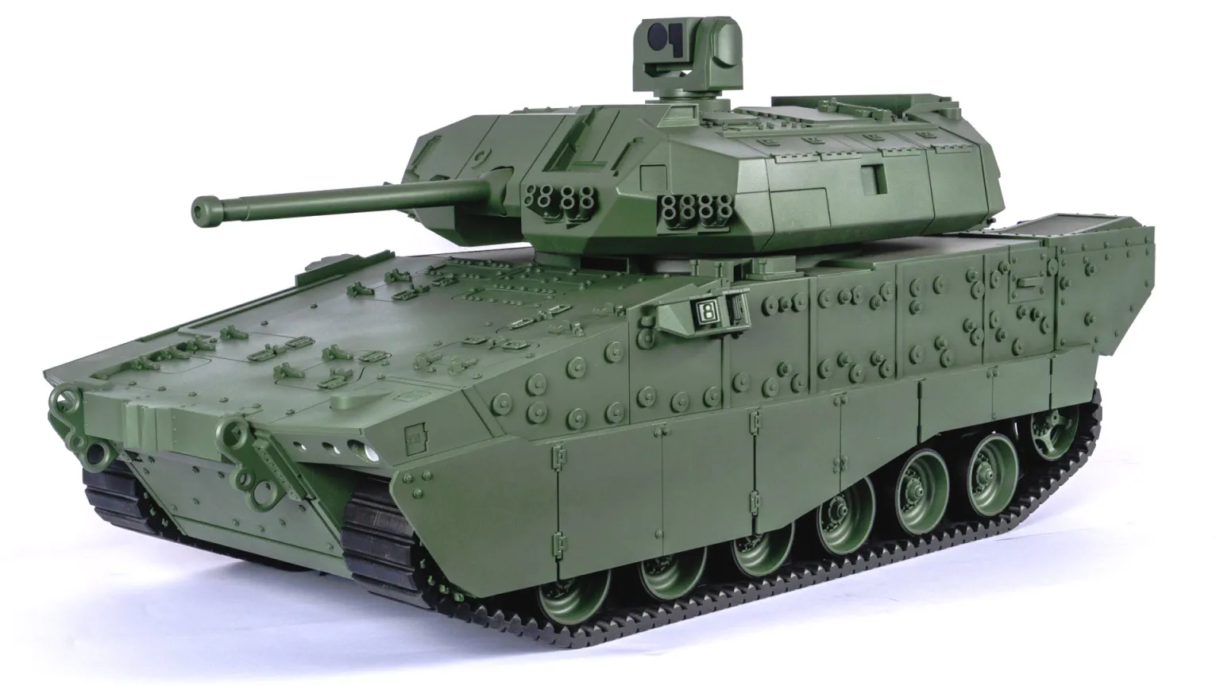
General Dynamics Land Systems (GDLS) recently displayed a one-eighth-scale model of its Wolf vehicle at the Association of the United States Army annual meeting. The U.S. Army is looking to replace its M2 Bradley Fighting Vehicles, which were supplied to Ukraine and employed in combat against Russian forces.
The Wolf is competing against Rheinmetall’s Lynx in the Army’s XM30 Mechanized Infantry Combat Vehicle program.
In a social media post on October 12, 2025, General Dynamics said the vehicle was designed from the start around the U.S. Army’s Modular Open Systems Approach, which uses common hardware and software interfaces so new sensors, weapons, and electronics can be added without redesigning the vehicle. It added that the Wolf was “born digital,” meaning it uses a digital engineering model for testing, production, maintenance, and design.
Earlier, GDLS had delivered its first Wolf XM30 mechanized infantry combat vehicle prototype to the U.S. Army on August 21, 2026, at Aberdeen Proving Ground, Maryland.
“This on-time delivery will allow Soldiers to start putting the Wolf through its paces, with the ultimate goal of getting it fielded into armored brigades as quickly as possible,” said Geoff Norman, director of strategy at General Dynamics Land Systems. “I would like to congratulate our XM30 team on the successful design and production of this game-changing solution. The Wolf is the most technologically advanced combat vehicle ever assembled.”
In June 2023, the U.S. Army awarded two contracts worth a combined approximately $1.6 billion to General Dynamics Land Systems Inc. and American Rheinmetall Vehicles LLC for Phase III (Detailed Design) and Phase IV (Prototype Build and Testing) of the Optionally Manned Fighting Vehicle (OMFV) program, which was subsequently redesignated as the XM30 Mechanized Infantry Combat Vehicle program.
The XM30 is expected to bring new capabilities that will transform how U.S. Army formations fight in the future. Developed with a modular open-system architecture, the XM30 is expected to permit new, developing technologies to be added as it evolves.
“Competition remains a vital aspect of the XM30 program,” said Doug Bush, Assistant Secretary of the Army for Acquisition, Logistics and Technology. “Fully funding two companies for the next phases of the program will allow the Army to place the XM30 on a rock-solid foundation from a resourcing perspective, while also maintaining a competitive environment.”
The XM30 aims to enhance lethality, survivability, and upgradability beyond the Bradley’s physical and economic limits.
Earlier this September, American Rheinmetall delivered the first of eight Lynx XM30 combat vehicle prototypes to the U.S. Army.
“Delivering our first prototype to the Army is an important step as the XM30 Combat Vehicle program enters a more visible phase,” said Matt Warnick, CEO of American Rheinmetall. “Team Lynx now has the opportunity to show the Army that we can deliver on the promise of a modern replacement for the Bradley.”
Bradleys in Ukraine War
The United States supplied over 300 Bradleys (specifically M2) to Ukraine.
The U.S. primarily delivered the M2A2 ODS-SA (Operation Desert Storm-Situational Awareness) variant. This version included digital battlefield management systems, improved thermal sights for the gunner, and laser rangefinders.
The U.S. also shipped several M7 BFIST (Bradley Fire Support Team) variants, which replace anti-tank missiles with advanced target-acquisition sensors to direct heavy artillery strikes.
Last year in June, the Russian defense and industrial conglomerate Rostec claimed that the Russian troops had eliminated all the US Bradley Vehicles in Ukraine’s arsenal.
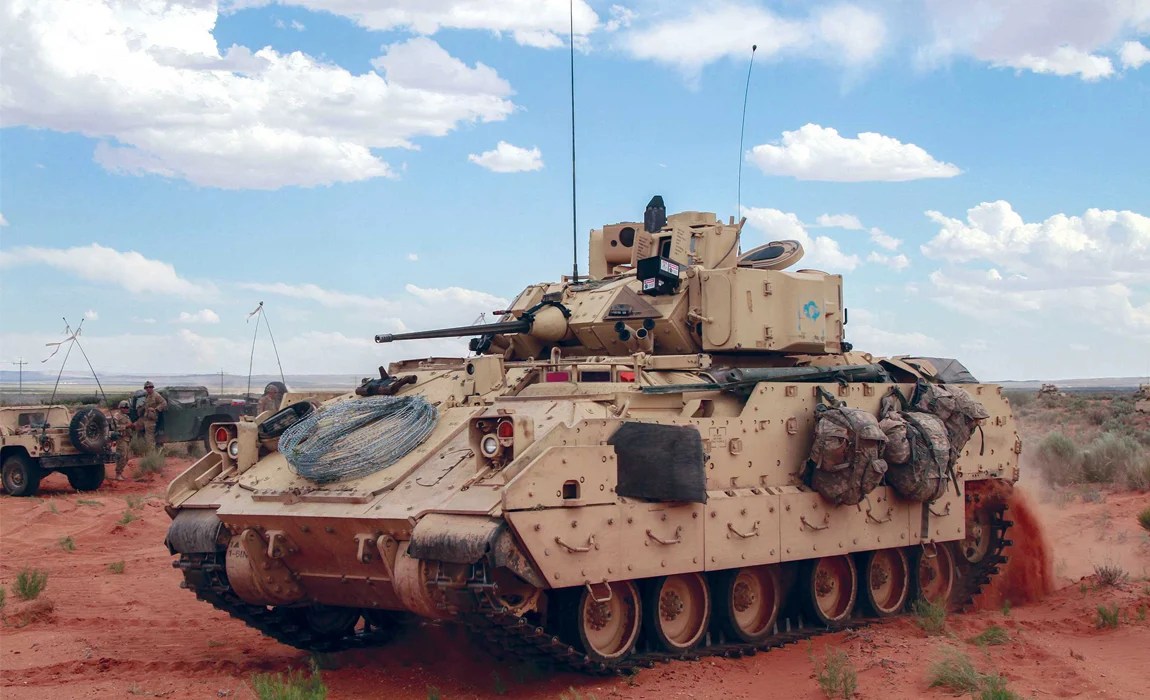
Independent tracking intelligence suggests that nearly half of the supplied vehicles have been damaged, destroyed, or abandoned over years of high-intensity combat.
In a June 2025 interview with Razvedchik (Scout) magazine, Rostec CEO Sergey Chemezov claimed that Russian forces had destroyed almost all the Bradley infantry fighting vehicles supplied to Ukraine. Chemezov did not provide a specific number, and no independent source has verified his claim.
Chemezov said: “Bradley IFVs have one serious weakness: problems with their cross-country capability, due to which they cannot move normally on rough terrain and through fields. They get stuck in dense soil and become easy targets because of their huge size. What’s the use of improved protection if the result is the same? In practice, all the Bradleys supplied to Ukraine have been destroyed. You have to understand, after all that, an IFV is not a tank.”
He further emphasized that a combat infantry vehicle should be swift, mobile, and able to move through rugged terrain and unbridged, unpaved rivers. “Our IFVs are capable of this, whereas American vehicles are not,” the Rostec chief stressed.
According to Oryx, a Dutch open-source intelligence blog that tracks equipment losses in the Ukraine War, the Ukrainian Armed Forces lost 189 M2A2 Bradley ODS-SA, many of which have also been captured by the Russian forces. These figures are based on visual confirmation, and the actual number of losses could be higher.
- By: ET Online Desk
- Mail us at: editor (at) eurasiantimes.com