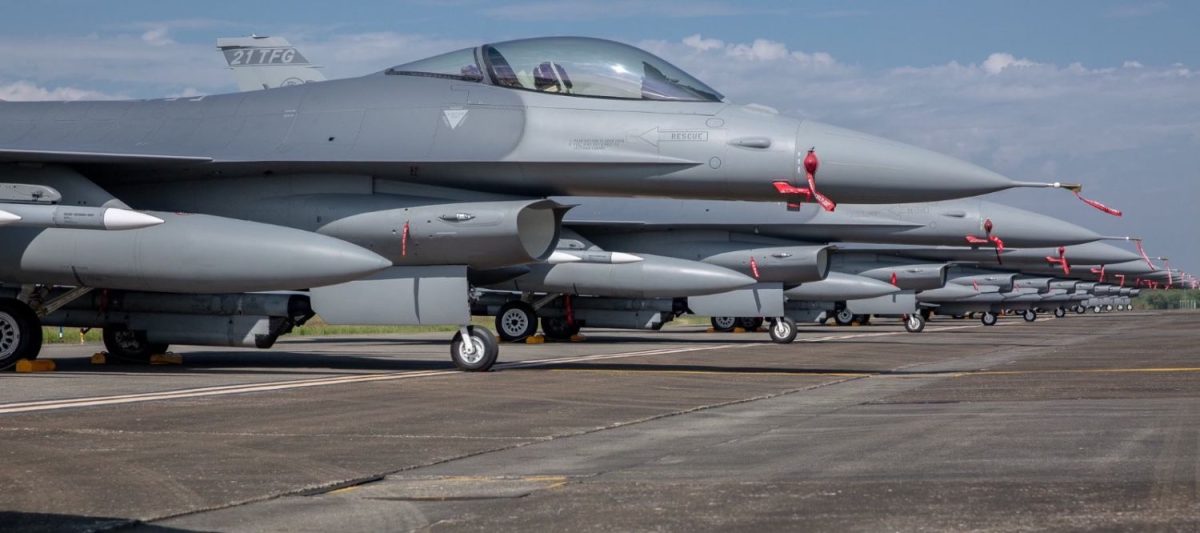
After years of delays and missed timelines, Taiwan recently received its first two F-16V (Viper) fighter jets from the US. Despite the arrival of two cutting-edge jets, Taipei’s problems may have just begun.
The two jets are part of a US$8 billion deal for 66 F-16Vs approved in 2019 during US President Donald Trump’s first term.
Taiwan was originally scheduled to receive the first new F-16V Block 70 fighter jets in 2023, but severe production and software-related delays pushed delivery back nearly three years.
Lockheed is expected to deliver all 66 F-16V Block 70 jets by 2028; however, Taiwan is still negotiating with authorities to finish the deliveries by the end of next year.
Taiwan has already upgraded 140 of its F-16A/B Block 20 fighter jets to the advanced F-16V (Viper) standard under the US$4.5 billion modernization initiative, the Peace Phoenix Rising program, completed in December 2023.
When Lockheed Martin delivers the 66 new jets by 2028, the Taiwanese Air Force will have more than 200 F-16 Viper fighter jets, making it the largest Viper-standard fleet in the Indo-Pacific region.
The F-16V Problem
However, this large F-16 Viper fleet will help Taiwan deter China only if the country has experienced, trained pilots to fly them, which seems like a problem right now, as the country is struggling to find new fighter pilots and retain experienced ones.
To tackle fighter pilot shortages, Taiwan’s defense ministry now plans to allow military pilots to serve until age 58.
Under the plan, pilots could serve until they turn 58, up from about 48 for lieutenant colonels and 52 for colonels, extending their current service limits of 26 and 30 years, respectively.
Effectively, lieutenant colonels will get a 10-year extension, and colonels will get a six-year extension.
Taiwan believes a longer service period will attract new talent, help retain experienced fighter pilots, and address chronic pilot shortages in the air force.
The Taiwanese Air Force would also create 72 additional posts for highly qualified lieutenant colonel and colonel pilots with at least 14 years of service, allowing them to keep their rank and focus on flying rather than command or administrative duties.
These 72 additional posts would be outside the regular personnel establishment, meaning they would not take positions from other officers or have to assume command roles.
“Their job would simply be to fly,” Koo said.
They would also help train and mentor younger pilots, he added.
These changes – allowing fighter pilots to serve longer, creating additional posts so that they can focus exclusively on flying, and reducing their administrative and command duties – are meant to retain fighter pilots in the Air Force when many of them are taking voluntary premature retirement to pursue more lucrative and less stressful careers in civilian airlines.
The Executive Yuan in Taipei is currently considering the defense ministry’s proposals.
Defense Minister Wellington Koo Li-hsiung said earlier this week that the arrangement was designed to keep experienced pilots in uniform when many faced a choice between remaining in the military and pursuing longer, potentially more lucrative careers with commercial airlines, the Hong Kong-based South China Morning Post reported.
Notably, civilian airline pilots can fly until age 65, giving Air Force fighter pilots a strong incentive to switch while they’re still young.
As mentioned earlier, before the changes, lieutenant colonels in Taiwan could fly fighter jets until age 48 and colonels until age 52, meaning they could fly 13 to 17 years longer in commercial airlines.
Extending their service term until age 58 will narrow this gap considerably.
“If they can serve until 58, the gap with civilian airline pilots, who can fly until 65, will not be that large,” Koo told lawmakers in the parliament.
The plan would still require annual health checks and other regular reviews, the minister said. Officers who failed the tests could no longer continue flying.
He said 57 air force pilots had retired so far this year, broadly in line with previous years but fewer than last year. All had completed the minimum required service period.
Defense Minister Koo also underlined that the post-pandemic expansion in commercial airlines has created a lucrative market for pilots, which is making it difficult for the Air Force to retain its fighter pilots.
As a result, many fighter pilots apply for voluntary premature retirement once they reach the minimum service age (20 years), well before the maximum service period for Air Force pilots: 26 years for lieutenant colonels and 30 years for colonels.
The defense ministry proposals also highlight how air forces worldwide place a higher premium on retaining experienced fighter pilots than on recruiting and training new ones.
Recruiting and training new pilots is expensive, time-consuming, and requires lots of effort and resources.
The defense ministry proposals also highlight that air forces worldwide place a higher premium on retaining experienced fighter pilots than on recruiting and training new ones.
These proposals to retain experienced fighter pilots come even as Taiwan has met its recent targets for recruiting new pilots.
The ministry said pilot recruitment reached 96.2 percent of its target in 2024, 112 percent in 2025, and 98.6 percent in 2026.
It also reported that the air force currently has an 87.8 percent personnel fill rate.
Experienced aviators, however, possess accumulated knowledge of aircraft systems, combat tactics, and operational procedures that newly trained pilots cannot easily replicate.
The challenge of retaining experienced fighter pilots is even more pressing, as Taiwan will receive over 60 new F-16V fighter jets in the next two years.
Notably, the Block 70 F-16V is an upgraded variant of the F-16 jets the Republic of China (another name for Taiwan) Air Force (RoCAF) has flown for nearly 30 years.
Taiwan first ordered 150 F-16 jets in the 1990s and received the first Block 20 fighters in April 1997.
It still has nearly 140 of these older F-16 jets, now upgraded to the Viper standard.
As a result, many of Taiwan’s fighter pilots already have years of experience flying these jets. This experience could be invaluable as the country starts integrating new F-16 Viper jets into its air force.
Taiwan plans to assign at least 100 fighter pilots to its fleet of 66 new F-16 Viper jets. The ministry informed that the air force had increased pilot positions and training in preparation for the new aircraft.
The first two of the 66 F-16V Block 70 fighters landed at Chihhang Air Base on October 2.
Koo said 63 of the 66 aircraft had entered production, including six that had reached the flight-test stage.
Another factor putting pressure on the RoCAF is almost daily violations of Taiwanese airspace by China’s People’s Liberation Army Air Force (PLAAF).
For instance, Taiwan’s Ministry of National Defense (MND) reported 181 violations of Taiwan’s ADIZ in September alone. Responding to these airspace violations is taking a toll on the RoCAF’s staffing ratio.
These near-daily PLAAF violations mean the RoCAF must keep aircraft and pilots ready at all times.
Asked about pilot fatigue from near-daily PLAAF airspace violations, Air Force Chief of Staff Lieutenant General Lee Ching-jan said the air force had moved away from scrambling fighters to shadow PLA aircraft one-for-one.
Instead, Taiwan was using a combination of fighters already on patrol, naval vessels, and land-based missile systems to monitor and respond to PLA activity, reducing strain on both pilots and aircraft, he added.
It remains to be seen whether Taiwan’s government will accept the proposals and what impact they would have on retaining experienced pilots in the air force.
- Sumit Ahlawat has over a decade of experience in news media. He has worked with Press Trust of India, Times Now, Zee News, Economic Times, and Microsoft News. He holds a Master’s Degree in International Media and Modern History from the University of Sheffield, UK.
- He can be reached at ahlawat.sumit85 (at) gmail.com