Amid simmering tensions with China, Japan plans to upgrade its F-15J fighter fleet to the “Super Interceptor” variant, while also procuring F-35 Lightning IIs and pursuing a sixth-generation fighter program.
The F-15J is a variant of the F-15 Eagle customized for the Japan Air Self-Defense Force (JASDF), produced under license, and upgraded over the years.
Japan’s F-15 Japan Super Interceptor program is a major modernization effort to upgrade the fleet with advanced sensors, avionics, electronic warfare systems, and expanded weapons capability.
The program reportedly includes 68 F-15Js modernized under an earlier Multi-Stage Improvement Program (MSIP), but Tokyo is currently focusing its attention on upgrading 20 F-15J aircraft to the F-15JSI standard first.
Japan is pushing its F-15 Japan Super Interceptor (JSI) program with fresh investments in the aircraft’s avionics and support systems, with a revised timeline that extends the deployment of the first 20 aircraft to fiscal year (FY) 2029, Janes reported.
“The original plan called for the completion of modifications to the 20 aircraft by the end of FY 2027. However, in light of the progress of the modification program, deployment completion is now targeted for the end of FY 2029,” a spokesperson for Japan’s Acquisition, Technology, and Logistics Agency (ATLA) said.
Notably, Japan has decided to retire older, non-upgraded F-15Js starting in the late 2020s, while keeping the upgraded fleet into the 2030s.
Japan’s Ministry of Defense (MoD) has described the Super Interceptor program as creating a bridge to the 2030s, when the sixth-generation Global Combat Air Program (GCAP) will likely enter service. The F-15JSI will complement Japan’s F-35 fleet. Tokyo’s program covers 147 Lightning IIs — 105 F-35As and 42 F-35Bs — of which dozens have already been delivered, with the rest still on order from the US
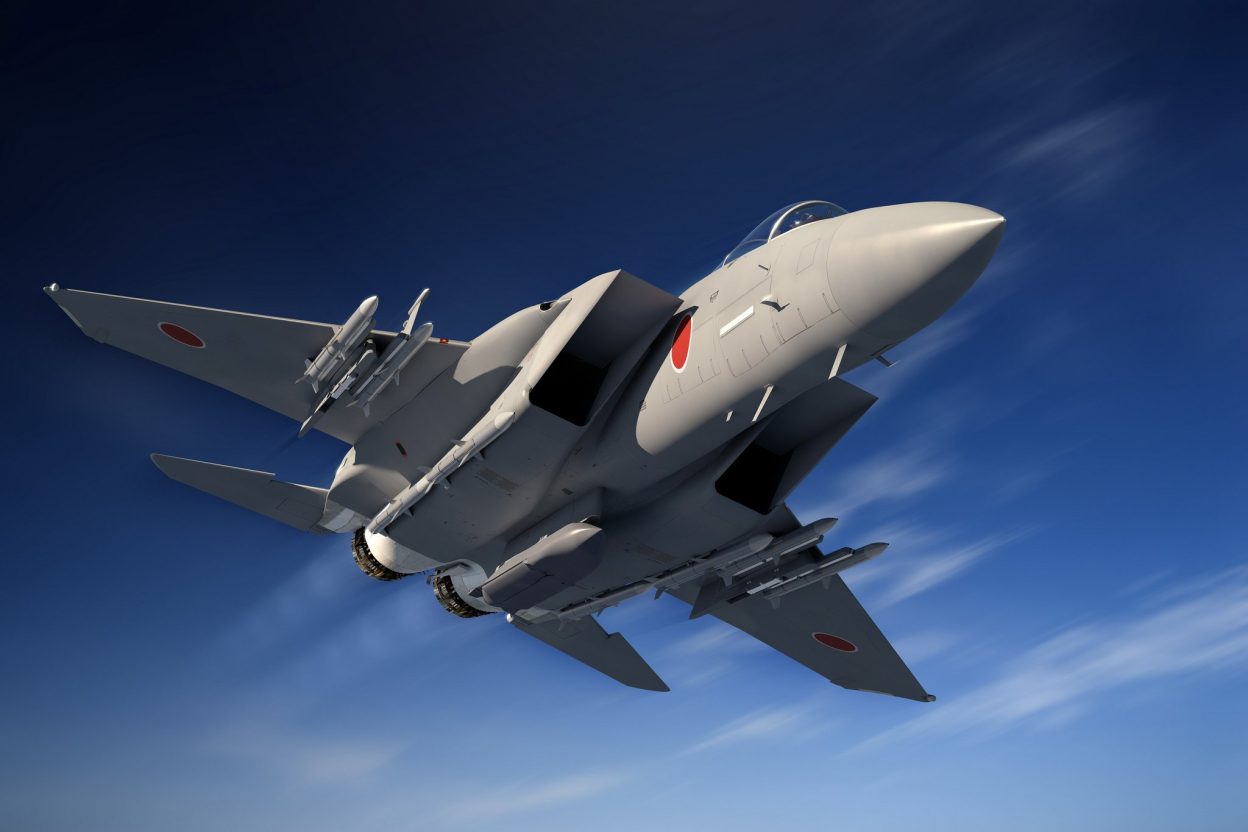
The upgrade will essentially boost JASDF’s air defenses and strike options against China’s growing military capabilities and assertiveness in the region, which has led to increased engagements between the two sides.
For example, a Chinese J-15 last year locked its fire-control radar on JASDF’s F-15J during an encounter southeast of Okinawa, as the EurAsian Times reported. No shots were fired, but Japan viewed this as a “dangerous act,” as fire-control locks represent the final step in the targeting process before a missile launch.
Notably, Japan’s F-15Js already handle most air defense identification zone (ADIZ) intercepts, and Okinawa-based squadrons alone often account for most scrambles, mostly against Chinese aircraft. The F-15JSI upgrades will improve Japan’s ability to detect, engage, and strike Chinese forces amid rising assertiveness in the East China Sea, around the disputed Senkakus Islands, and near Okinawa, which lies between Japan and Taiwan
The development comes as the US Air Force (USAF) has confirmed that it will deploy its first Boeing F-15EX Eagle II fighter aircraft to Kadena Air Base in Okinawa, Japan, by the end of the year. About 36 Eagle IIs will be stationed at Kadena to replace older fourth-generation US aircraft based in Japan, with an eye on China.
What is the Super Interceptor Program?
Japan originally received about 213 F-15J and twin-seat F-15DJ aircraft and still operates the world’s largest F-15 fleet outside the United States.
Japan initiated the Super Interceptor program in 2019 as the “F-15 capability enhancement” effort. Boeing and Mitsubishi Heavy Industries (MHI) are jointly undertaking the program through an “integrated partnership,” which will introduce some technologies currently fielded on the F-15EX.
At the heart of the upgrade is replacing the older mechanically scanned AN/APG-63(V)1 radar with the Raytheon AN/APG-82(V)1 active electronically scanned array (AESA) radar.
The AESA radar offers longer detection ranges, better multi-target tracking, jamming resistance, and improved performance against low-observable or high-speed threats. This system will provide the F-15J a dramatic leap in detection range, resolution, and multi-target tracking. The new radar will also support more sophisticated air-to-ground mapping and targeting modes, enabling the aircraft to perform precision strike missions.
The radar is closely tied to the Advanced Display Core Processor II (ADCP II) mission computer (ADCP II), which processes information from the AESA radar, electronic warfare suite, and other sensors much faster. This will enhance situational awareness and support advanced software architectures that allow for easier future upgrades and integration of new weapons or sensors. Succinctly put, this will turn the aircraft into a far more flexible, networked fighter, capable of sharing data with other platforms.
The JSI upgrade will dramatically improve the F-15J’s electronic warfare with the BAE Systems AN/ALQ-250 Eagle Passive/Active Warning Survivability System, or EPAWSS. This sophisticated electronic warfare suite combines radar warning, electronic support measures, and active jamming capabilities into a single, highly integrated package.
EPAWSS will help the aircraft detect and counter a wide range of modern threats, including advanced surface-to-air missiles and fighter radars.
It will improve the aircraft’s ability to operate closer to contested airspace or survive long enough to launch standoff weapons from safer distances, while working with the AESA radar’s EW features to create a layered defensive capability. This would be particularly critical against China’s growing EW capability, AESA radars, and missile threats.
More importantly, the airframe’s hardpoints and systems are modified to carry a substantially larger missile load than the standard F-15J’s eight missiles, potentially more than double in some configurations.
The aircraft will carry significantly more air-to-air weapons, as well as long-range standoff strike options, allowing the JASDF to strike land or maritime targets from hundreds of kilometers away. The upgraded F-15s will be able to act as “missile trucks,” launching precision strikes against Chinese surface ships, coastal missile batteries, radar sites, or other targets from outside the range of many PLA air defenses, while complementing the stealthy F-35 in combat.
Notably, experts believe that Japan could go to war with China over a potential Chinese invasion of Taiwan due to its geographical proximity to the self-ruled islands. The increase in armaments would be particularly useful in that scenario—networked with F-35 aircraft, E-2D Hawkeyes, ground or naval sensors, and US forces, the F-15JSIs could provide volume of fire while stealth assets handle forward roles.
Additionally, the aircraft is expected to receive a host of upgrades to the cockpit, communications, and avionics to modernize the pilot interface and connectivity.
There is also some speculation that the platform will also receive infrared search-and-track technology to enable long-range target identification.
That said, the F-15JSI is not a stealth aircraft and will still face disadvantages against China’s most advanced systems such as the J-20 and future sixth-generation platforms. However, the planned upgrade will transform the F-15J into a more lethal, survivable, and versatile platform tailored to the specific challenges of Chinese air and maritime assertiveness in the region near Japan.
- Contact the author at sakshi.tiwari13 (at) outlook.com
- Follow EurAsian Times on Google News