In what could be described as the display of Iran’s surviving air power, a Cold War-era relic F-4 Phantom II fighter was spotted escorting the aircraft carrying Pakistan’s Army Chief Asim Munir and Interior Minister Mohsin Naqvi to Tehran.
The Pakistani Army Chief landed in Tehran on April 15, where he was warmly greeted and embraced by Iranian Foreign Minister Abbas Aragchi.
The visit comes in the wake of a fragile ceasefire between Iran and the U.S. amid escalating tensions, and is reportedly aimed at arranging a second round of negotiations between the two sides after they failed to reach an agreement during initial talks in Islamabad.
However, in the midst of the high-profile visit, what caught the eye of military analysts and aviation enthusiasts worldwide was an Islamic Republic of Iran Air Force (IRIA) F-4E Phantom II fighter allegedly escorting Munir’s aircraft as it entered Iranian airspace, which is a standard protocol for high-profile visits as a sign of respect and coordination.
A surviving Iranian F-4 Phantom II jet escorted the aircraft carrying Pakistan’s Chief of Army Staff, Asim Munir, who arrived in Tehran today for discussions on the second round of U.S.–Iran negotiations. pic.twitter.com/rrygIam8bI
— Clash Report (@clashreport) April 15, 2026
The photos and videos of the combat jet have been widely shared on social media since their publication. Subsequently, open-source trackers identified another jet, the MiG-29B, flying alongside the F-4 Phantom II.
Earlier, the Israeli Air Force (IAF) reportedly struck Iran’s Tabriz airbase in the opening days of the war and destroyed at least one F-4 Phantom II, along with an F-5 Tiger II, while the jets were on the ramp or preparing for takeoff. Subsequently, it released footage and statements to validate the direct hits on the Phantom II.
Similarly, the U.S. forces hit multiple Iranian airbases and destroyed additional F-4D/E Phantoms on the ground, along with Su-22s and drone facilities.
In addition, the F-14 Tomcat, one of the most potent surviving Iranian fighters, was known to have been fully obliterated. The Israel Defense Forces (IDF) claimed that it had destroyed multiple IRIAF F-14 Tomcats in an air strike on Isfahan Airport on March 7, signaling the end of Iran’s Tomcat era, as reported by the EurAsian Times at the time.

The latest video of the Phantom II demonstrates that Iran continues to operate a small number of these aging US-origin jets despite decades of maintenance challenges.
A few Phantoms could have survived because Iran’s fleet was dispersed across multiple bases, and not every aircraft was targeted or operational at the time. Additionally, they could have been placed in fortified underground facilities to avert damage from missile strikes.
Target Aircraft for USAF
The Phantom II was developed for the U.S. Navy fleet defense and entered service in 1961. The F-4 was the primary fighter-bomber aircraft in the U.S. Air Force throughout the 1960s and 1970s. The modified F-4 became the QF-4.
The QF-4 is a remotely controlled target that simulates enemy aircraft maneuvers. The QF-4 is flown unmanned when missiles are fired at it, and only in specific over-water airspace authorized for uncrewed flight.
The visuals of the surviving Iranian F-4 have drawn comparisons to the QF-4, the U.S. Air Force’s full-scale aerial target drone derived from the same Phantom platform.
The QF-4 is a modified, remotely piloted version of the F-4 Phantom, used for realistic air-to-air and surface-to-air weapons testing. It can be flown unmanned over restricted ranges, complete with electronic and infrared countermeasures, and is often fitted with a self-destruct mechanism for safety.
The U.S. military retired the QF-4 program around 2016, replacing it with newer QF-16 targets.
For many, the sight of Iran’s aging manned F-4s flying ceremonial missions serves as a stark reminder of the technological gap. While Tehran has demonstrated impressive sustainment skills in keeping a handful of these 66-year-old jets airworthy through reverse-engineering and indigenous upgrades, they remain highly vulnerable in any modern conflict against advanced air defenses or fifth-generation fighters.
Iran’s F-4 Phantom II
Iran has operated an air force comprising 1970s Cold War-vintage jets, including the F-4 Phantom II, the F-5 Tiger II, the F-14 Tomcat, and Russian-origin MiG-29, Su-24 Fencer, and Su-22 Fitter.
The induction of F-4s began in the U.S. Air Force (USAF), Navy (USN), and Marine Corps (USMC) in 1960, so they are effectively 66 years old.
Iran is the largest operator of the F-4—the two-seat, twin-engine, all-weather interceptor rose to fame in the Vietnam War, where it was used as a fighter-bomber. The aircraft was operated by the IRIAF as its frontline fighter and was acquired during the reign of Mohammad Reza Shah Pahlavi, who was deposed in 1979 in an uprising led by Ayatollah Ruhollah Khomeini.
Interestingly, the F-4 was also operated by the Israel Air Force (IAF) and extensively used in the Arab-Israeli wars of 1967 and 1972. However, the IAF retired its last remaining jets in 2004, more than two decades ago.
When it emerged, Phantom was lauded for being a large fighter with a top speed of over Mach 2.2 and the AN/APQ-50 radar, which provides all-weather interception capability. The landing gear was appropriately adjusted to fulfill carrier operations requirements. Subsequently, a gun was later installed on the E model. The aircraft set 15 world records for in-flight performance, starting in 1959, including absolute speed and altitude records.
Since the Phantom’s biggest advantage in air warfare was acceleration and thrust, which allowed a skillful pilot to enter and leave the fight at will, the F-4 pilots adopted the motto “speed is life.”
After the F-15 Eagle replaced it, the F-4 was used as a bomber, and the G model was used as a “Wild Weasel,” a USAF code name for any aircraft equipped with anti-radiation missiles and tasked with suppressing enemy air defenses (SEAD). The aircraft was out of combat use in the USA in 1996, in Japan in 2021, and in South Korea in 2024. The U.S. used these as combat drones until 2016, as previously explained by the EurAsian Times.
After the US-Iran fallout following the revolution, Iran sent experts to reverse-engineer and develop components for fighter jets, particularly the Phantom, to sustain this quickly aging fleet. Additionally, Iran has kept these jets airworthy through indigenous upgrades, including glide weapons, anti-ship missiles, and improved electronic components and avionics.
Some photos released in the past have shown US-made Mk-82 dumb bombs, AGM-65 Maverick air-to-ground missiles, and Paveway II laser-guided bombs arming the aircraft. A previous Defense Intelligence Agency (DIA) report stated that the IRIAF’s possible missions are centered around “air intercept, ground attack, and close air support” with some aircraft “capable of mid-air refueling.”
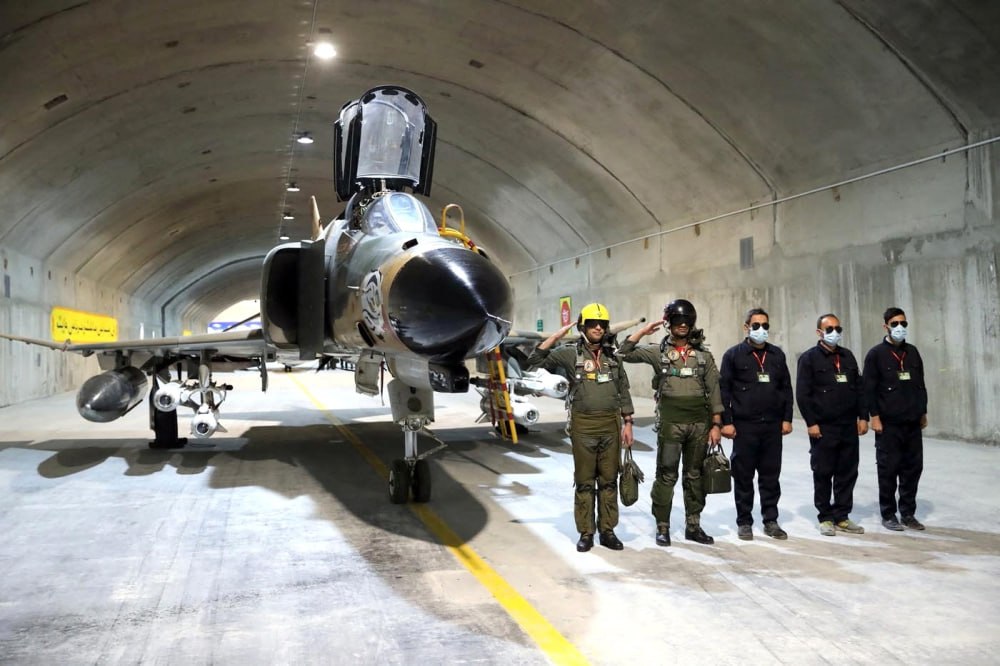
“The IRIAF’s F-4 serves as Iran’s primary attack aircraft,” the DIA said. “To supplement its long-range strike capabilities, Iran could also attempt to use its regional proxies and limited air strike capability to attack an adversary’s critical infrastructure. Iran’s F-4 Phantoms could be used to attack its regional adversaries. However, these older platforms would be more vulnerable to air defenses than modern combat aircraft,” it added.
Interestingly, the F-4 Phantoms had a meet-cute with American F-22 Raptors in 2013, when the Raptors were escorting an MQ-1 drone on a surveillance mission just outside the Iranian border. At the time, two Iranian F-4 Phantoms advanced to intercept the American drone, unaware that an American fifth-generation fighter was chasing it.
By this time, the Raptor had not made its formal debut. The F-22 pilot understood that the Iranian pilots had no chance against him because of the Raptor’s stealth, thrust vectoring, and sophisticated avionics, even though he was alone against two F-4 Phantoms.
The harsh reality facing Iran in 2013 was that the F-4s had already become obsolete, especially in an era when fifth-generation stealth fighters were poised to dominate the skies. Nonetheless, despite the odds, Iran has managed to keep its fleet of Phantoms operational. In fact, just as the Operation Epic Fury was launched, Iranian state media released a video announcing plans to bomb U.S. bases in the region using F-4 Phantom jets.
- Mail EurAsian Times at editor (at) eurasiantimes.com
- Follow EurAsian Times on Google News