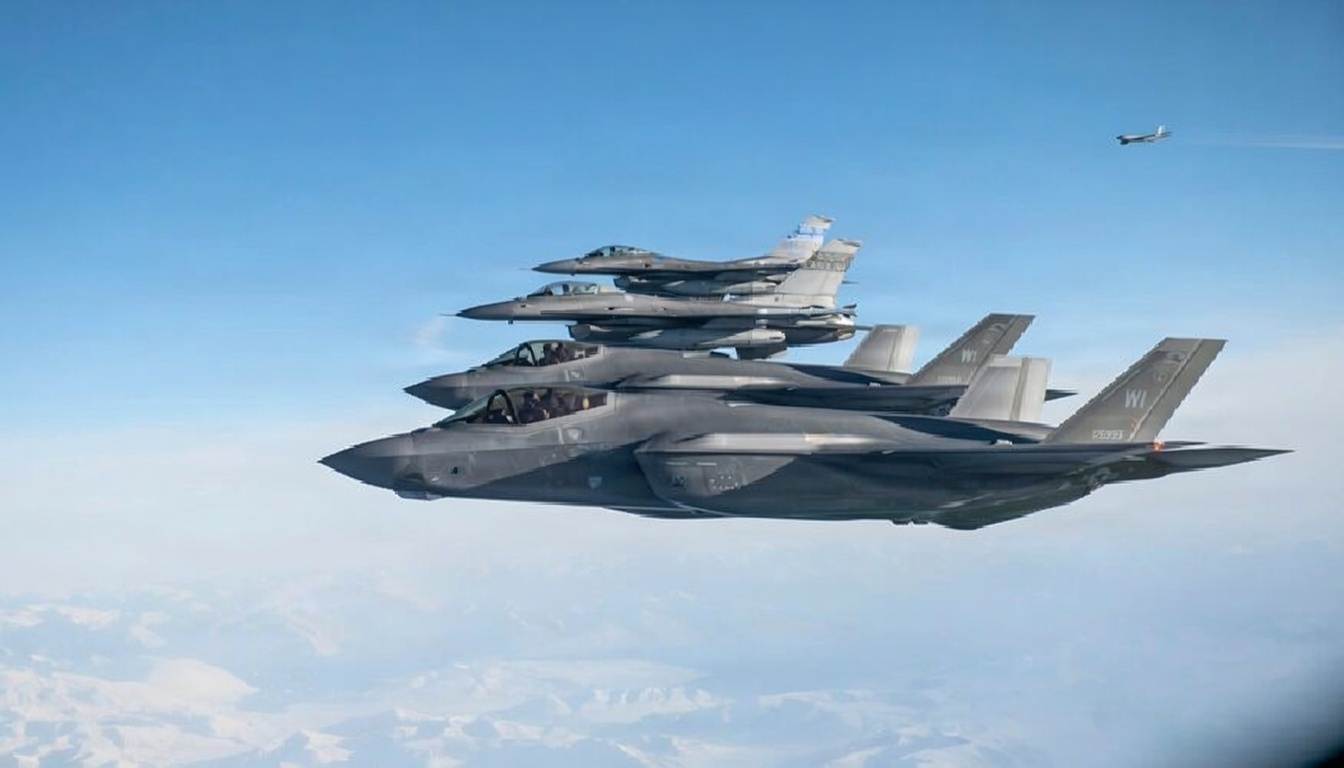
Indonesia has reportedly confirmed that it will not proceed with co-producing the KF-21 Boramae fighter jet with South Korea. The decision comes after years of mounting difficulties for Indonesia in paying its dues amid sustained fiscal constraints.
Indonesia would no longer co-produce South Korea’s KF-21 fighter jet, and would instead procure the aircraft from Seoul, the Jakarta Post reported, citing a statement from a spokesperson of the Defense Ministry.
“The government is adjusting the scheme in the KF-21 Boramae program. We will no longer co-produce the jet, but we will adopt a direct procurement mechanism,” spokesman Rico Ricardo Sirait told the publication via text.
Jakarta conducted a “comprehensive evaluation” of the program’s effectiveness, technological transfer, economic value, and internal defense requirements before deciding to abandon co-production plans, the spokesperson stated. However, he remained noncommittal about the number of KF-21 jets Jakarta would buy.
“Everything is still under assessment. We will adjust the [purchase] depending on the Indonesian Air Force’s operational needs and our country’s spending capacity,” Rico said.
The decision comes days after the South Korean government gave the green light for the transfer of one of the six KF-21 Boramae prototypes to Indonesia in April 2026, building upon a working-level agreement signed in February on a plan for value transfer, as reported by Korean media at the time.
The agreement’s overall value-transfer scale was reported as 600 billion won ($398 million), corresponding to Indonesia’s agreed-upon final contribution. The package reportedly included the transfer of the fifth KF-21 prototype, a single-seat model worth about 350 billion won; 174.2 billion won for the technology transfer and local research personnel costs; and 75.8 billion won for the supply of development data.
Moreover, both sides had categorically asserted in April this year that the KF-21 project was progressing well. At the time, Indonesian President Prabowo Subianto and South Korean President Lee Jae Myung outlined in a 29-point statement that the KF-21 development is “scheduled for completion in June 2026.”
Additionally, both leaders had reaffirmed their commitment to the KF-21 collaboration and hinted at intentions to extend to include anti-tank guided missile systems and trainers.
Indonesia’s Complicated Relationship With KF-21
The KF-21 project, initiated by South Korea in 2015, aims to develop a cutting-edge 4.5th- and beyond-generation supersonic fighter jet. Indonesia joined the program and pledged to cover 20% of the program’s estimated cost of 8.1 trillion won, committing to roughly 1.6 trillion won (about $1.1–1.2 billion at the time) in development costs.
In exchange, it expected significant technology transfer, one prototype aircraft, co-production rights, and allocation for up to 48–50 aircraft.
However, Indonesia faced persistent budget constraints and payment delays from the very outset, with payments lagging as early as 2019–2020.
These financial difficulties were exacerbated by the COVID-19 pandemic and its aftermath, and by 2023, only a fraction of the cost had been paid, which frustrated Seoul and created somewhat of a temporary rift between the two countries. Notably, Indonesia’s mounting dues as a co-producer strained the program’s finances, prompting repeated renegotiations between the two sides and creating uncertainty about the program’s future.
British Pilots Who Worked on F-35 Stealth Fighters Reportedly Training Chinese Air Force: UK Media
In addition to non-payment of dues, South Korea also alleged that Indonesian workers had committed a breach of trust. Tensions peaked in 2024, when South Korea accused Indonesian engineers involved in the KF-21 project of stealing related technologies. The accused engineers were caught attempting to remove a USB flash drive containing classified KF-21 data from a production facility.
Despite these hiccups, Seoul agreed to renegotiate.
In August 2024, South Korea’s Defense Acquisition Program Administration (DAPA) announced that Indonesia’s contribution had been slashed from 20% to 7.5%. At the time, reports suggested that the benefits associated with technology transfer to Indonesia would also be scaled back in proportion to the reduction in contributions, although no clarity was provided.

Subsequently, another restructured agreement on Indonesia’s participation was signed in June 2025, and Indonesia’s contribution was ultimately finalized at 600 billion won, representing roughly a two-thirds cut from the original pledge.
According to recent reports, Indonesia has finally settled its remaining financial obligations under the revised KF-21 Boramae development program, bringing years of uncertainty over non-payments to an end. If true, it settles all remaining financial dues for the joint development phase and essentially ends the most important phase of this collaboration.
If the reports are anything to go by, Indonesia’s PT Dirgantara Indonesia (PTDI) will not assemble or co-produce KF-21 aircraft in Bandung as originally planned–a major downgrade from the original vision of Indonesia as a co-developer and co-producer.
The change in plans means reduced industrial and technological benefits for Indonesia. For example, there will be far less technology transfer than originally promised, and fewer opportunities for Indonesian industry to build expertise in advanced fighter manufacturing, supply chain integration, or maintenance and overhaul. Moreover, there would be a loss of potential long-term economic spin-offs, such as increased employment, skills development, and growth in the Southeast Asian country’s aerospace ecosystem.
Nonetheless, Indonesia is still slated to receive one KF-21 prototype as part of the settlement of its revised development contribution, but the delivery status is unclear for now. The prototype Jakarta would receive is intended for evaluation or testing rather than for production, unlike the original plans.
Earlier this year, Indonesian President Prabowo Subianto vowed to continue boosting Indonesia’s military capabilities amid uncertain times.
The procurement of fighter jets and the modernization of the Indonesian Air Force are at the heart of this conviction.
At the same time, though, it is worth underlining that Indonesia’s hands are currently full, which may have prompted a rethink of local production of the KF-21 and the huge costs it would entail. For example, Jakarta signed an $8.1 billion deal in 2022, under then-defense minister Prabowo, to purchase 42 French-made Rafale fighters. In addition, it signed a Letter of Intent (LoI) to expand the order during French President Emmanuel Macron’s visit to Indonesia in May 2025, as the EurAsian Times reported at the time.
In addition, the Indonesian government signed a contract to acquire 48 KAAN fighter jets from Turkey in July last year. The agreement covers extensive collaboration in manufacturing, technology transfer, and engineering, and includes establishing a local aerospace infrastructure in the Southeast Asian country in collaboration with Indonesian companies PT Republika Aero Dirgantara and PT Dirgantara Indonesia.
There is currently no indication about how Jakarta will fund the acquisition, and no allocation has been made for this purchase
And, if that was not enough, Indonesian officials have expressed interest in acquiring the Chinese J-10C on the record.
China offered “battle-tested” J-10C to Indonesia less than a month after the May 2025 Indo-Pakistan conflict, as disclosed by the Southeast Asian country’s Deputy Defense Minister Donny Ermawan Taufanto. In October 2025, Indonesia said it was considering purchasing 42 J-10C fighters, but that a decision had not yet been made.
These acquisitions are intended to further President Subianto’s agenda to diversify arms supplies and avoid overreliance on a single supplier. However, all of this would come at a cost, which may have influenced Jakarta’s decision to walk away from the KF-21 co-production deal.
For now, it is safe to say that by paying the final development dues, Indonesia has closed the book on its troubled role as a development partner and transitioned to a simpler customer relationship with South Korea.
- Contact the author at sakshi.tiwari13 (at) outlook.com
- Follow EurAsian Times on Google News