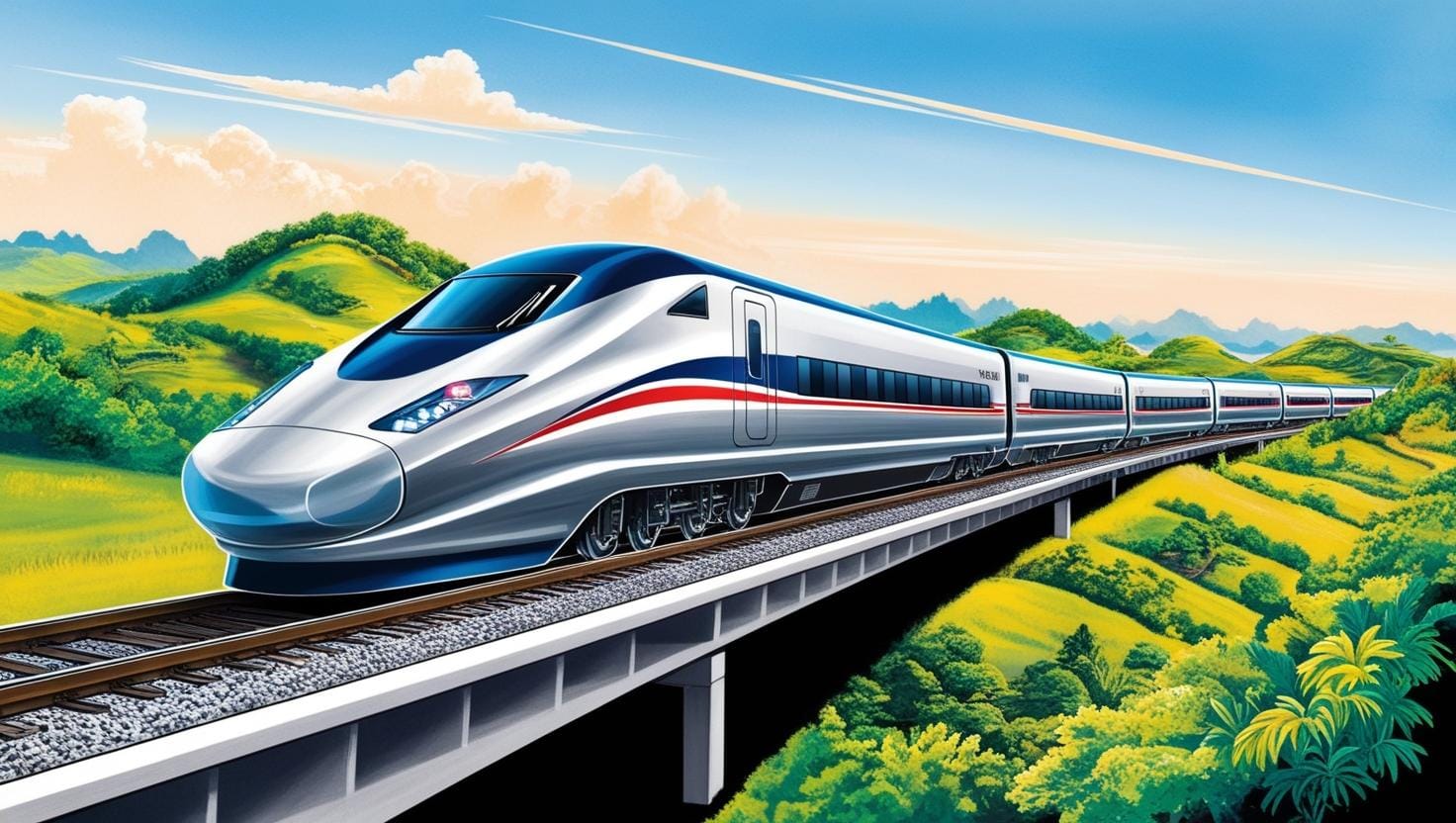
The 508-kilometer corridor, developed with Japanese Shinkansen technology and financed by the Japan International Cooperation Agency, will initially operate on the Surat-Bilimora stretch in Gujarat as part of a phased rollout. The full line, designed for speeds of up to 320 km/h and featuring elevated viaducts, tunnels and India’s first undersea rail tunnel, is targeted for complete commercial service by 2029.
New Delhi views the milestone — described by officials as a major step in India’s railway modernization — as a foundation for building a wider national network of electrified high-speed lines. The project has faced repeated delays, largely due to land acquisition challenges and regulatory clearances, which have also significantly increased costs beyond the original estimate.
“The knowledge, skills, and capabilities developed through the project are expected to support future high-speed rail corridors across the country,” the government’s plan reads.
The first 508-kilometer line, the Mumbai–Ahmedabad High Speed Rail Corridor, is being built along its west coast.
“A considerable amount of work on the entire corridor has already been completed,” Dharmendra Tewari, Indian Railways’ additional director general, told AFP. “The first section of the bullet train will be operational in 2027, between the cities of Surat and Vapi,” he added.
Surat, the global diamond cutting center, and Vapi, known for its chemical and manufacturing industries, are about 100 kilometers apart.
The project has been a long time coming, mired in cost overruns and delays.
The much-vaunted project, using Japanese “Shinkansen” technology, was launched in 2017 by then-Prime Minister Narendra Modi and his Japanese counterpart Shinzo Abe — and was originally planned to be completed by 2023.
Abe’s protege and current premier, Sanae Takaichi, is due in India for a three-day visit starting Wednesday.
The government says the project will cost $17 billion, funded by an 81 percent loan from Tokyo, via the Japan International Cooperation Agency (JICA).
But some Indian media reports say the sizeable delays, as well as higher land acquisition costs, could push that price tag up considerably.
India’s railways have come a long way since the first passenger steam train puffed out of what is today Mumbai in 1853.
New Delhi has pumped billions of dollars into overhauling creaking colonial-era infrastructure — rolling out higher-speed trains, modernizing stations, and tackling its once-woeful safety record.
It has one of the world’s longest rail networks — carrying 7.41 billion passengers last year and 1.67 billion tonnes of freight — with around 85,000 kilometers now capable of speeds of 110 kilometers per hour or above, accounting for around 80 percent of its total lines.
Its domestically designed Vande Bharat — or “Salute to India” — trains can reach 180 kph and carried nearly 40 million passengers last year.
But its bullet train — with a design speed of 350 kph and an operational speed of 320 kmph — is its flagship.
When completed, the government says it will slash travel times between Mumbai — India’s financial capital of 22 million people — and Ahmedabad, the key city in Modi’s home state of Gujarat.
The journey is expected to take just under two hours, compared with the current six hours by existing rail routes, or the four to five hours by air, including airport procedures.
Officials say it will be complete by the end of 2028 — in time for Ahmedabad to host the 2030 Commonwealth Games — an event widely seen as a stepping stone towards India’s ambition to host the 2036 Olympics.
The route has required some impressive feats of engineering, including a 21-kilometer-long tunnel that goes through mountains and the county’s first undersea rail tunnel, which is yet to be completed.
The bullet train is a key project of Modi, who promised a high-speed train network when he was first elected prime minister in 2014.
India hopes the project will gather momentum, floating ambitious proposals for seven high-speed rail corridors spanning 4,000 kilometers.
“These corridors will integrate key cities and regions, facilitate efficient movement of people, and support economic interaction across states,” the government said in a June briefing note.
The proposed network would include an east-west route linking New Delhi to Varanasi — Modi’s parliamentary constituency and one of the holiest sites for Hindus — and the strategic city of Siliguri, which connects the northeastern states with the rest of the country.
A second network, running roughly north to south from Ahmedabad to Mumbai, would then cross the country to the southeast, linking the tech hub cities of Pune, Hyderabad and Chennai.
India’s government calls the planned routes “growth connectors,” but for now, those remain plans on paper only, without a timeline.
By Agence France-Presse