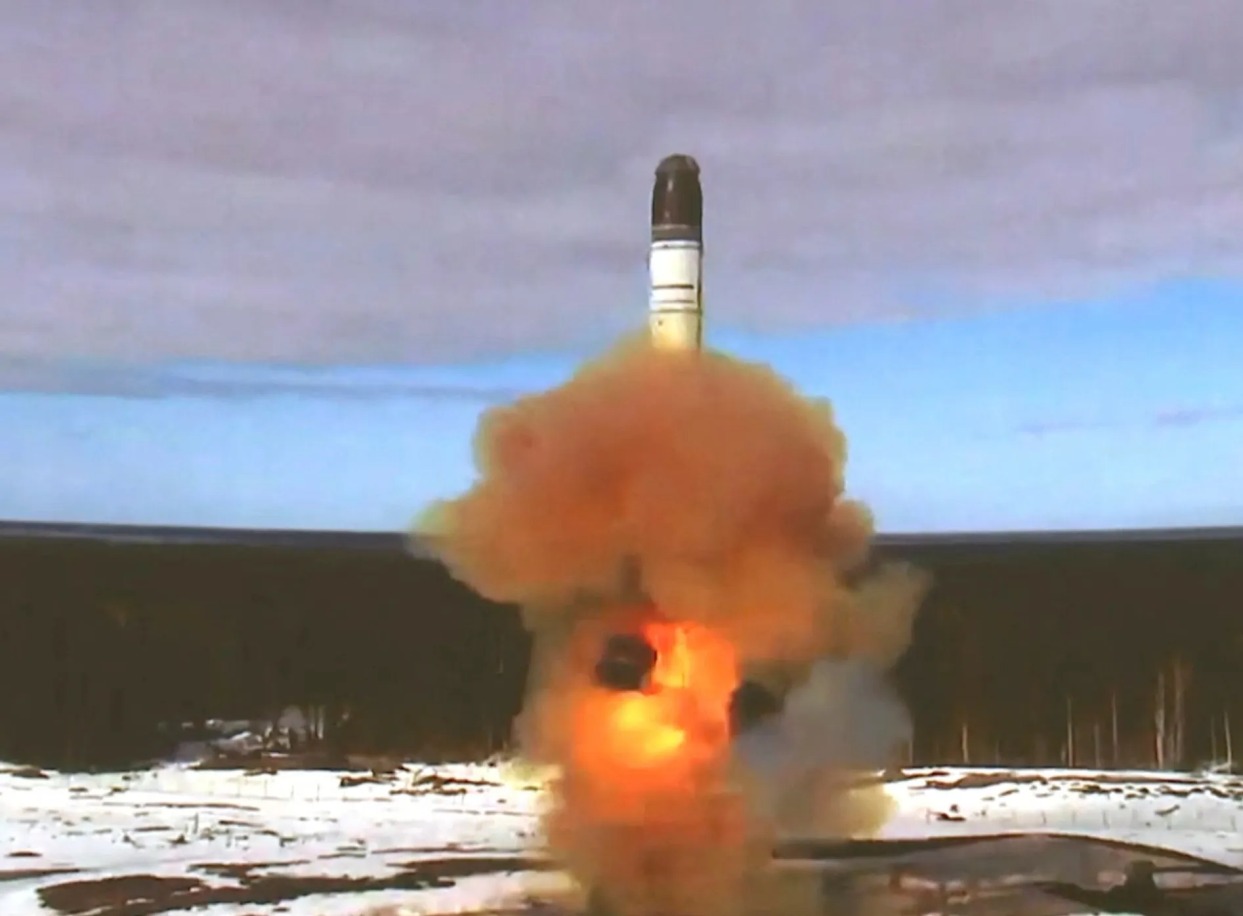
On May 12, Russian President Vladimir Putin announced the successful testing of the RS-28 Sarmat intercontinental ballistic missile (ICBM), calling it Russia’s most lethal ICBM so far that can hit any part of the Earth, penetrate any present or future missile defense system of the West, and said that the missile can carry four times more payload than any of the existing Western ICBMs.
“This is the most powerful missile in the world,” Putin said of the Sarmat missile, adding that the combined power of its individually targeted warheads is more than four times that of any of its Western counterparts.
Further, Putin said that the missile has a maximum range of more than 35,000km (21,750 miles), far more than any of its Western counterparts, and claimed it could “penetrate all existing and future antimissile defense systems”.
Putin also claimed that the ICBM will enter combat service by the end of this year.
So, is Russia really at the cusp of gaining a decisive edge over the West in terms of ICBM technology? This question is even more relevant since the US’s silo-based ICBMs, Minuteman, are themselves aging, and its replacement, the Sentinel program, is still years behind.
Further, can the RS-28 Sarmat really travel over 34,000 km and hit any part of the Earth, as claimed by Putin?
Is the West, especially the US, really defenseless against the Sarmat ICBM, known in the West as Satan II?
And, most importantly, can Russia actually field this missile by the end of this year?
These questions are critical not only for Russia and Putin but for everyone, as if the claims are indeed true, they could alter the global balance of power and give Moscow a decisive edge over the US at a time when the world is embroiled in multiple hot wars.
RS-28 Sarmat ICBM Development
Designed to replace Russia’s aging Soviet-built Voyevoda missiles (SS-18 Satan ICBM), the RS-28 Sarmat began development sometime in the 2000s.
In 2011, Russia awarded production contracts to Makeyev Design Bureau and NPOMash.
Russia completed its first prototype of the missile in late 2015.
The RS-28 Sarmat is a land-based guided missile designed for the delivery of nuclear weapons with a minimum range of 5,500km (about 3,400 miles).
Putin claimed that the missile has a range of over 35,000 km; however, Western analysts believe its actual range is around 18,000 km, still sufficient to hit any part of the US from any point on Russian territory.
The Sarmat’s maximum payload is 10 tonnes, according to an April 2024 report by the Washington, DC-based Center for Strategic and International Studies (CSIS) think tank.
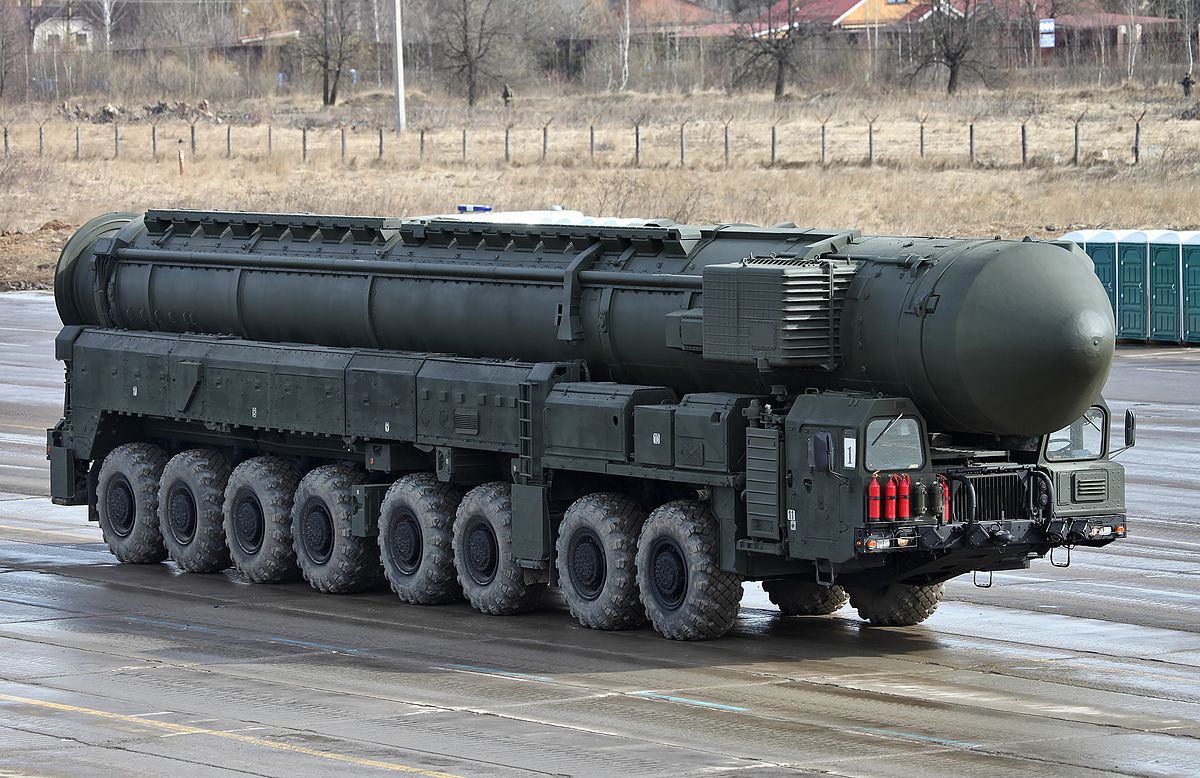
According to Missile Technology, the Sarmat is a three-stage, liquid-fueled missile with a launch weight of 208.1 metric tons. The missile is 35.3 meters long and 3 meters in diameter.
Designated a “heavy” ICBM, the Sarmat can load a wide variety of warhead options. According to Russian media, Sarmat can reportedly load up to 10 large warheads, 16 smaller ones, a combination of warheads and countermeasures, or hypersonic boost-glide vehicles.
In December 2017, Russia conducted its first silo ejection test of the Sarmat, which reportedly revealed technical deficiencies with the launch system.
Two subsequent silo ejection tests in March and May 2018 were apparently successful.
The RS-28 was initially scheduled to enter service in 2018 with 50 missiles on order. After several technical delays, the Sarmat missile’s operational entry was pushed to 2021.
The last test launch of the Sarmat ended in a catastrophic failure. In September 2024, during the test launch, the Sarmat exploded in its launch silo, further pushing its timeline.
Now, the latest test in May has been reportedly successful, and Putin is promising that the missile will enter combat service by the end of this year.
“By the end of this year, the Sarmat will indeed enter combat duty,” Putin said after the successful test launch.
However, Putin has been promising this at least since 2021.
In fact, the Russian opposition publication Astra has documented a total of 10 such statements since 2021—an average of two per year—each time postponing the initially announced deployment date.
Furthermore, it must be noted that the R-36M2 Voevoda (the ICBM RS-28 Sarmat is to replace) underwent extensive successful test series (reportedly around 20) before full operational status.
In fact, as a general rule, in the Soviet Union, nuclear-capable heavy ICBMs were typically put on alert only after a series of consecutive successful launches.
Since the last test launch of the Sarmat in 2024 was a catastrophic failure, with the missile exploding in its silo, there remain serious questions over the technological maturity of the ICBM despite the successful test launch in May this year.
According to a research paper by the UK-based think tank, RUSI, the 2024 failure of the Sarmat test launch suggested “potential propulsion issues”.
“The difficulties faced by the Russian nuclear enterprise with respect to Sarmat may be a reflection of the inherent complexity of the new system’s propulsion and its lighter structure,” the RUSI research paper said.
According to Putin, the Sarmat has a much shorter boost phase, an apparent attempt by the Russians to beat the US’s space-based infrared satellites, which pick ballistic missile launches in their boost phase.
The shorter the boost phase of a missile, the less time for the missile defense network to detect its heat signature.
However, this shorter boost phase might have created additional complexities for the Missile’s propulsion system, the RUSI paper concluded.
As such, Russia, at least theoretically, would need more test launches before it can securely put the nuclear-capable ICBM on alert.
Further, the Sarmat is not as invincible as Putin is making it out to be.
No missile launch, however small its boost phase, can completely go undetected by space-based infrared seeker satellites.
Meanwhile, as the US launches its Golden Dome project, with space-based trackers and interceptors as its key components, the chances of an ICBM, even the latest RS-28 Sarmat, going undetected are extremely low.
According to a latest report by the US Congress Budget Office (CBO), the Golden Dome project could deploy as many as 7,800 space-based interceptors.
These thousands of interceptors should be able to target the RS-28 Sarmat during its boost phase.
Additionally, while liquid-fuel ICBMs offer greater payload capacity and better efficiency, this comes at a cost in both system complexity and the time required to prepare a missile for launch.
Moreover, silo-based missiles are static targets and thus more vulnerable than solid-fuel missiles such as the RS-24 Yars.
Further, while liquid-fuel missiles allow heavier payloads and greater trajectory flexibility, solid-fuel missiles like Yars are faster to launch and easier to maintain. Sarmat’s size makes its silos fixed and potentially vulnerable.
Therefore, while the RS-28 Sarmat appears to be Russia’s most lethal ICBM on paper, in reality, it is less survivable on the ground than the RS-24 Yars, is difficult to maintain, needs a long time to prepare for launch, and is probably still not technologically mature enough for combat deployment.
- Sumit Ahlawat has over a decade of experience in news media. He has worked with Press Trust of India, Times Now, Zee News, Economic Times, and Microsoft News. He holds a Master’s Degree in International Media and Modern History from the University of Sheffield, UK.
- VIEWS PERSONAL OF THE AUTHOR.
- He can be reached at ahlawat.sumit85 (at) gmail.com