US President Donald Trump appears to be inching closer to achieving his objective of using Greenland as a bulwark against security threats posed by adversaries such as Russia and China, even though he abandoned efforts to annex the Arctic island by force after a long, drawn-out pressure campaign.
For months, the US President made direct threats of invading Greenland, a semi-autonomous, self-governing island state under Danish sovereignty, before he suddenly backtracked and ruled out the use of force in January this year.
Subsequently, diplomacy and talks replaced harsh warnings, opening the door to high-level meetings among US, Danish, and Greenlandic officials.
The talks also included discussions on how to modernize or upgrade the 1951 Defense of Greenland Agreement, which already gives the US broad rights to build and operate bases with Danish approval, expand NATO’s footprint in Greenland, and use Greenland’s strategic location to counter Russian or Chinese influence in the Arctic, all without a transfer of sovereignty.
As it turns out, the United States is now poised to expand its military presence in Greenland beyond the lone Pituffik Space Base, which supports missile warning, missile defense, and space surveillance for the US and NATO. Citing informed sources, BBC News reported that US officials are holding regular discussions with Denmark to establish three new US military bases on the strategic Arctic island.
The latest update comes weeks after General Gregory Guillot, commander of US Northern Command, first informed the Senate of these plans during a March hearing.
The Trump administration has reportedly proposed that the three additional bases the US is seeking be formally designated as sovereign American territory. Further, the bases will be located in southern Greenland and will mainly be used to monitor potential Russian and Chinese maritime activity in the GIUK Gap, a region of the northern Atlantic between Greenland, Iceland, and the UK, according to the authorities who spoke to the BBC.
The report states that at least one of these proposed bases could be located in Narsarsuaq, which previously housed a US base and airport that were transferred to the Danish government in 1958. The other bases could be established in regions that already have functional airfields or ports, or other infrastructure that the US military can leverage with upgrades.

However, these discussions are in a nascent stage, and the two sides have yet to reach an agreement. In fact, the final number of bases or their locations could change as discussions advance, according to the US officials with knowledge of the matter.
The US and Denmark struck a deal in 1951 that allowed American forces to establish a military facility in Greenland. The act was later updated in 2004 with a clause that gave the US the freedom to ramp up its military deployments, subject to advanced notifications to Danish and Greenland authorities. Additionally, the updated act stated that the US could establish new facilities, but it would need Denmark’s green light.
Denmark had previously indicated its willingness to discuss establishing additional US bases in Greenland. “There is an ongoing diplomatic track with the United States. The Ministry of Foreign Affairs will not go into further detail at this time,” a spokesperson of the Danish Foreign Ministry had stated.
Separately, Greenland’s Prime Minister Jens-Frederik Nielsen recently announced that the talks for additional US bases on the island were progressing. “We are negotiating, but we don’t have an agreement,” Nielsen said during a speech at the Copenhagen Democracy Summit. “The EU member countries have been a steadfast friend and have stood by us when we needed it the most,” he added.
The Expansion of the US Military in Greenland
As soon as he took office as President in January 2025, Donald Trump kick-started a campaign calling for the annexation of Greenland to boost the defense of the United States and NATO against modern missile threats.
When NATO allies pushed back against Trump’s calls for aggression against a fellow NATO state, Trump issued a chilling warning, saying, “NATO has been telling Denmark, for 20 years, that ‘you have to get the Russian threat away from Greenland.’ Unfortunately, Denmark has been unable to do anything about it. Now it is time, and it will be done!”
Additionally, the President announced 10% import tariffs on goods from eight countries, including Denmark, Norway, Sweden, France, Germany, the UK, the Netherlands, and Finland—warning that it would be increased to 25% on June 1, 2026, and remain in place until a deal was reached for the US to purchase Greenland.
Responding to threats of invasion, the Danish Prime Minister Mette Frederiksen warned that any US military attack on Greenland would mean the “end of everything,” including NATO and the post-WWII security order. In addition, Denmark deployed troops to Greenland in January this year, including a “substantial” contingent led by the Chief of the Royal Danish Army, with orders to “shoot first, talk later” without awaiting orders from Commanders if anyone were to invade Greenland.
Not just that, the country began preparing for a potential attack from the US in January this year, as previously reported by the EurAsian Times.
However, Trump surprisingly walked back on his threats within days. Speaking at the World Economic Forum in January 2026, he announced that although the US needed to own Greenland for security reasons, he would not order the use of military force to seize the Arctic island.
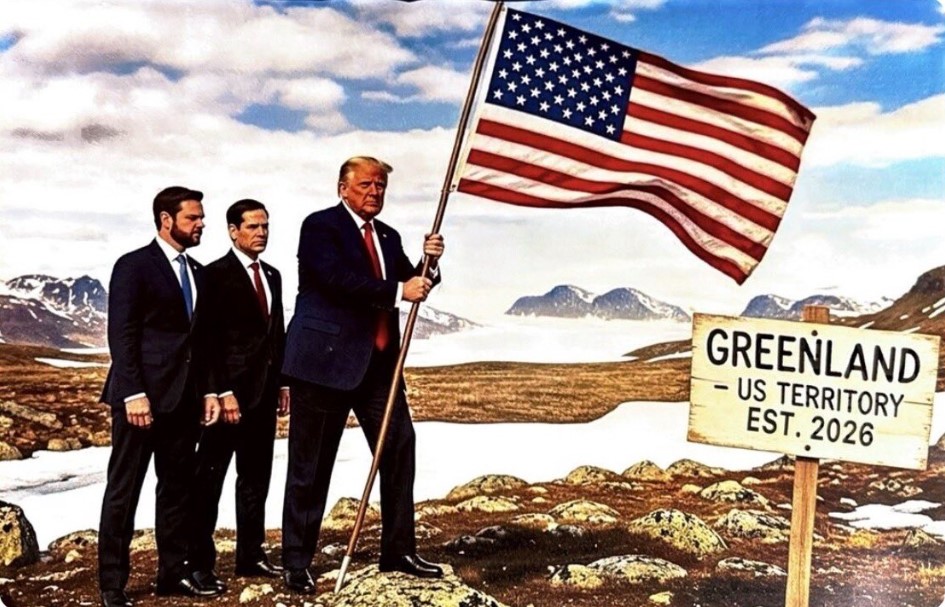
Trump’s obsession with Greenland is based on the need to consolidate power and exploit Greenland’s strategic location.
The territory is seen as a key strategic outpost for US and NATO security, particularly in the Arctic and North Atlantic, due to its geography. It forms a critical part of the GIUK Gap, a chokepoint for monitoring and potentially restricting naval movements, especially Russian submarines and surface vessels, between the Arctic and the North Atlantic.
Additionally, Greenland’s location makes it ideal for early warning of threats crossing the Arctic, such as ballistic missiles from Russia or China aimed at North America, as the shortest polar routes pass nearby.
Trump’s rationale is straightforward: Greenland is crucial for American security, especially Alaska, the largest state of the US, in the event of a potential clash with Russia or China.
Additionally, Greenland is believed to be vital to the Golden Dome project, which includes a constellation of satellites equipped with advanced sensors and space-based interceptors to monitor airspace and near-Earth space for the timely detection of launches and the interception of various types of offensive weapons by adversaries.
If Russia were to launch missiles toward the United States, they would probably pass over Greenland. This could make the region a strategic site for US missile interceptors as part of the “Golden Dome” missile defense system, as argued by Dr. Marion Messmer, Director of the International Security Program at London’s Chatham House.
Chinese and Russian analysts believe that if the Golden Dome is successful, it would make it more difficult for China and Russia to use nuclear weapons against the US, undermining their strategic deterrents, as noted by the Center for Strategic and International Studies (CSIS) in an article that examined Chinese and Russian responses to the project.
Beyond that, Greenland has emerged as a vital asset in the geopolitical rivalry with China.
Although it lies on another continent and is not an Arctic state, China described itself as a “near-Arctic state” in the first iteration of an Arctic policy paper in 2018. The Trump administration fears that an increase in Chinese military presence in the region could turn the Arctic into a flashpoint between China and the US.
Donald Trump has repeatedly said that the self-governing island will unintentionally end up in the hands of China or Russia if the United States does not seize control of it. “We need that because if you take a look outside of Greenland right now, there are Russian destroyers, there are Chinese destroyers, and, bigger, there are Russian submarines all over the place. We’re not gonna have Russia or China occupy Greenland, and that’s what they’re going to do if we don’t,” the President warned earlier.
Experts have dismissed any immediate threat to Greenland from Russia or China. However, they believe that the rapid melting of glaciers due to global warming is likely to increase Russian and Chinese presence in the wider Arctic region, and the US wants to leverage Greenland as a bulwark against that expansion.
Three or more additional bases should help Trump achieve those objectives, one way or another.
- Contact the author at sakshi.tiwari13 (at) outlook.com
- Follow EurAsian Times on Google News