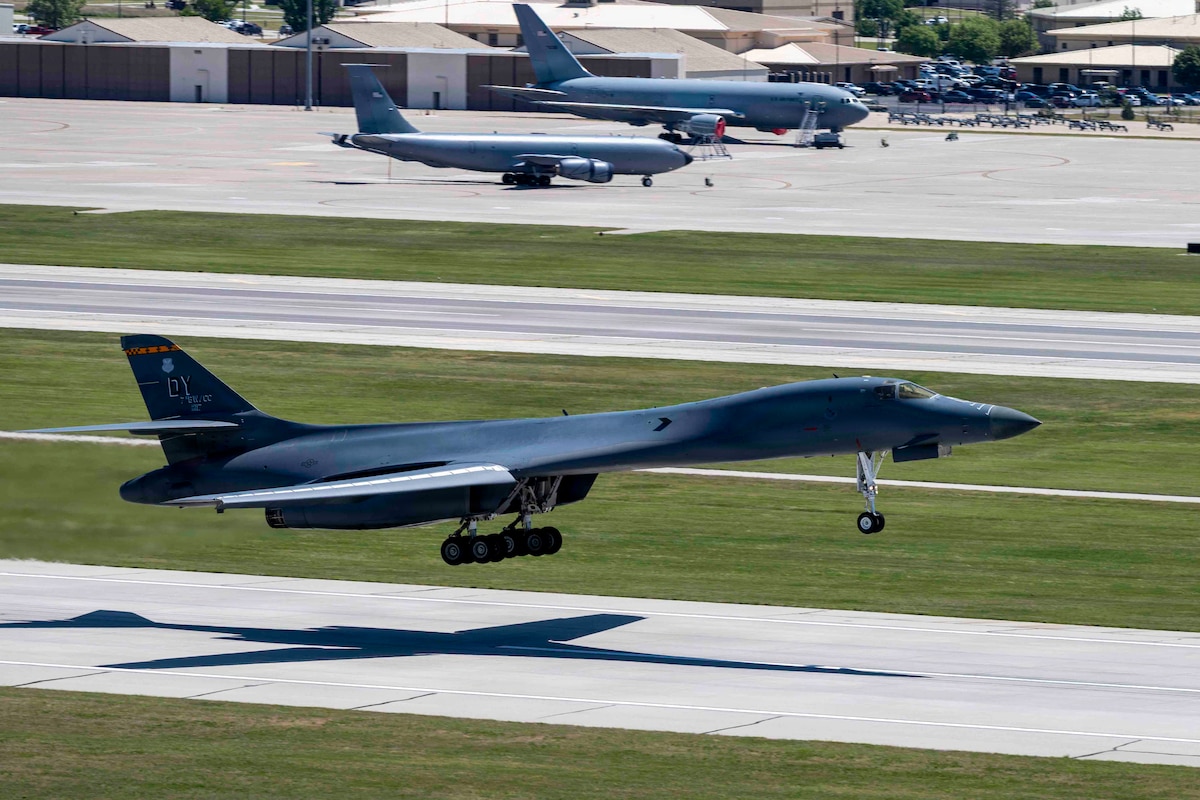
The US Air Force has given a B-1B Lancer a little “backbone” surgery, paving the way for the bomber’s return to service ahead of schedule.
“A B-1B Lancer that arrived at McConnell Air Force Base last September for a major structural repair is heading back to the fleet significantly ahead of schedule, proving that digital engineering can revolutionize the sustainment of legacy aircraft,” the USAF’s Global Strike Command said in a statement on May 12, 2026. “Originally slated to take a full year, the joint Air Force and NIAR team completed the structural repair in record time,” it added.
The Lancer underwent a preemptive replacement of its Forward Intermediate Fuselage (FIF) at Wichita State University’s National Institute for Aviation Research (NIAR).
In September 2025, the bomber arrived at McConnell Air Force Base as part of the BackBONE Project, an initiative that aims to extend the B-1 fleet’s service life through preemptive structural repairs, particularly the replacement of the FIF, a critical 33-foot upper spine or fuselage section ahead of the wings.
While the structural repair was expected to take at least a year, the USAF and NIAR team completed the job approximately 3.5 months ahead of schedule.
A B-1B Lancer is returning to the fleet well ahead of schedule after undergoing a historic "backbone" surgery!
Read more here: https://t.co/UJH3gXY3hD@US_STRATCOM | @usairforce | @AFLCMCofficial | @HQ_AFMC | @22ARW | #B1Lancer | #B1 pic.twitter.com/QkEbwjHa0E
— Air Force Global Strike Command (@AFGlobalStrike) May 13, 2026
“When we started work on the aircraft, we were looking at a 12-month repair,” Abigail Ngo, program manager with the re B-1 Program Office, was quoted as saying in a statement. “All in all, we were three-and-a-half months ahead of schedule. That is a good news story in itself—just the speed at which we were able to do a really hard thing.”
The service said that the success of this prototype repair sets a precedent and new standard for complex sustainment. Joe Stupic, Senior Material Leader and Division Chief of the B-1 Program Office, said, “We’re glad to return the aircraft to the fleet early.” “It was a big team effort, a great win, and the field gets back a better jet. A jet that will require fewer inspections because of this repair.”
The latest example of repair comes as the USAF has reneged on its plans to retire the B-1B bombers by the 2030s, instead focusing on modernization and extending their lifespan.
The new budget documents indicate that the service plans to spend $342 million on B-1 modernization between 2027 and 2031, as highlighted by the Air and Space Forces Magazine last month. “This request provides the necessary funding to modernize the platform, ensuring its lethality and relevance through 2037,” the budget document states.
Therefore, making the BackBONE project and the preemptive repairs of Lancers all the more significant. “The B-1 is the backbone of America’s bomber force, and proves it every day,” Stupic said. “This repair keeps it in the fight longer.”
The Formidable B-1B Lancer Bomber
The B-1B Lancer, a supersonic variable-sweep wing bomber, excels in conventional precision strikes with a massive payload capacity up to 75,000 pounds of munitions. It carries joint direct attack munitions (JDAMs), small-diameter bombs, and standoff weapons. It can perform a wide range of missions, including close air support, strategic bombing, maritime operations, and intelligence, surveillance, and reconnaissance (ISR).
While it was originally created as a strategic bomber to penetrate Soviet air defences and deliver nuclear warheads inside enemy territory, the Lancer entered service just years ahead of the disintegration of the former Soviet Union.
As soon as it entered service in 1986, the B-1B quickly became a cornerstone of the US nuclear deterrence strategy.
Initially, as part of the nuclear triad, the B1B contributed to deterrence by providing rapid response capabilities against nuclear threats. However, as the Cold War ended, the B-1B quickly transitioned to a conventional bombing role, raining hell during Operation Desert Fox in 1998 and subsequently during NATO’s bombing action in Kosovo.
Just a few years later, the B-1B supported the US-led NATO military forces in Afghanistan and Iraq, demonstrating its versatility and adaptability to new mission requirements.
More recently, the USAF used the B-1B Lancers to carry out long-range deep attacks in Iran during the initial days of the operation. The strikes primarily targeted Iran’s ballistic missile launch locations, ballistic missile depots, and command-and-control centres.
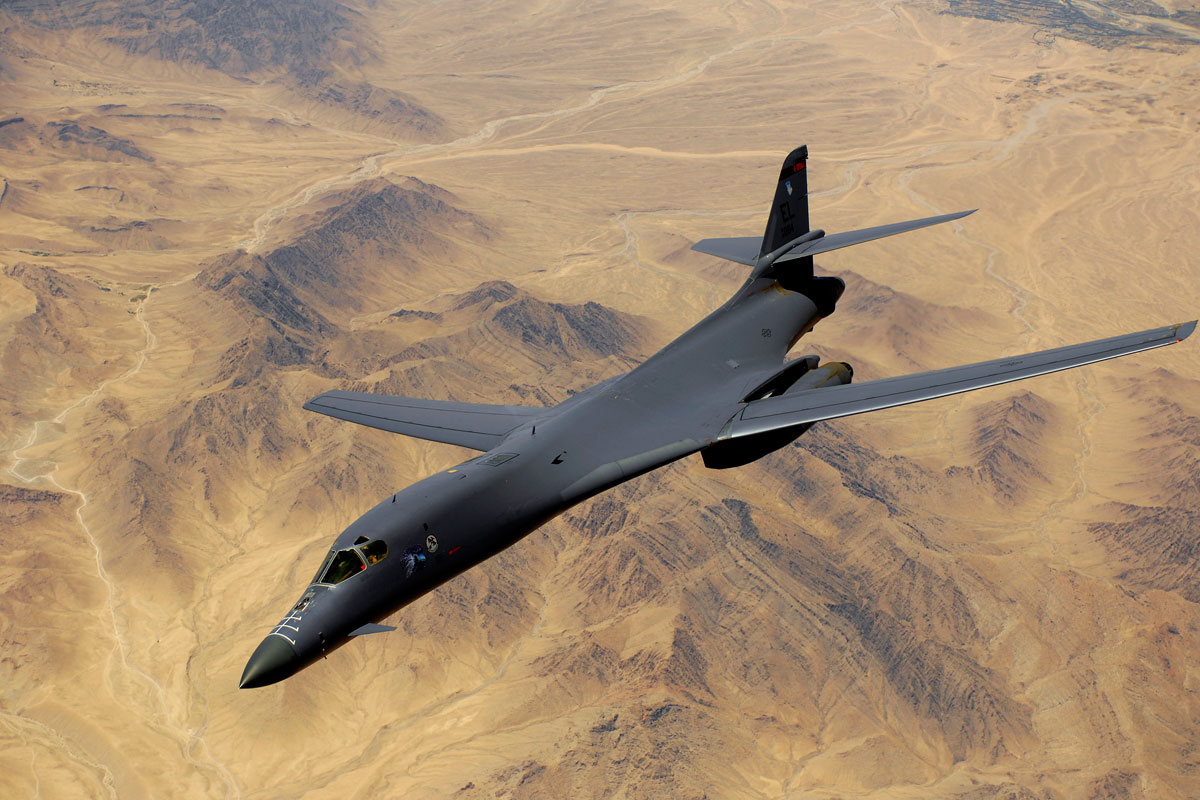
“The B-1’s ability to deploy quickly, operate at supersonic speeds, and carry the largest conventional payload makes it inherently unpredictable to adversaries and a flexible combat asset,” Lt. Col. Ryan Stillwell had said earlier. “Whether it’s integrating with our allies or responding to our adversaries, the B-1 enables a forward presence alongside critical strategic reach. Our adversaries never know when or where a B-1 will show up, but they all know exactly what it can do when it does.”
In early March 2026, the Pentagon published a video of a B-1B Lancer operating alongside the USS Abraham Lincoln, highlighting integrated military operations.
Despite the introduction of newer bombers like the B-21 Raider, the B-1B remains relevant, thanks to the regular upgrades. The bomber is getting an upgraded Identification, Friend or Foe (IFF) system, Link 16 tactical data link, updated defensive avionics, and improved mass data storage for modern battlefield information. Other Enhancements include advanced targeting pods, improved radar systems, and the reactivation and upgrading of the B-1B’s six external hardpoints, among other things.
The B-1B already offers the largest conventional payload in the USAF inventory, with upgrades to internal reconfiguration and increased payload capacity.
The combat utility of the B-1B Lancer is underscored by the USAF’s recent resurrection of a B-1 Lancer bomber it had previously retired.
A B-1B Lancer, once parked in the Arizona desert, is back in the air after an intensive regeneration and depot maintenance effort led by the Oklahoma City Air Logistics Complex at Tinker Air Force Base, as explained in detail by the EurAsian Times.
Not just that, the USAF is considering new, more significant roles for the bomber, including as a carrier of hypersonic weapons. For instance, an A-1B Lancer equipped with an AGM-183 Air-launched Rapid Response Weapon (ARRW) hypersonic missile was photographed earlier this month. Additionally, the USAF purports to create a different air-launched ballistic missile (ALBM) and an enhanced version of the ARRW.
Both of these initiatives could be connected to the B-1B Lancer.
- Contact the author at sakshi.tiwari13 (at) outlook.com
- Follow EurAsian Times on Google News