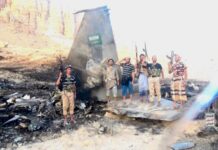
As the war between Saudi Arabia and the Iran-backed Houthis escalates, Riyadh has made a bold claim. Saudi Arabia has accused the Houthis of an attempted attack on Mecca, the holiest city in Islam and a site of pilgrimage for millions of Muslims.
Turki Al-Malki, spokesperson for the Saudi-led coalition forces in Yemen, said that the Houthis launched a drone toward Mecca on September 15, but it was shot down by the Saudi Air Defense Forces before entering the city’s restricted airspace.
“The security of the Two Holy Mosques and the pilgrims is a red line,” said Al-Malki, and warned that the Saudi-led coalition “will not hesitate to take the necessary and deterrent measures” against the Houthis.
“This can only be described as a disgraceful act, an attempt to target the birthplace of revelation, the land of the message, and the destination that draws the hearts of millions of Muslims from around the world.”
“This hostile attempt will remain a mark of shame on the record of violations committed by the Extremist Terrorist Houthi militia, as it was intended to provoke the feelings of millions of Muslims,” the statement added.
Saudi Arabia also reminded the world that this is the second attempt by Houthis to target the Grand Mosque of Mecca, following the first attempt with a ballistic missile on July 27, 2017.
The Houthis, however, rejected the allegation.
Earlier in 2017, the Houthis also rejected the Saudi allegation, saying that they were targeting the international airport at Jeddah and not the Holy Mosque in Mecca.
Whether or not the Houthis actually targeted Mecca, the Saudi statement is clearly an attempt to discredit the Houthis as an anti-Islamic terrorist militia. However, the Saudi statement has unwittingly revived an older and more uncomfortable question: who has the right to control the Grand Mosque in Mecca.
The alleged Houthi strike would not be the first time Islam’s holiest site has come under threat. Over the past 1,400 years, Mecca has repeatedly been pulled into intra-Muslim power struggles.
The Kaaba was bombarded during the Umayyad siege of 683, sacked by the Qarmatians in 930, seized by militants in 1979, and caught up in deadly Hajj clashes in 1987. In almost every case, the attackers were Muslims, not outsiders.
Control of Mecca and Medina has never been settled. In fact, over roughly 14 centuries of Islamic history, the Saudis held full suzerainty over these sites for less than two centuries, and the House of Saud, Saudi Arabia’s ruling family, has controlled them for only one century.
In other words, Saudi custody of the two holy sites is modern, not ancient, and it has never gone unchallenged.
Iran, for that matter, has always questioned the Saudi control of Islam’s two holiest shrines and suggested that the administration of both sites should be handled by a joint body of all Islamic countries.
1,400 Years of Contest Over the Custodianship of Mecca
The conflict over control of Mecca and Medina is almost as old as Islam itself.
Whoever held Islam’s two holiest sites gained unmatched prestige – and a powerful claim to speak for the wider Muslim world.
Prophet Muhammad (PBUH) conquered Mecca in 630 CE.
During his lifetime, and under the first four pious Caliphs, the administration of both Mecca and Medina remained under their control. However, during this time, Islam expanded aggressively, conquered new territories, and became an empire.
As a result, schisms grew in Islam and new centers of power emerged.
From 661 CE to 750 CE, the Umayyad Caliphate, centered in Damascus, controlled Mecca and Medina.
From the eighth to the mid-tenth century, the Abbasid Caliphate, centered in Baghdad, controlled these two sites.
In the mid-tenth century, the hereditary Sharifs of Mecca became the local rulers of the Hejaz region. However, they often had to recognize the suzerainty of some distant ruler, such as the Fatimid Caliphate, based in Egypt.
During the Ottoman period, roughly from 1517 CE to the end of the First World War, both sites were under Ottoman suzerainty, based in Istanbul.
From 1916 to 1925, the Hashemite Kingdom of Hejaz controlled the sites.
In 1924, Abdulaziz Ibn Saud’s forces entered Mecca. The territory was incorporated into the Kingdom of Hejaz and Nejd and then the unified Kingdom of Saudi Arabia in 1932. The Saudi royal family – the House of Saud – has controlled Mecca ever since.
Therefore, the Saudi control of Mecca is fairly recent. In the past, Damascus, Baghdad, Cairo, and Istanbul have controlled the site.
Many of these transfers of control were fairly violent, and many times, even the Kaaba itself was damaged during these conflicts.
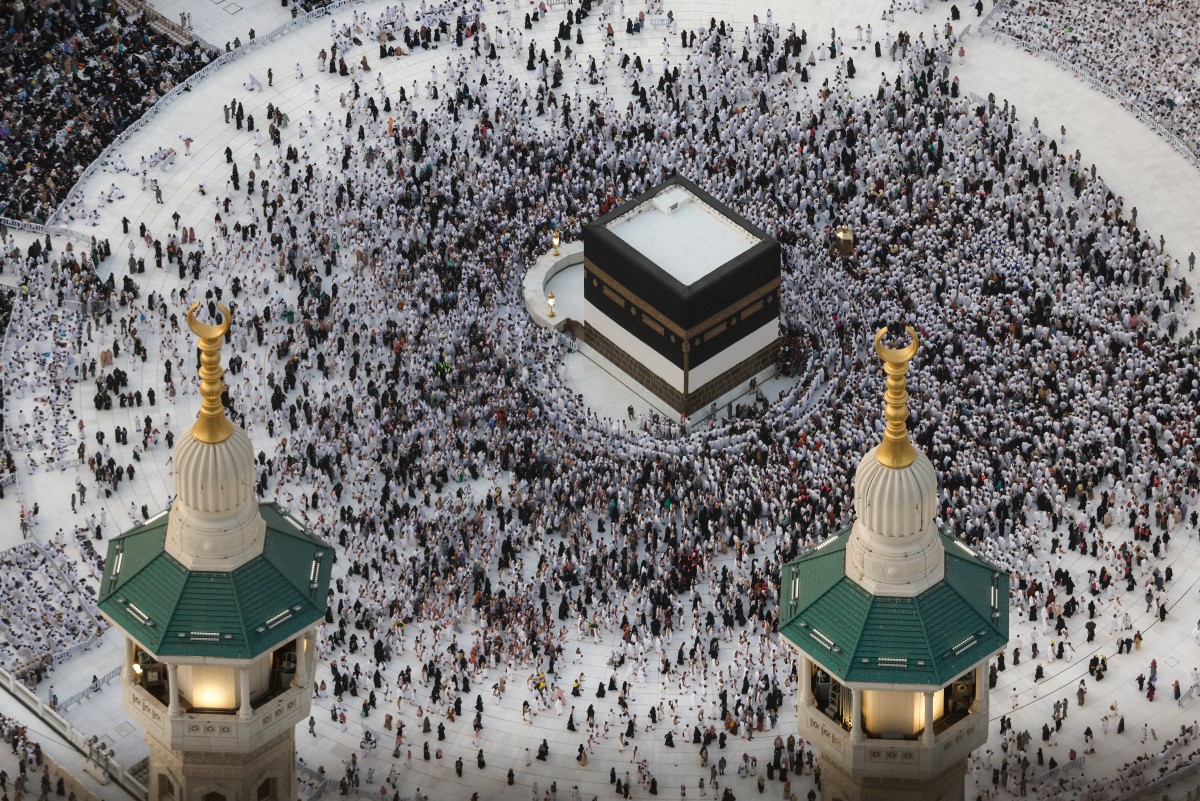
The Many Attacks on the Kaaba
Over the past 1,400 years, every major attack on Mecca has come not from outside the faith, but from Muslims themselves.
The first came in the 7th century, barely 50 years after the death of the Prophet Muhammad. In 683, during a Muslim civil war, an Umayyad army besieged Mecca, then held by a rival claimant to the caliphate.
Catapults pounded the city. The Kaaba caught fire, and the sacred Black Stone reportedly split into pieces.
The next assault came in 930, when the Qarmatians – a radical Ismaili sect – stormed Mecca during the Hajj.
Reportedly, they massacred thousands of pilgrims in and around the Grand Mosque and carried off the Black Stone. The relic was returned only after 22 years.
In modern times, the Kaaba was attacked again in 1979.
Several hundred armed militants entered the Grand Mosque among worshippers. Their leader was Juhayman al-Otaybi, a Saudi Islamist who denounced the royal family as corrupt and too close to the West.
He proclaimed his brother-in-law, Muhammad Abdullah al-Qahtani, the awaited Mahdi and called on Muslims to reject the House of Saud.
The gunmen seized the mosque and took thousands of pilgrims hostage.
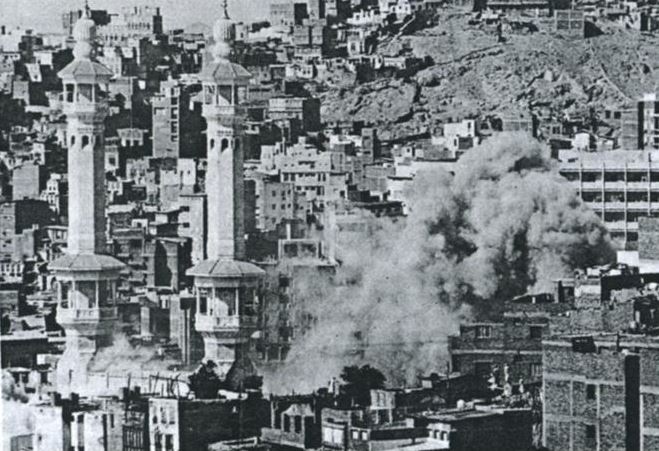
Saudi forces struggled to retake it. Official figures put the death toll at 127 security personnel, 117 militants and 26 pilgrims, with hundreds more wounded.
After the siege ended, 63 of the captured rebels, including Juhayman, were executed.
During this assault, Saudi troops were advised by a small team from France’s elite GIGN, who helped plan the final assault and supplied incapacitating gas used in the mosque’s underground chambers.
This history shows that the Kaaba has been attacked repeatedly.
After the 1979 Islamic Revolution in Iran, the new regime in Tehran has repeatedly questioned the exclusive Saudi control of Mecca.
Ruhollah Khomeini, Iran’s first Supreme Leader, often said that Mecca and Medina are not the personal property of the House of Saud and should be jointly administered.
Throughout the 1980s, Iranian pilgrims protested in Mecca during the Hajj pilgrimage.
In 1987, during one such protest, Saudi armed forces opened fire, which resulted in the deaths of over 400 people, nearly 300 of them Iranians.
At that time, Ruhollah Khomeini reportedly announced that Mecca was in the hands of “a band of heretics.”
An Islamic convention was organized in Tehran, which said that the Saudi government was not capable of administering these holy sites.
In 2018, Ali Khamenei once again said that Mecca and Medina belonged to the whole Muslim ummah, and not just to one particular government.
In Turkey, some scholars have also suggested that Mecca should be declared a sovereign territory, akin to Vatican City, and that an OIC (Organization of Islamic Cooperation) body should administer it.
While the House of Saud has controlled Mecca and Medina for the last century, the custodianship of these territories has long been contested in Islamic history.
Saudi Arabia’s accusation looks designed to isolate the Houthis by charging them with an attack on Mecca. But the claim also revives a more awkward question: who should control Islam’s holiest shrines?
- Sumit Ahlawat has over a decade of experience in news media. He has worked with Press Trust of India, Times Now, Zee News, Economic Times, and Microsoft News. He holds a Master’s Degree in International Media and Modern History from the University of Sheffield, UK.
- He can be reached at ahlawat.sumit85 (at) gmail.com