After years of excruciating delays, Taiwan is poised to receive its first two F-16 Viper Block 70 fighters, amid simmering tensions with China.
Beijing maintains that the Republic of China, popularly known as Taiwan, is a renegade province and has vowed to seize the island state with force, if necessary. With the threat of an invasion looming, Taiwan has purchased several cutting-edge weapons from the US, with the F-16Vs among the most prominent.
The US approved Taiwan’s request to purchase 66 F-16 Block 70/72 fighters from Lockheed Martin in 2019. In addition, the island state has upgraded its older F-16A/B Block 20 aircraft to the latest F-16V standard under the Peace Phoenix Rising initiative.
The newly-produced F-16V jets were originally expected to begin arriving in 2023, with full delivery targeted by the end of 2026, but factors such as relocation, the restart of the production line, and supply chain disruptions due to COVID and other software issues led to unprecedented delays.
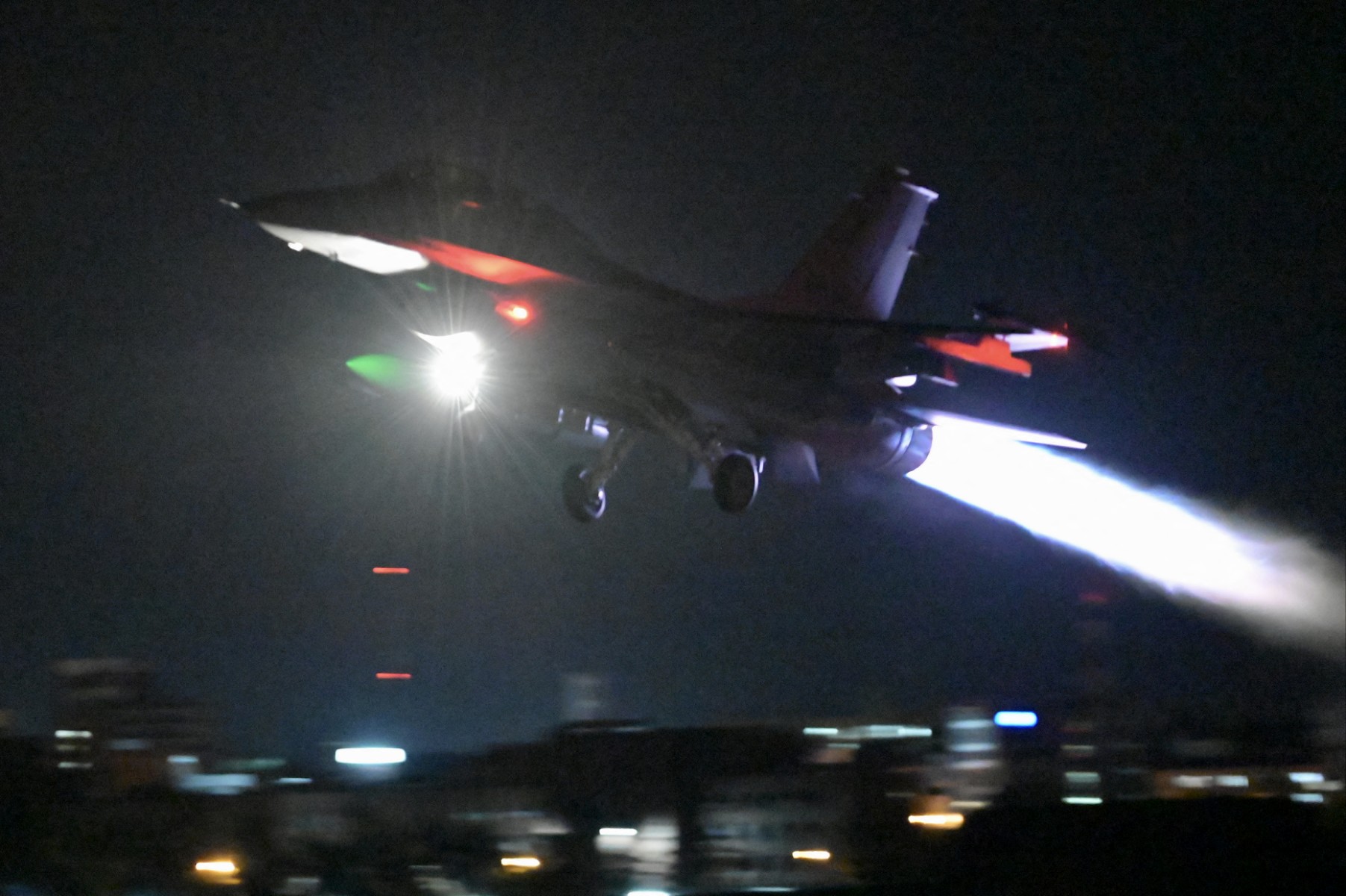
The first two of the 66 F-16V Block 70 fighter jets departed Lockheed Martin’s South Carolina factory on August 17 and are expected to arrive in Taiwan shortly, Taiwanese media reported, citing informed sources.
Photographs of the single-seat jets, tail No. 6727 and 6728, were posted by a plane spotting enthusiast on Facebook.
The aircraft were seen outfitted with conformal fuel tanks, three underwing fuel tanks, and cargo pods under the wings, for their journey to Taiwan. This means they would be refueled mid-air and make maintenance stops throughout the trans-Pacific journey to meet the pilots’ physical requirements and the aircraft’s range limitations.
“A major milestone for Taiwan’s air defense and the Taiwan-U.S. security partnership. The first two F-16V Block 70s are on their way home. Strengthening our capabilities strengthens deterrence and helps preserve peace across the Taiwan Strait,” Wang Ting-yu, a Taiwanese lawmaker and Senior member of the Foreign Affairs & National Defense Committee, wrote on X, in response to the news.
The development comes months after Taiwan’s Defense Minister Wellington Koo told the press in January 2026 that Lockheed Martin was working on 46 single-seat and 10 twin-seat F-16V Block 70 jets for Taiwan.

The jets will be deployed at Chihhang Air Base in Taitung County and operated by the air force’s 7th Tactical Fighter Wing to defend Taiwan’s eastern region.
Located at the eastern coast of the self-ruled island, the Chihhang Air Base is known for its fortified underground facilities, including aircraft shelters carved into mountainsides.
Taiwan has been building new aircraft shelters in the Eastern region, as disclosed in a Ministry of National Defense’s 2026 budget plan last year. The project reportedly included provisions for 24 hangars, taxiways, and auxiliary facilities at Taitung’s Chihhang Air Base, as EurAsian Times reported at the time. The Air Force Command reportedly announced that the new hangars and other facilities are being designed to aid maintenance and training, and to support personnel as the F-16V fleet expands.
It is pertinent to note that the F-16V (Viper)—both the upgraded older airframes and the new-build Block 70s now beginning to arrive—is the most advanced combat aircraft in the Republic of China Air Force (ROCAF/Taiwanese Air Force) inventory, and it represents Taiwan’s strongest fighter capability against the People’s Liberation Army Air Force (PLAAF).
F-16 Viper: Taiwan’s Best Bet Against China
The PLAAF boasts some of the world’s most potent fighter jets, including the fifth-generation J-20 and J-35A stealth aircraft, the J-10C, and the J-16, also known as the world’s “most advanced” Flanker. In addition, China is also testing prototypes of two different sixth-generation fighter designs—the J-36 and the J-50.
For Taiwan, the F-16 Viper is expected to be its most advanced aerial combat asset.
Despite being a fourth-generation fighter, the F-16V has several advanced features. One of the aircraft’s highly sophisticated features is the Northrop Grumman AN/APG-83 Scalable Agile Beam Radar’s (SABR) active electronically scanned array (AESA).
Notably, the sophisticated radar technology increases resilience to electronic countermeasures, extends detection and engagement ranges, and enhances target-spotting capabilities for low-observable targets like cruise missiles.
The F-16V’s unique center pedestal display enhances tactical situational awareness by providing the pilot with access to data from the SABR and other sensors.
Upgrades to the F-16V include a sniper aiming pod, Link 16, a helmet-mounted cueing system, accurate GPS navigation, improved weapon capability, an upgraded modular mission computer, and an Ethernet high-speed data network.
Additionally, the aircraft’s wings, fuselage, and landing gear have undergone several structural improvements that have enhanced its sustainability and utility. It also allows a higher takeoff and landing weight than its predecessor, the F-16 A/B variant.
Unlike the older F-16s, which had an 8,000-hour service life, newly built F-16Vs will have a 12,000-hour service life.
Not just that, the improved F-16V fleet’s armament is more versatile and can carry heavier weapon payloads. These include more sophisticated weapons like the AGM-88 High-Speed Anti-Radiation (HARM) missile for defense suppression and the AGM-154 Joint Stand-Off Weapon (JSOW) for precision strikes, as well as the AGM-84 Harpoon missile, which is well known for its effectiveness in anti-shipping operations.
The AGM-154 Joint Standoff Weapon (JSOW) has a range of about 112 kilometers. Once integrated with the F-16s, the missile will boost Taiwan’s air fleet as it prepares to stave off a potential Chinese invasion.
Taiwan is also reportedly buying the JASSM, a highly precise and durable missile that is more resistant to electronic warfare, including GPS jamming.
Experts believe the J-20 and J-35’s stealth characteristics could make it harder for the Taiwanese F-16V to identify and attack PLAAF jets, potentially giving Chinese fighters an advantage in aerial combat. These concerns were exacerbated by reports that a J-20 flew undetected miles away from Taiwan during the recent military drills.
To counter this edge, the Pentagon approved the sale of infrared search and track (IRST) systems to Taiwan in 2023, expected to allow the F-16s to detect Chinese stealth fighters at long range. Unlike radar, which uses radio wave reflections to detect targets, IRST uses thermal signals emitted by its target. While stealth aircraft have low radar observability, they cannot completely eliminate infrared radiation.
Chinese experts believe that the J-20 would outperform the Taiwanese F-16 Vipers in beyond-visual-range combat with the help of its stealth, radar capabilities, and long-range missiles.
In contrast, Taiwan’s Deputy Defense Minister Po Horng-huei, a retired pilot himself, stated in March 2024 that Taiwan maintains “absolute air superiority” over China within its own airspace, citing the island’s robust air defense systems and firepower.
In December 2025, a Taiwanese F-16V monitored a Chinese J-16 fighter jet using the AN/AAQ-33 “Sniper Advanced Calibration Pod,” and obscured and cropped key parameter data, as EurAsian Times reported. Thus, demonstrating the ability to track Chinese jets.
At the time, Su Tzu-yun, director at Taiwan’s Institute for National Defense and Security Research (INDSR), said the Sniper pod’s passive nature means a PLAAF aircraft “may be unable to detect” being targeted from the rear or side. This “symbolizes that even with powerful electronic warfare capabilities, the [Taiwan] Air Force can effectively crack” them.
After locking the fighter jet, the ROCAF’s F-16V could launch an AIM-9X Sidewinder air-to-air missile (AAM) to shoot down the enemy aircraft. Furthermore, Su Tzu-yun also stated that the F-16V Block 70’s APG-83 AESA radar gives it an “over 60% probability” of detecting J-20 or J-35 stealth fighters, as the radar was developed for small radar cross-section targets and offers superior sensitivity compared to older systems.
Separately, retired ROCAF F-16 seed instructor Huang Yang-te has stated that the J-20’s incomplete stealth technology gives it “no advantage” against an F-16V Block 70 equipped with APG-83 AESA radar and IRST, which can “catch” the J-20’s track and allow countermeasures.
He has repeatedly argued the J-20 is optimized more for opposing F-35s than Taiwan’s F-16Vs, which may present a unique opportunity to the Taiwanese Air Force.
- Contact the author at sakshi.tiwari13 (at) outlook.com
- Follow EurAsian Times on Google News