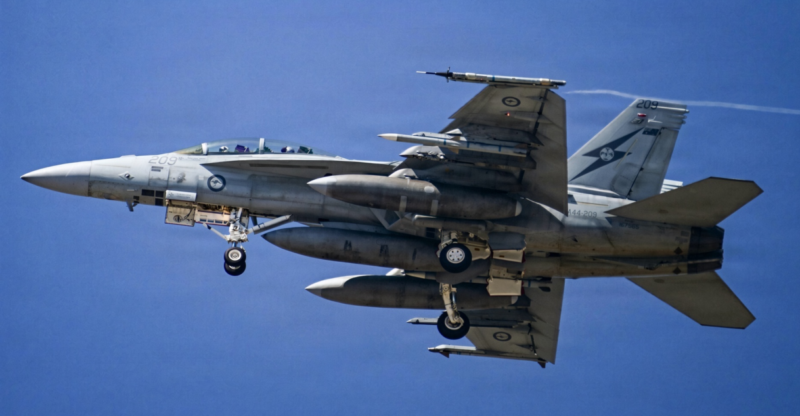
A Royal Australian Air Force (RAAF) F/A-18F Super Hornet was pictured carrying an AIM-260 Joint Advanced Tactical Missile (JATM) during a US test event in California. The development comes weeks after RAAF said it would become the first operator, outside the US, of the JATMs.
The image, clicked on Sept. 11 at Naval Base Ventura County Point Mugu and released by the U.S. Navy, shows aircraft A44-209 of No. 1 Squadron during Exercise Gray Flag 2026. However, the missile’s ownership remains unconfirmed.
The Navy caption does not name the weapon. Analysts identified the weapon as an AIM-260 training round, citing blue bands that mark an inert motor or warhead. No live firing was reported. The sortie appears to have been a captive-carry flight.
Earlier, as EurAsian Times reported, Australian Defense Minister Richard Marles said at Exercise Pitch Black on 6 August that Australia would invest almost A$736 million, about $518 million, to buy the missile through US foreign military sales.
Canberra did not say how many rounds that sum would buy. A separate U.S. notification in March covered a possible sale of up to 450 AIM-260s, plus test vehicles, estimated at $3.16 billion.
“This announcement is the latest milestone in the delivery of long-range, high‑tech capabilities for our Defense Force,” Marles said in Darwin. “The Albanese government continues to deliver critical capabilities that will allow the ADF to strike at a longer range, deter any adversary, and protect our national interests. It is fitting to make this announcement at Exercise Pitch Black, which is an important demonstration of Australia’s commitment to the peace, stability, and security of our region.”
Australia will integrate the missile first on the F/A-18F, then on the F-35A and the EA-18G Growler. Canberra said Australia would be the first country to field the AIM-260 outside the United States, and that it would complement existing air-to-air missiles.
“The acquisition of the AIM-260 JATM will provide Air Force platforms with a credible deterrent against airborne targets, complementing existing air-to-air missile capabilities and other surface-based missile capabilities across the Australian Defense Force (ADF). It will also further enhance Australia’s interoperability with the United States,” the Australian Department of Defense earlier said in a statement.
The existence of the AIM-260 JATM was initially confirmed in 2019 during an Air Force Life Cycle Management Center industry conference. Because of its sensitivity, the AIM-260 JATM is classified as a Special Access Program (SAP), and details have remained mostly classified.
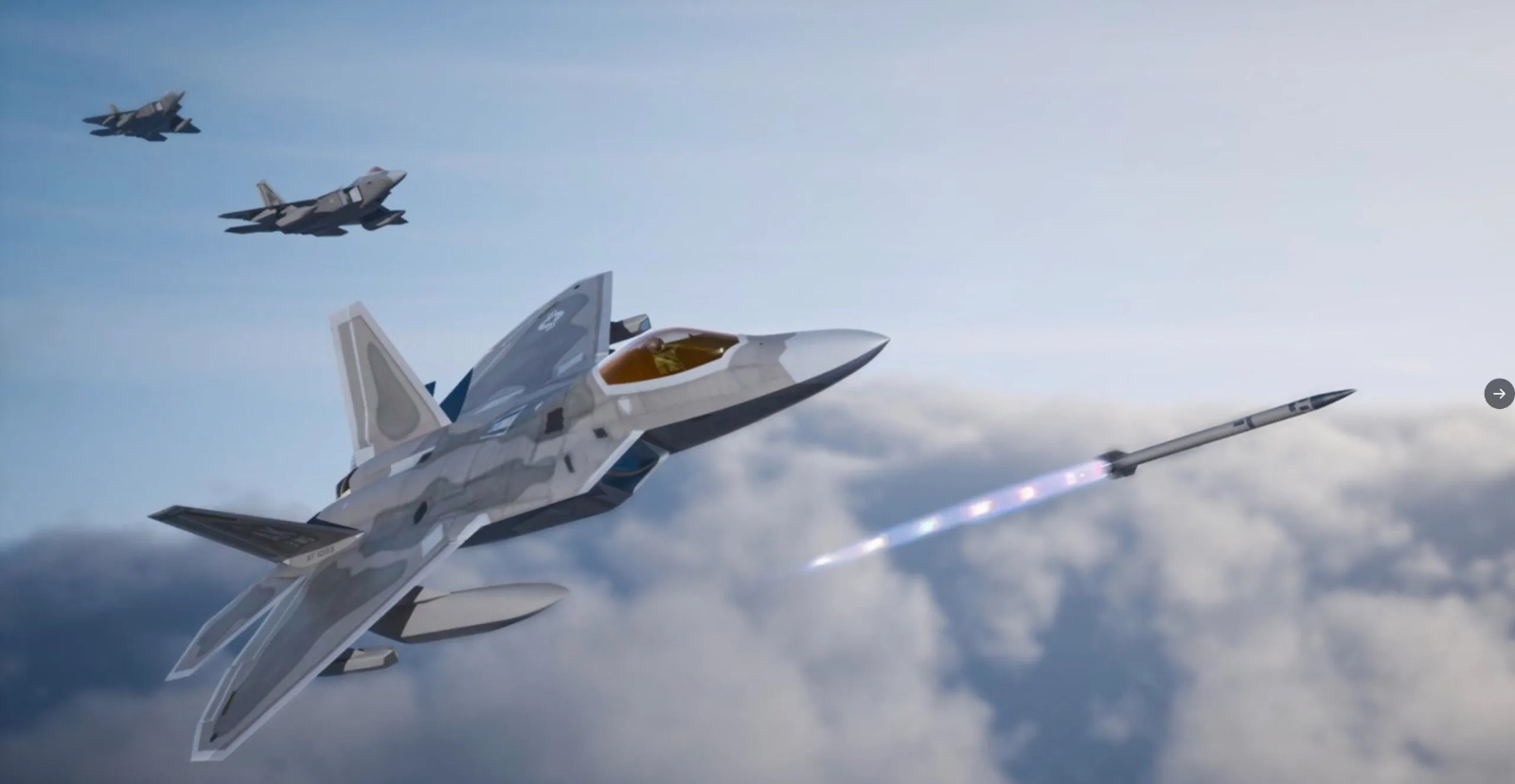
In 2022, General Mark Kelly, the head of the United States Air Force’s Air Combat Command, shared an artist’s concept of the Lockheed Martin F-22 firing an AIM-260 JATM.
More recently, the US Navy publicly revealed the rendering of the missile in February 2025. At the time, experts said it looked similar to the AIM-120 medium-range air-to-air missile.
Nonetheless, the AIM-260 appears to have a larger rocket motor section and no mid-body surfaces, unlike the AIM-120. Although little is known about the JATM, reports suggest it will use dual-pulse rocket motors or ramjets to increase range and performance.
The AIM-260 could carry an advanced multi-mode seeker system that may include infrared imaging and active radar. The dual-seeker system could improve resilience to electronic warfare countermeasures and increase accuracy.
Like the AIM-120D-3 AMRAAM derivative, the AIM-260 is anticipated to have a two-way datalink. This feature would greatly increase the missile’s efficacy in networked battle by enabling mid-course targeting upgrades or re-targeting.
The planned US sequence has the AIM-260 entering service first on the F-22 Raptors, then the F-35s and the Navy’s F/A-18E/F. Australia intends to integrate it on the F/A-18F before the F-35A and EA-18G.
US Arms Australia
The Indo-Pacific landscape is rapidly changing, with China emerging as a global military power and intimidating its neighbors. Although not an immediate neighbor, Australia is also concerned by Beijing’s growing military might and ambitions.
Australia has emerged as one of America’s strongest military partners. At the heart of this security architecture is the AUKUS submarine pact, signed alongside the UK.
Under this pact, Australia will acquire a fleet of nuclear-powered (not nuclear-armed) submarines. Nuclear propulsion would give the Australian Navy unparalleled stealth, range, and endurance, allowing it to operate deep within contested waters without surfacing for oxygen, as conventional submarines do.
Washington is also strengthening Australia’s strike capabilities. The RAAF has also acquired F-35 stealth jets, ensuring seamless interoperability with the US military and allies like Japan.
To complement these platforms, Washington has approved the sale of advanced long-range strike weapons, including Tomahawk cruise missiles, HIMARS, and AGM-158B JASSM-ER missiles. These weapons effectively shift Australia’s military posture from territorial defense to robust power projection.
The US is boosting Australia’s capabilities to establish domestic guided-missile manufacturing, securing a resilient supply chain outside the American mainland. Increased rotations of US bombers, maritime patrol aircraft, and troops to northern Australian military bases further cement this partnership.
While Washington and Canberra frame these advancements as essential steps to maintain a “free and open Indo-Pacific,” Beijing views the militarisation as an encirclement strategy. By arming Australia with these cutting-edge capabilities, the US is ensuring that any potential conflict in the region would face a highly sophisticated and unified allied front.
- By ET Online Desk
- Mail us at: editor (at) eurasiantimes.com