After a long period of uncertainty and an ice-thin contest with Northrop Grumman, Boeing has won the US Navy’s F/A-XX next-generation carrier-based fighter contract, making it the sole developer of America’s crewed sixth-generation combat jets, after F-47.
On September 29, the Department of War awarded Boeing a $20 billion contract for the F/A-XX’s full-scale development phase. The contract covers multiple test aircraft for ground, airworthiness, systems, and weapons integration testing.
“The F/A-XX is a critical pillar in our commitment to maintaining peace through strength. F/A-XX will dominate contested airspace, extend operational reach, and deliver a decisive combat advantage for the warfighter,” Michael P. Duffey, Under Secretary of War for Acquisition and Sustainment, was quoted as saying in the official statement.
Boeing had already secured the Air Force’s F-47 program in March 2025, defeating Lockheed Martin—the company behind both of the service’s fifth-generation fighters, the F-22 Raptor and F-35 Lightning II.
Responding to the Navy award, Steve Parker, president and CEO of Boeing Defense, Space & Security, stated: “Delivering two advanced fighters in parallel was always our plan, and we invested accordingly. We are ready and able to build multiple concurrent future combat aircraft franchise programs.”
The decision ends nearly a year of ambiguity surrounding the F/A-XX, which will eventually replace the F/A-18E/F Super Hornets in US Navy service since the 1990s. Last year, the Pentagon said it was prioritizing the F-47 over the F/A-XX, and asked the House and Senate defense policy committees to divert $500 million from the “accelerated development” of a Navy stealth fighter to the F-47.
However, the US Navy’s leadership and Congress pushed back against the Pentagon and called for increased funding and award of the contract.
In January 2026, the House and Senate Appropriations Committees negotiated a draft defense spending bill that earmarked nearly $900 million for the F/A-XX, a stark increase from the $74 million the Pentagon sought.

Naval officials and analysts made the case for the F/A-XX by pointing to its utility amid the burgeoning threat from China in the Indo-Pacific theatre. Rep. Ken Calvert, R-Calif., the head of the House Appropriations subcommittee on defense, said, “We need sixth-generation fighters. The US Navy needs sixth-generation fighters. I’m concerned that any hesitancy on our part to proceed with the planned procurement of the sixth-gen fighters for the Navy will leave us dangerously outmatched in a China fight.”
Meanwhile, Daniel Cheever, Commander of Naval Air Forces, was quoted saying: “I’m looking forward to [the F/A-XX] because that sixth-generation means air superiority in that timeframe in the future, which means sea control. And as long as you have air superiority, you have sea control around the globe.”
Beijing has been flying two different prototypes of sixth-generation fighters—the J-36 and the J-50—one of which could possibly evolve into a carrier-based sixth-generation fighter aircraft. This sparked concerns across the US Navy that the service that fielded the world’s first-ever carrier-capable stealth fighter may lose out on this crucial race.
“This achievement marks a new era for the US Navy,” said acting Secretary of the Navy Hung Cao. “The Sixth-Generation fighter is a generational leap in air superiority and will provide the world’s best aviators with unparalleled capabilities to fight, win, and come home safe. We are excited to partner with Boeing, and for our warfighters to continue to dominate the skies and defeat our nation’s enemies.”
Unlike the USAF NGAD program, the US Navy has released little information on a futuristic F/A-XX, although authorities have said the F/A-XX will have a longer range than current aircraft and serve as a covert tip of the spear for the carrier air wing. In addition, the F/A-XX will be interoperable with manned and unmanned platforms such as Collaborative Combat Aircraft (CCA) and increase the capability of every CCA it teams with.
However, a pressing question experts have been discussing after the award was presented to Boeing is whether the naval fighter will be a navalized variant of the F-47, or the aerospace giant will build a new fighter from the ground up.
F/A-XX vs F-47
Boeing can leverage relevant production experience, supply chains, and design work it has already completed for the F-47 program.
Many aviation enthusiasts have wondered if Boeing will produce the F/A-XX as a navalized version of the F-47; the two aircraft are built for fundamentally different environments and missions, which will influence their design differences.
The F-47 is a land-based air-superiority fighter focused on speed, altitude, long-range penetration, and counter-air roles to succeed the F-22, whereas the F/A-XX is a carrier-based multirole strike fighter to replace the F/A-18E/F Super Hornet and EA-18G Growler.
This distinction means that the naval F/A-XX next-generation fighter jet must be designed for catapult launches, arrested landings, folding wings for carrier storage, saltwater corrosion resistance, and high sortie rates in a maritime environment, while prioritizing range for Pacific operations and multirole strike capability.

Notably, several past studies examined a joint sixth-generation solution and concluded it was unworkable. For this reason, the USAF and the Navy formally split their paths and decided to pursue separate programs based on specific requirements.
The US Navy has consistently asserted that its fighter will have a separate airframe from the Air Force, rejecting the joint approach controversially used for the F-35 program for many practical reasons.
The Navy’s carrier version, the F-35C, required extensive modifications from the USAF’s F-35A baseline, including a larger wing area, stronger landing gear and structure, folding wingtips, a tailhook, corrosion-resistant materials and coatings, and revised fuel and internal arrangements. The changes added weight, cost, and complexity, contributing to schedule delays and performance compromises.
When every percentage of range, stealth, and kinematic performance matters against near-peer threats such as China, the structural and aerodynamic penalties of carrier suitability become more painful for a pure air-superiority fighter.
That said, the F-47 and F/A-XX may share some basic commonalities, which may even help the US Navy’s next-generation fighter program.
The first question is how quickly a workable F/A-XX can be fielded—which really comes down to how much it draws on the already-developed F-47. If the two designs share much commonality, or were developed together, an F/A-XX could fly much sooner than expected.
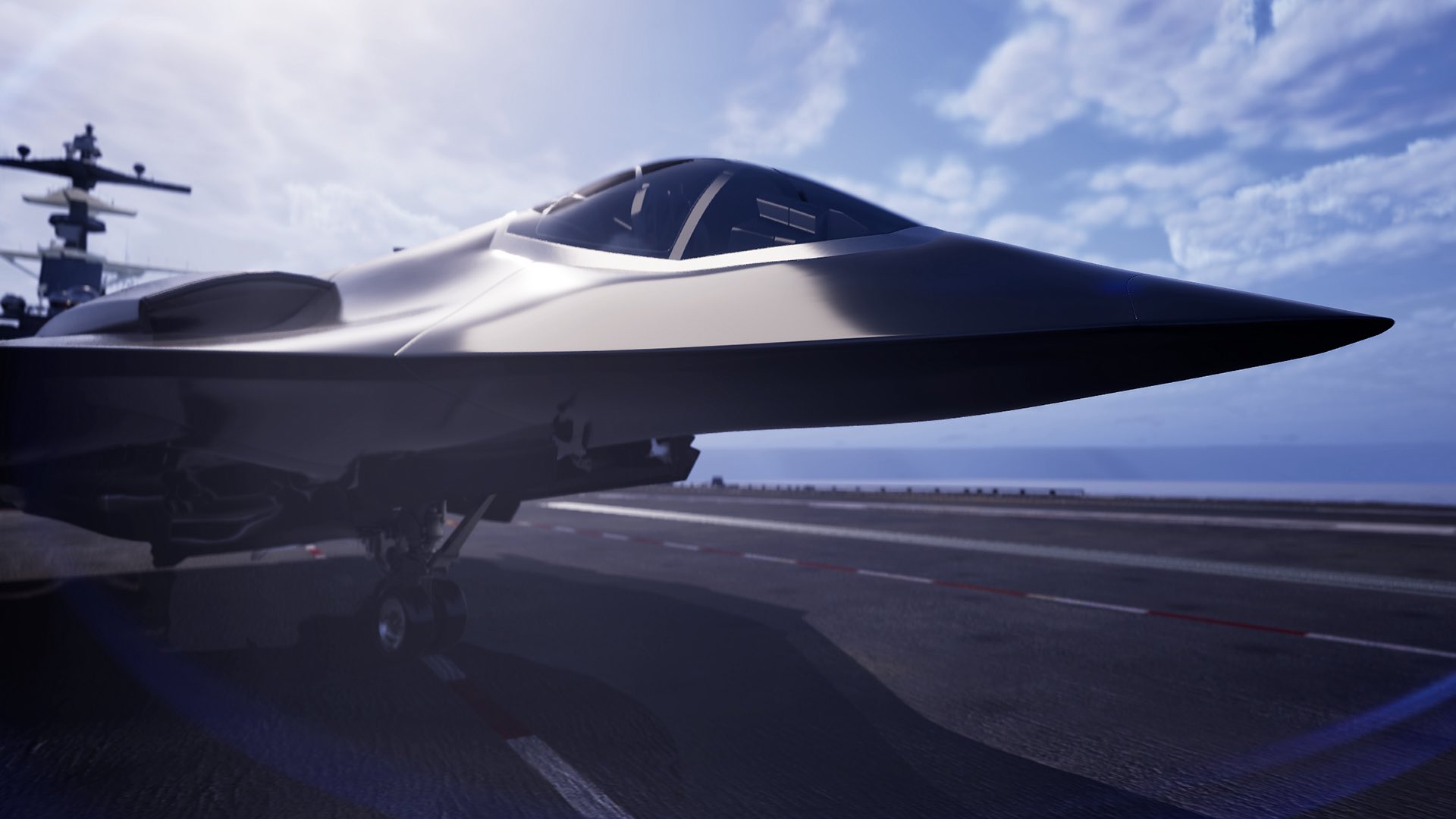
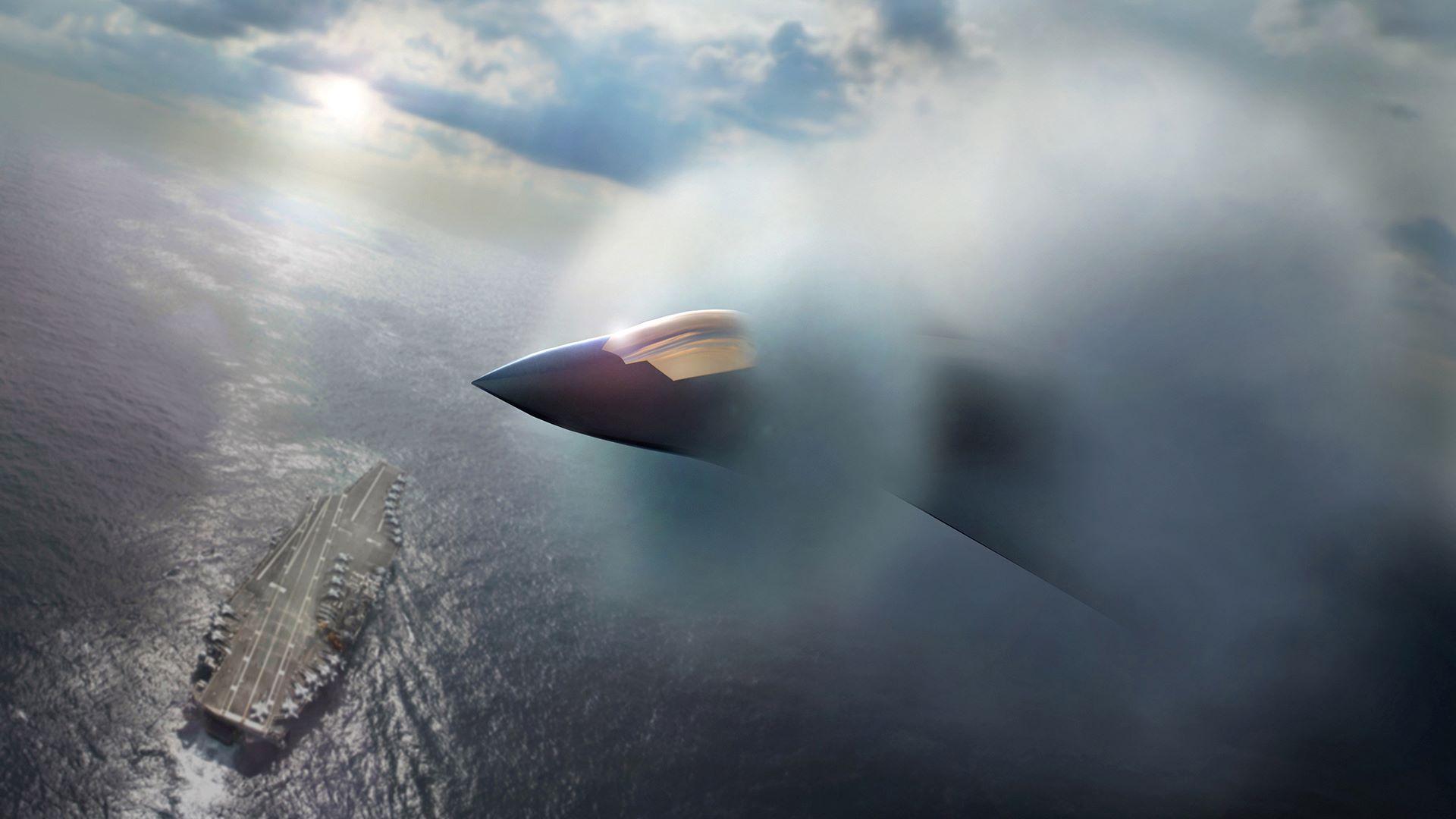
Boeing released F/A-XX concept renderings, including one shown at the 2025 Tailhook Symposium and newer ones after the award, that visually resemble its F-47 concepts in areas such as cockpit shape, overall planform, and possible canard-like foreplanes.
Moreover, the two Boeing designs can share high-value subsystems, sensors, software, open mission systems, Artificial intelligence, or Collaborative Combat Aircraft (CCA) integration, and design philosophy without locking both aircraft into the same airframe.
This level of commonality could offer high cost and risk benefits while preserving optimization.
US Navy’s Fighter Program Trails Yet Again
While the F-47 is on track for its first flight, the F/A-XX has yet to receive a designation, and concerns remain about how Boeing will manage the industrial constraints of pursuing two contemporary programs at the same time.
Air Force Brig. Gen. Timothy Helfrich, the service’s Portfolio Acquisition Executive for Fighters and Advanced Aircraft, recently stated, “We’re not too far away from an F-47 production line, which will be additive to the production capacity.”
By contrast, the F/A-XX is roughly 18 months behind the F-47 in program phase and several years behind in physical hardware maturity.
Boeing has already invested heavily in expanded, secure St. Louis facilities sized for multiple advanced fighters. However, with the F/A-XX, the company will likely face significant industrial constraints developing both aircraft simultaneously while still supporting F-15EX and T-7 production. The company is likely to be constrained by a limited specialized workforce and potential supply-chain bottlenecks.
Against that backdrop, the F-47 will likely receive priority focus first so manufacturing lessons, tooling, supply-chain fixes, and digital production processes can be refined on the Air Force lines before F/A-XX ramps into full-scale assembly in the early 2030s.
Notably, the delay in awarding the F/A-XX contract somewhat mimics a historical pattern of laxity in advancing the US Navy’s fighter jet programs, giving dominant USAF programs more leverage.
The US Navy formally launched the F/A-18E/F Super Hornet program in 1992 as a lower-risk alternative. Although the aircraft made its maiden flight on November 29, 1995, its Engineering and Manufacturing Development (EMD) phase faced intense political scrutiny and budget constraints throughout the mid-to-late 1990s over its effectiveness and cost.
Meanwhile, a comparable multirole fighter for the USAF, the F-15E Strike Eagle, progressed much faster.
Selected for the Dual-Role Fighter program in February 1984, the Strike Eagle flew its first production model on December 11, 1986, and reached Initial Operational Capability (IOC) in September 1989—a full decade before the Super Hornet entered fleet service in 1999 and reached IOC in 2001.
Later, the Joint Program Office-managed F-35 program prioritized the F-35A and F-35B because of their earlier operational needs and less complex technical requirements than the F-35C. In fact, the F-35C carrier variant was the last to achieve Initial Operational Capability (IOC) in 2019, following the F-35A (2016) and the F-35B (2015).
Since both contracts are now with Boeing, whether this historical pattern will reverse or shrink remains to be seen.
- Contact the author at sakshi.tiwari13 (at) outlook.com
- Follow EurAsian Times on Google News