Once pitched to India under the MRFA contract, five Boeing F-15 fighter jets have been confirmed lost since January 2026, all during combat missions.
On 02 March, the United States Air Force (USAF) lost three F-15E Strike Eagles that were shot down and crashed over Kuwait. It was reported as a result of friendly fire. All six crew members safely ejected and were recovered.
On 03 April, a USAF F-15E Strike Eagle was shot down by an Iranian shoulder-fired, heat-seeking missile over western Iran. Once again, both the crew members ejected. They were extracted during a highly coordinated and publicized combat search-and-rescue (CSAR) operation.
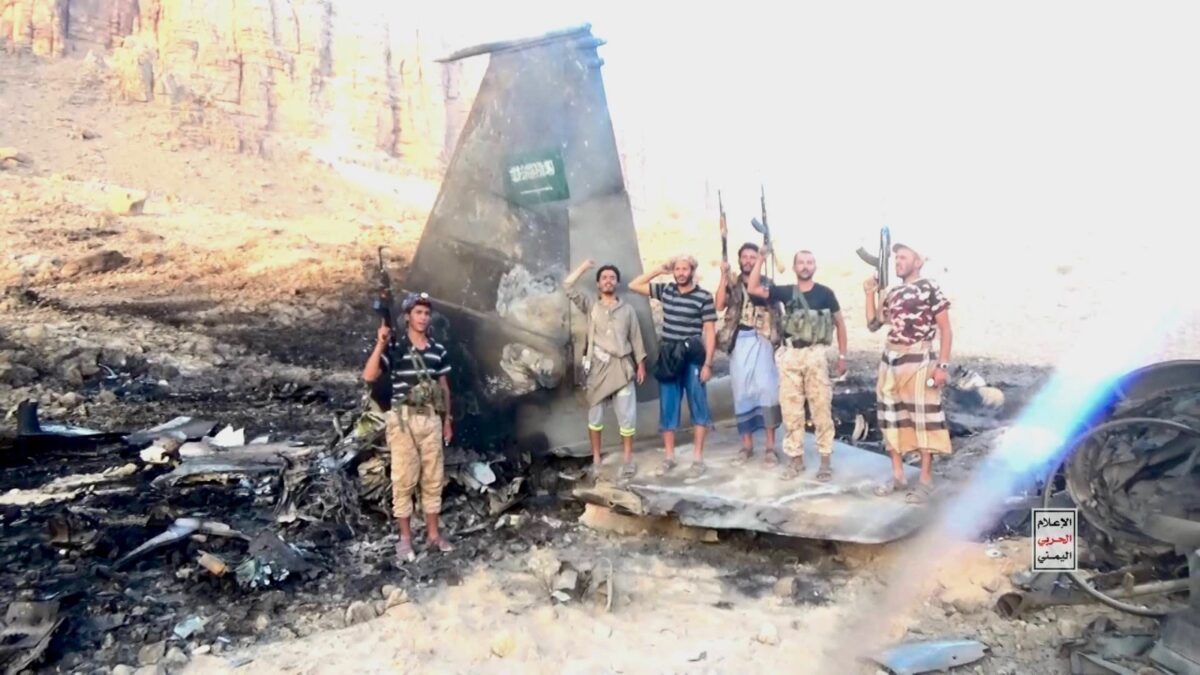
On 15 September, a Royal Saudi Air Force (RSAF) F-15SA crashed after being hit by a surface-to-air missile (SAM) launched by Houthis over the Marib province in Yemen. The Houthis subsequently released footage verifying the burning wreckage at the crash site.
The air forces of the USA, Israel, Japan, South Korea, Qatar, Saudi Arabia, and Singapore operate F-15 variants. More than 1,770 F-15 Eagles have been built across all variants since production began in 1972. The F-15 remains in active production. F-15EX Eagle II is the most advanced variant.
In January 2021, the U.S. government approved the possible sale of the aircraft to India as part of the Indian Air Force’s (IAF) MRFA (Medium Multi-Role Combat Aircraft) tender. Indian firm Dynamatic Technologies already manufactures specific F-15EX aero-structures in Bengaluru.
In April 2026, IAF Chief Air Marshal Amar Preet Singh flew a sortie in the F-15EX Eagle II at Nellis Air Force Base in Nevada during a bilateral visit to the United States, igniting speculations about a possible offer to the IAF. But for various reasons, there has been no further progress on shortlisting the aircraft for purchase.
Ultra-8500 Thermal Camera-cum-Turret AD System
Ansar Allah is the official name of the Houthi movement, a Zaydi Shia political and military organization based in Yemen.
Ansar Allah has traditionally relied on the Forward Looking Infra-Red (FLIR) Ultra-8500 thermal camera. It is a compact, multi-camera, stabilized airborne multi-sensor thermal imaging system designed primarily for law enforcement, patrol, and pursuit operations.
Open-source reporting from 2018 linked some Houthi thermal videos to a FLIR Ultra 8500 turret. That sensor was a compact, stabilized airborne electro-optical/infrared system built mainly for helicopter patrol and law-enforcement work.
In 2009, the Pentagon’s DSCA approved a Pseudo-FMS package to upgrade Yemeni Bell Huey II helicopters. The package listed three Ultra 8500 turrets, or equivalent, from what is now Teledyne FLIR. After the Yemeni civil war began, Houthi engineers were assessed to have captured and reused high-end thermal turrets on the ground, pairing passive optics with converted Soviet air-to-air missiles such as the R-27T, R-60, and R-73. That reconstruction explained the 2017–18 engagement videos.
It is not proven as the fire-control chain for the September 2026 Marib shoot-down. A typical airborne FLIR can detect a person at a few kilometers and a vehicle at roughly 8–15 km, depending on optics, weather, and altitude. Published Ultra 8500 look-up ranges against an F-15-class fighter are not in the public specification.
Treating 20–30 km as a measured figure would be a guess. For the 2026 clip, Ansar Allah said only that a locally manufactured SAM was used. Video analysis of the new engagement has focused on a missile that flew about 24 seconds before detonation.
That flight time sits poorly with short-burn missiles such as the R-73 or R-60 and better matches a medium-range interceptor. Candidates discussed by analysts include Houthi/Iranian systems in the Barq family and, less securely, an R-27-derived Thaqib-2. The sensor in the new video has also been compared with newer Iranian electro-optical trackers, not only the 2009 Ultra 8500.
The Houthi military spokespersons stated that the F-15 fighter jet was carrying out hostile air operations and supporting military mobilizations against Houthi forces. Houthi rebels claimed they shot down the aircraft using a locally manufactured SAM.
The pilot reportedly made a sharp maneuver at first. Perhaps his aircraft, or he himself, detected a threat. The RSAF-operated F-15SA carries the British BAE Systems AN/AAR-57 Common Missile Warning System (CMWS).
It provides real-time threat detection, hostile fire indication, and automated countermeasure cueing for over 40 types of fixed-wing and rotary-wing aircraft. It automatically detects infrared (IR) and radio-frequency (RF) guided missiles, unguided munitions, and incoming hostile fire.
The system is designed to automatically activate and dispense chaff and flares from its AN/ALE-47 Airborne Countermeasures Dispenser System, as well as advanced laser-based Directed Infrared Countermeasure (DIRCM) systems.
The RSAF F-15SA also carries the BAE Systems AN/ALQ-239 Digital Electronic Warfare System (DEWS), or advanced Radar Warning Receiver (RWR), designed to provide warning of radar-guided threats by detecting hostile radar emissions and radar lock-on. It is a fully integrated, all-digital EW suite. It provides all-aspect, broadband 360-degree radar warning and threat geolocation. It utilizes digital radio frequency memory (DRFM) jamming.
The pilot would have released chaff to deceive hostile radars. Against an IR missile threat, the chaff can actually enhance the IR signature when warmed by the aircraft exhaust.
If the aircraft had released flares, the same would have appeared in the IR video released by the Houthis and, of course, would have been more effective. There is also indication that the pilot tried to speed away to shrink the missile envelope. In the process, he reportedly engaged afterburner, which would have greatly increased the IR signature.
The video analysts have calculated that the Yemeni missile flew for 24 seconds before exploding. The R-27T travels at 5,556 km/h, or 1,500 meters per second. That would have been a 36 km-range kill. If it were an R-73, then the speed would be 850 meters per second, and the range would be around a 20-kilometer kill.
The R-73 has a motor burnout time of only 5.5 seconds and a max range of 30 kilometers, which would be reduced if fired vertically. The R-27T has a maximum range of up to 60 kilometers and, by conjecture, may have been the likely missile.
Boeing F-15 EX Eagle II on Offer to India
The Boeing advertises its F-15EX Eagle II by saying, “With a payload capacity of 29,500 lbs. (13,300 kg) – including outsized weapons – the F-15EX delivers affordable mass to address rapidly evolving threats. Combined with range, contemporary sensors, and an advanced electronic warfare suite, the F-15EX presents peer adversaries with multiple challenges both inside and outside threat rings.
They claim that the F-15EX can shoot from a significantly increased range – farther than any other fighter in the U.S. Air Force arsenal – and provides the unique capability of holding 12 AMRAAMs or other large ordnance. It prides itself on an electronic warfare suite that doesn’t require pods that take away weapon stations.
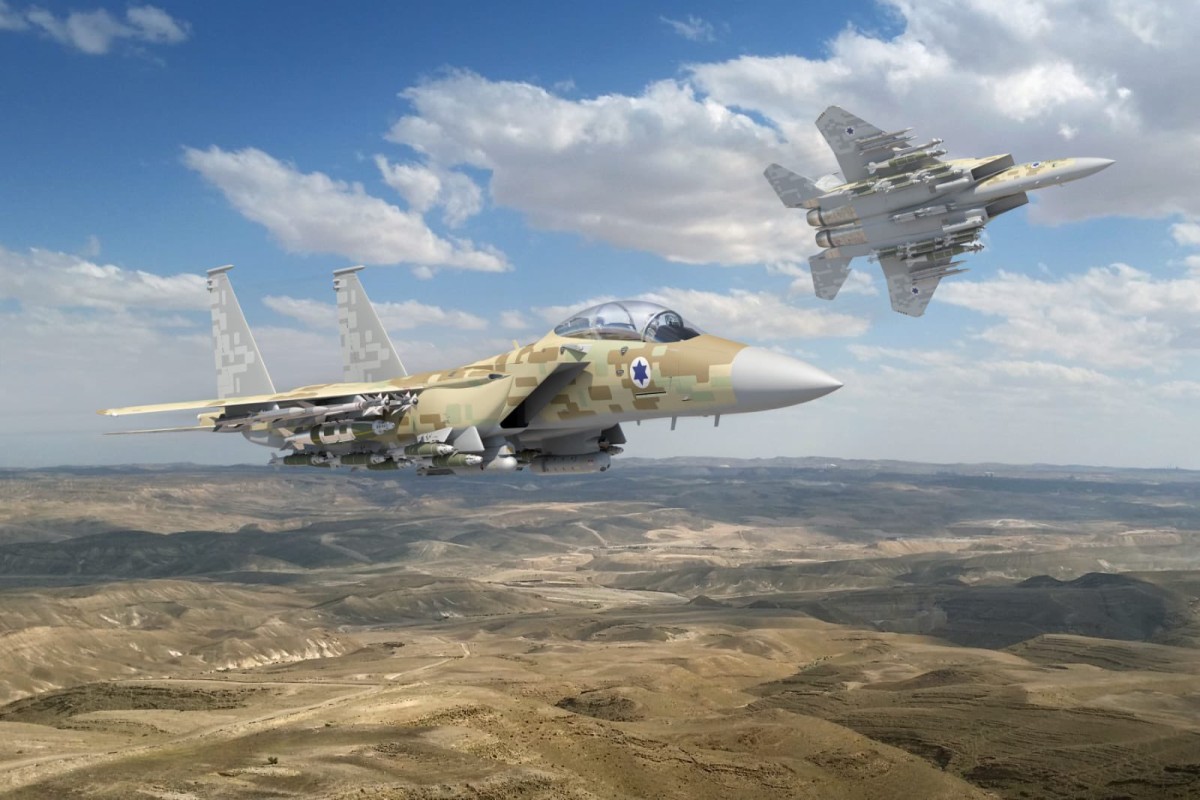
At 36,741 kg max take-off weight, this twin-cockpit aircraft is considered large and is interestingly quite close to the Su-30MKI with a max take-off weight of 38,800 kg. It can carry 13,300 kg of ordnance, compared with 8,130 kg on the Su-30MKI.
The multirole strike fighter has been derived from the McDonnell Douglas F-15E Strike Eagle. The program gained impetus when the US government saw delays in the F-35 program and, as part of cost management vis-à-vis capability management, cut Lockheed F-22 numbers.
The F-15EX is a member of the F-15 Advanced Eagle family of aircraft, a further development of the F-15E, with upgrades beginning in 2011 for Saudi Arabia and Qatar. The first F-15EX was delivered in 2021 and entered full operational service in July 2024. The U.S. had earlier ordered 104 jets. Based on official numbers, the U.S. has received roughly 22 to 25 of the now-expanded plan of 267 aircraft.
The Israeli Air Force ordered 25 F-15IA fighters based on the F-15EX and had planned to upgrade 25 F-15Is to the F-15IA standard. First deliveries are scheduled to begin in 2031, at the rate of 4 to 6 aircraft per year until the contract concludes in 2035.
The F-15EX was not an ideal contender for India due to a combination of issues, including high costs, logistical complications of multiple fleets, geopolitical constraints, a recent trust deficit with the USA, and a preference for indigenous development.
The F-15EX carries a very high price tag for acquisition and lifecycle maintenance, rivaling or exceeding other heavy multirole competitors.
The flyaway price is reportedly between $94M – $97M per jet, and it costs $29,000 per operating hour. It remains a 4.5-generation fighter.
The IAF already operates a complex, mixed inventory of Russian, French, and domestic fighter aircraft. Introducing a completely new American heavy platform would add an extra logistics and training burden.
India already relies heavily on the twin-engine Su-30MKI as its primary heavy air-superiority and strike fighter, reducing the urgent operational need for another large platform with a similar role.
United States defense sales often come with strict end-user monitoring, operational clauses, and legislative strings attached that can limit how or where equipment is deployed during strategic contingencies. India’s defense procurement heavily prioritizes deep technology transfer and domestic manufacturing under the Make in India initiative, while French competitors like the Rafale offer much better deals. Even Russia is willing to offer the fifth-generation Sukhoi Su-57 at a cheaper price ($7 billion for 40 aircraft with full make-in-India ToT).
Pouring massive financial resources into importing the F-15EX could divert funding and attention away from domestic military projects like the Tejas LCA and the planned fifth-generation AMCA (Advanced Medium Combat Aircraft).
Additionally, despite Boeing’s pitch to the IAF, the F-15EX was never a serious contender like the Rafale or even Eurofighters, as India was apprehensive about permitting the US into its fighter-jet ecosystem. India already operated the Su-30MKI, and it had no requirement for another air-superiority aircraft.
Out of all the aircraft pitched to India under MRFA, i.e., Rafale, Eurofighter, Gripen, F-15EX, F/A-18 Super Hornet, F-21, Su-35, MiG-35, we could conclude that 4 jets were unofficially out of the race even before they started: the Russian Su-35 & MiG-35 and American F-15EX, F/A-18 Super Hornet.
To Summarise
The fact that F-15SA-class aircraft are being shot down by a militant group that is being supported by older Iranian technologies is questioning the efficacy of modern fighters even in a less contested environment.
Houthi rebels have successfully shot down multiple U.S. MQ-9 Reaper drones, with reports indicating at least 7 to over 10 confirmed or claimed during recent escalations and regional conflicts. The US military has lost at least 45 MQ-9 Reaper drones during the ongoing conflict with Iran in the Middle East.
The question being asked is that, with nearly 260 Su-30 MKIs, which make up over 40 percent of the IAF’s fighter fleet of similar size class, and with their planned upgrade, does the IAF require more aircraft of that weight and size? India already has the know-how and ability to modify the aircraft and integrate Indian weapons.
At this point, F-15EX would be meaningless for India. IAF needs a fifth-gen aircraft, ideally indigenous AMCA or a jet with full tech transfer like the Su-57.
- Air Marshal Anil Chopra (Retired) is an Indian Air Force veteran, fighter test pilot, and ex-director-general of the Center for Air Power Studies. He has been decorated with gallantry and distinguished service medals during his 40-year tenure in the IAF.
- He tweets @Chopsyturvey
- Follow EurAsian Times on Google News