The surge in low-cost drones has upended traditional air-defense economics, driving a global pivot toward cost-effective laser-guided rockets. The latest nation to embrace this solution is Saudi Arabia, which recently secured US approval to purchase 20,000 APKWS II laser-guided rockets.
The US State Department approved a potential $1.96 billion arms sale to Saudi Arabia, including 10,000 Advanced Precision Kill Weapon System (APKWS-II) air-to-air guidance sections and up to 10,000 APKWS-II air-to-ground guidance sections, according to an official notification published on July 15.
Additionally, the package includes a host of non-major defense equipment items, including LAU-131 A/A launchers, Mk-152 high-explosive warheads, MK66 rocket motors, proximity fuzes, WTU-1/B practice warheads, and inert MK66 rocket motors, among other things.
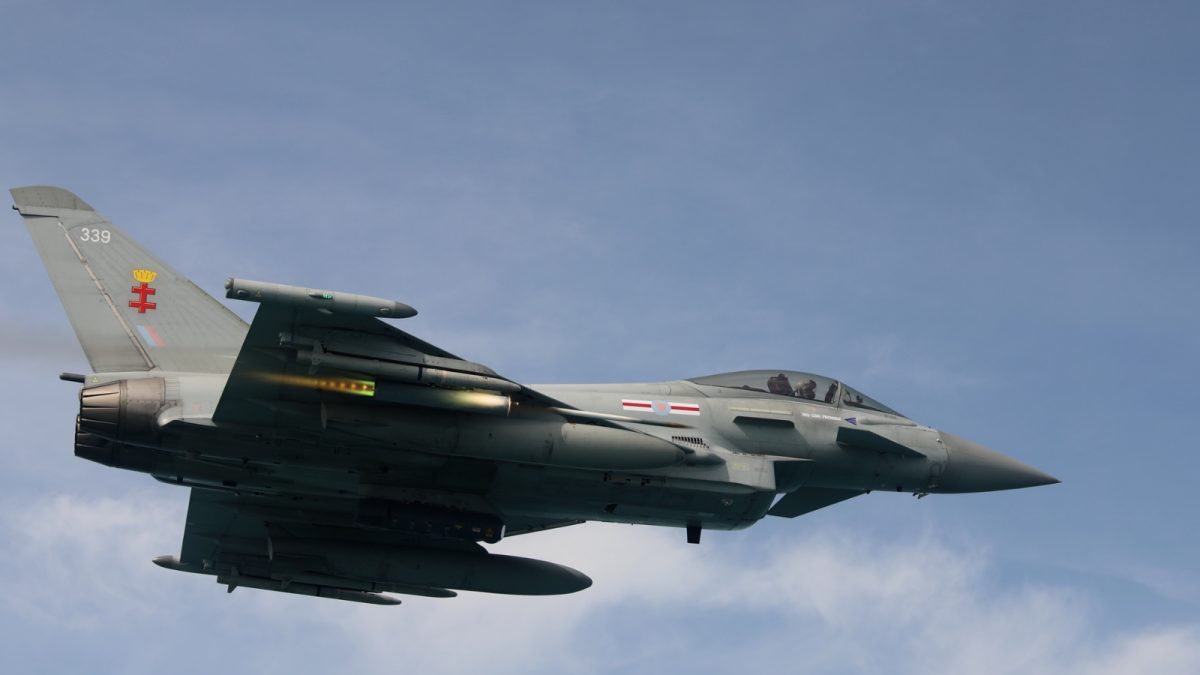
Interestingly, Saudi Arabia has not yet disclosed which aircraft will integrate the APKWS II, but the US Air Force (USAF) and the Royal Air Force (RAF) have already integrated the weapon into their F-15s and Eurofighters, respectively, creating a model for others to follow.
The Royal Saudi Air Force (RSAF) could, in fact, mount the weapon on both the F-15SA and the Eurofighters in its inventory.
“This proposed sale will support the foreign policy and national security objectives of the United States by improving the security of a Major non-NATO Ally that is a force for political stability and economic progress in the Gulf Region,” the US State Department stated.
Saudi Arabia seems to have been spared by the Iranian IRGC (Islamic Revolutionary Guard Corps) in the latest round of escalation that has mainly targeted Kuwait and Jordan. However, the Prince Sultan Airbase in Saudi Arabia, which hosts US personnel and assets, was attacked multiple times during the initial phase of the 40-day US-Iran war.
The latest bout of tensions between Saudi Arabia and Yemen-based Houthi rebels has further complicated Riyadh’s security calculus.
Since 2015, a Saudi–UAE-led coalition supporting Yemen’s recognized government has fought a grinding conflict against the Houthis, who seized much of northern Yemen, including the capital Sanaa.
While a truce brokered in 2022 offered a brief respite, it has remained tenuous and now seems to be on the verge of unraveling amid renewed tensions. On July 13, for instance, the Houthis launched ballistic missiles and drones targeting Abha International Airport and military bases in southern Saudi Arabia in response to the Yemeni government and Saudi Arabia’s attempts to block the landing of an Iranian plane at Sanaa airport.
Both Iran and the Houthis boast a massive arsenal of cheap, one-way attack drones that pose a massive threat to military and civilian assets and are expensive to take down using advanced, precision interceptors.
The purchase of APKWS II, therefore, is meant to balance the economy of modern warfare.
Typically, cheap laser-guided rockets — such as the APKWS II — provide pilots with a more proportionate alternative for swatting drones while allowing them to reserve expensive interceptors for faster, more sophisticated threats on a dynamic battlefield. This could be particularly crucial when dealing with large-scale drone attacks or swarms, as evident in the current conflict raging in the region, because using expensive missiles against low-cost targets quickly depletes supplies and becomes economically unsustainable.
Moreover, the laser-guided rockets also provide an aircraft with vital magazine depth. A Saudi fighter loaded with multiple rocket pods can carry dozens of rounds, allowing it to remain on station for extended periods and engage multiple drones in a single mission—turning the jet into an efficient drone-killing asset.
The Advanced Precision Kill Weapon System (APKWS), designated as AGR-20 or APKWS II, is a laser-guided rocket system developed primarily by BAE Systems in collaboration with the US. It transforms standard unguided Hydra 70 (2.75-inch or 70 mm) rockets into precision-guided munitions by adding a mid-body guidance kit.
The APKWS II originated from a US Army effort in the late 1990s/early 2000s to fill the gap between cheap unguided rockets and expensive missiles like the AGM-114 Hellfire.
It was primarily intended for air-to-ground use on helicopters and later fixed-wing aircraft, enabling precise strikes on lightly armored targets with minimal collateral damage. However, it evolved into a ground-launched anti-drone weapon and an air-to-air weapon.
The US launched the development of an air-to-air-optimized variant—the AGR-20F, or FALCO (Fixed Wing, Air Launched, Counter-Unmanned Aircraft Systems Ordnance)—for the counter-drone role. This variant features a proximity fuze and refined guidance and sensing algorithms, tailored for engaging fast-moving aerial targets such as drones
Notably, the mid-body guidance kit of the APKWS II effectively creates a round that is about one-third the weight and cost of similar precision-guided missiles by adding folding wings for stability and control.
For precision attacks, it uses semi-active laser homing, which generally yields a low circular error probability (CEP) that is considered appropriate for point targets. This provides a low-cost, low-collateral-damage alternative for attacking poorly armoured targets and low-cost drones, bridging the gap between unguided rockets and more expensive missiles.
The main innovation of this weapon is the Distributed Aperture Semi-Active Laser Seeker (DASALS) technology.
The guidance section of the APKWS II has laser seekers on the leading edges of its forward control canards and is positioned between the rocket motor and the warhead.
The APKWS II can shoot down one-way attack drones like the Shahed-136 (priced at $20,000 to 30,000) for a fraction of the cost of an air-to-air missile. In fact, the $35,000 price tag of APKWS rockets matches that of the cheap drones that it is meant to neutralise.
This parity is significant in a protracted conflict because using a $1 million-plus air-to-air missile to shoot down a drone that costs a few tens of thousands of dollars is expensive in both money and munition inventory.
In Ukraine, where APKWS II rockets have been employed in the anti-air role—most notably via ground-launched systems such as VAMPIRE—the munition emerged as a significantly more affordable option than conventional air-to-air missiles for countering Russian-operated one-way attack drones.
The US military has led the way in integrating and operationally deploying APKWS II on fighter and attack aircraft for counter-drone missions. It has equipped the F-16 Fighting Falcon, F-15E Strike Eagle, and A-10 Warthog with the laser-guided rocket system.
The US Air Force Test Center successfully integrated APKWS II rockets onto an F-15E Strike Eagle in mid-September 2025 under an accelerated timeline, as previously reported by EurAsian Times.
The APKWS II has now become the US Air Force’s primary air-to-air weapon for countering drone threats in the Middle East. For example, USAF A-10 Warthogs equipped with the APKWS II were deployed to hunt down drones in Iraq during “Operation Epic Fury.”
It is safe to say these laser-guided rockets have been thoroughly combat-tested on battlefields. The Ukrainian F-16s were first seen carrying LAU-131/A seven-round rocket pods loaded with APKWS II in December 2025 and have since been employed extensively in combat to swat Russian drones like flies, according to open-source reporting.
The success of this approach has prompted other countries to adopt the weapon. The UK, for instance, deployed Eurofighter Typhoons equipped with the laser-guided APKWS for air defense missions in the Middle East in May 2026. Meanwhile, France has integrated a 68mm laser-guided rocket on its Dassault Rafale multi-role jet as a counter-drone weapon.
For Saudi Arabia, which finds itself placed in an extremely volatile neighborhood and facing off with a non-state actor armed to the teeth with drones supplied by Iran, seeking low-cost weapons that can neutralize cheap threats while maintaining cost parity seems to be a pragmatic decision as tensions rise.
- Contact the author at sakshi.tiwari13 (at) outlook.com
- Follow EurAsian Times on Google News