Australia has signed a record Aus$2.5 billion (US$1.8 billion) agreement with Canada to sell JORN (over-the-horizon radar), officials said Monday.
“It is far and away the largest defense export that we have ever done,” Defense Minister Richard Marles told a news conference.
The contract covers the supply of technology based on Australia’s Jindalee Operational Radar Network (JORN), which uses high-frequency radio waves to detect aircraft, ships, and other objects at long ranges beyond the line of sight.
The agreement boosts defense ties between the two countries and will support Canada’s ability to enhance its surveillance capabilities, particularly in vast northern regions.
Australian industry is expected to benefit through manufacturing, technology transfer, and related contracts. Details on shipment schedules and system configurations were not immediately released.
The deal comes as both nations deepen security cooperation amid shared interests in regional stability and advanced defense capabilities. Australia has positioned JORN-derived systems as a key export offering in its defense industry strategy.
Australian Prime Minister, Anthony Albanese, welcomed the deal and said: “Australia is a world leader in Over the Horizon Radar technology, and this agreement showcases Australian innovation.”
“As close friends and valued partners, Australia and Canada’s relationship is grounded in decades of operational cooperation, shared strategic interests, and deep collaboration through the Five Eyes partnership.
“Today’s agreement marks a significant milestone in Australian defence trade and lays the foundation for deeper and mutually beneficial defence industry collaboration with Canada.”
Minister for Defence Industry, Pat Conroy said: “The Jindalee Operational Radar Network is a great Aussie success story – world-leading technology that has led to the biggest defence export agreement in Australia’s history.
“The arrangement represents a powerful example of how defence exports support economic growth, build high-technology capability, and strengthen national resilience.”
“BAE Systems Australia, as the key industry partner, plays a central role in reinforcing Australia’s position as a global leader in OTHR technology. Today’s agreement directly supports the ongoing evolution and resilience of the Jindalee Operational Radar Network (JORN).”
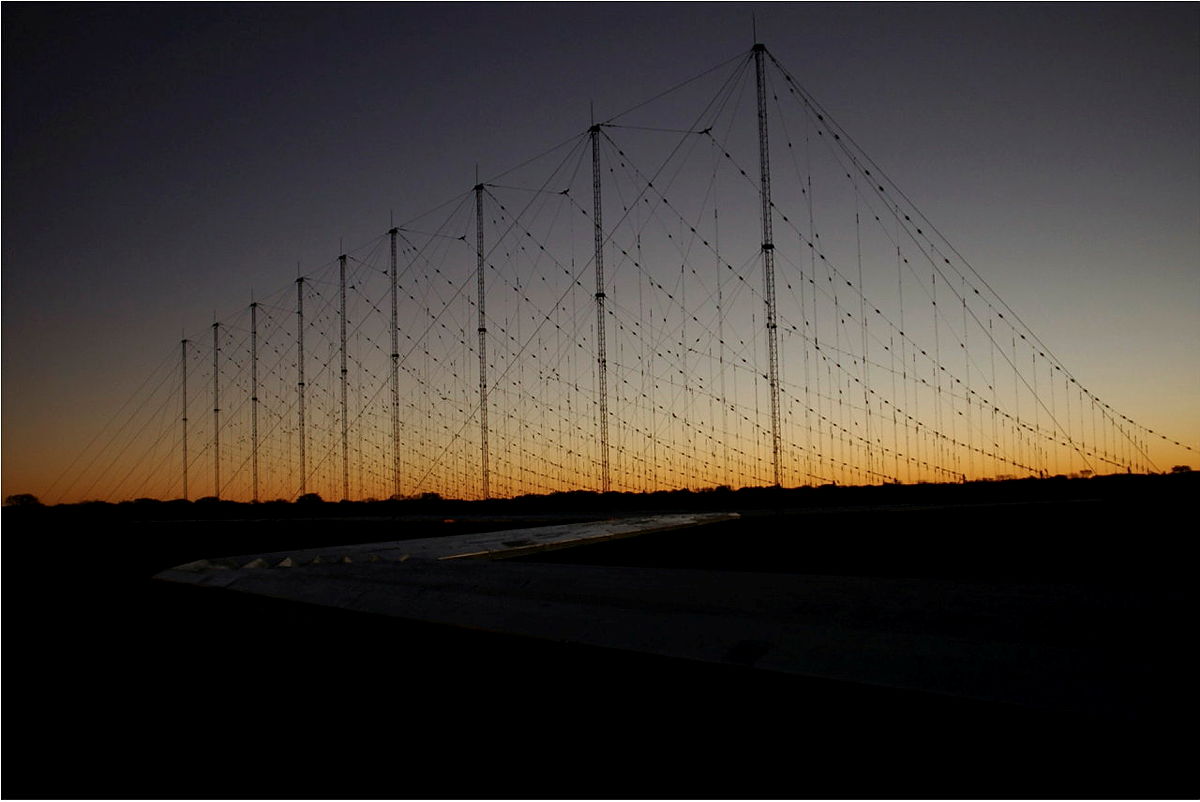
Jindalee Operational Radar Network (JORN)
JORN is Australia’s Over-the-Horizon Radar (OTHR) system, designed to detect aircraft and ships far beyond the range of conventional radars.
Conventional microwave radars, like those at airports, travel in straight lines and stop at the visual horizon. OTHR gets around this by using High Frequency (HF) radio waves that bounce off the ionosphere — the layer of charged particles 75 to 450 km above Earth.
These waves are refracted back to the surface, reflect off metal objects such as planes or ships, and return to the receiver. Computers then process the signals to locate and track targets.
OTHR relies on the Doppler effect: it detects objects moving toward or away from the radar at a different speed from their surroundings. The system uses large fixed antenna arrays for transmitting and receiving. Coverage depends on the arrays’ location and the ionosphere’s condition, which varies with solar activity, time of day, and other factors.
Unlike regular radars that sweep continuously, OTHR focuses energy on specific areas within its coverage arc and shifts focus as needed.
JORN consists of three main radar sites spread across Australia: Longreach in Queensland, Laverton in Western Australia, and Alice Springs in the Northern Territory.
A central coordination center at RAAF Base Edinburgh in South Australia pulls everything together. Each site has massive antenna arrays — some stretching for kilometers — with hundreds of elements that steer the beam electronically without moving the hardware.
The system can cover up to 3,000 kilometers from the radars and monitor an enormous area to the north and west of Australia. It tracks air and sea traffic, supports border protection, aids maritime operations, and can even provide data on wave heights and wind patterns for civilian use.
The story of JORN goes back to the 1970s. Australian scientists at what is now the Defence Science and Technology Group began experimenting with over-the-horizon radar under the name “Jindalee” — an Aboriginal word meaning “the place the eye cannot see.”
Early tests proved the concept could detect aircraft at long distances. By the 1980s and 1990s, the project had grown into a fully operational network. It entered service in stages, with major upgrades continuing over the years. Today, it remains a home-grown success story, with ongoing improvements to keep it effective against modern threats.
JORN is sensitive enough to detect aircraft as large as a Hawk jet trainer or larger, and ships similar in size to Australian patrol boats. Because it continuously covers such a wide area, it provides early warning of movements well beyond Australia’s shores.
JORN isn’t flashy or secret in the way some high-tech weapons are, but it quietly does one of the hardest jobs in defence: giving a country the ability to know what’s happening across huge distances in real time. For a nation with vast coastlines and interests across the Indo-Pacific, that’s an enormous advantage.
By ET Desk