The Soviet MiG-23 swing-wing fighter may now be a forgotten relic of the Cold War, but the day it flew pilotless for miles at a stretch before crashing onto the ground will be remembered for posterity.
The MiG-23 Flogger is a third-generation, swing-wing fighter jet produced by the Soviet Union in response to the US F-4 Phantom II during the Cold War. The first MiG-23 flew in 1967 and entered service in 1970. Russia produced about 5,000 units and exported them to allies and partners worldwide to support its foreign policy objectives.
The aircraft participated in the Soviet-Afghan War, the many Arab-Israel conflicts, the Iran-Iraq War, and the Gulf War of 1991, among many other conflicts.
However, one of the most notable incidents involving the aircraft occurred not in combat but on a routine flight by a Soviet pilot.
When The MiG-23 Flew Without A Pilot
During the twilight of the Cold War, on July 4, 1989, a Soviet pilot, Col. Nikolai Skuridin, took off from the Bagicz Airbase near Kolobrzeg in Poland in his MiG-23 “Flogger” fighter on a routine training mission near the Baltic Sea.
It was an ordinary day in the USSR, while Americans celebrated their Independence Day, or the “Fourth of July,” as it’s popularly known.
A few minutes into the flight, the MiG-23 piloted by Col Nikolai suffered what seemed to be an afterburner failure, which caused power loss in the aircraft.
With smoke emanating from the engine, the aircraft started to descend, and Col Nikolai was sure he had to eject before the aircraft went down. Upon receiving instructions to abandon the jet, he ejected from the aircraft.
Even though the pilot had ejected, the aircraft’s engine still had some residual power, and soon, with the ejection seat, canopy, and pilot removed, its center of gravity shifted, causing the nose to slant upward.
In an unexpected development, the MiG-23 maintained its takeoff speed of 170 knots and eventually reached an altitude of 35,000 feet as it flew westward over East Germany.
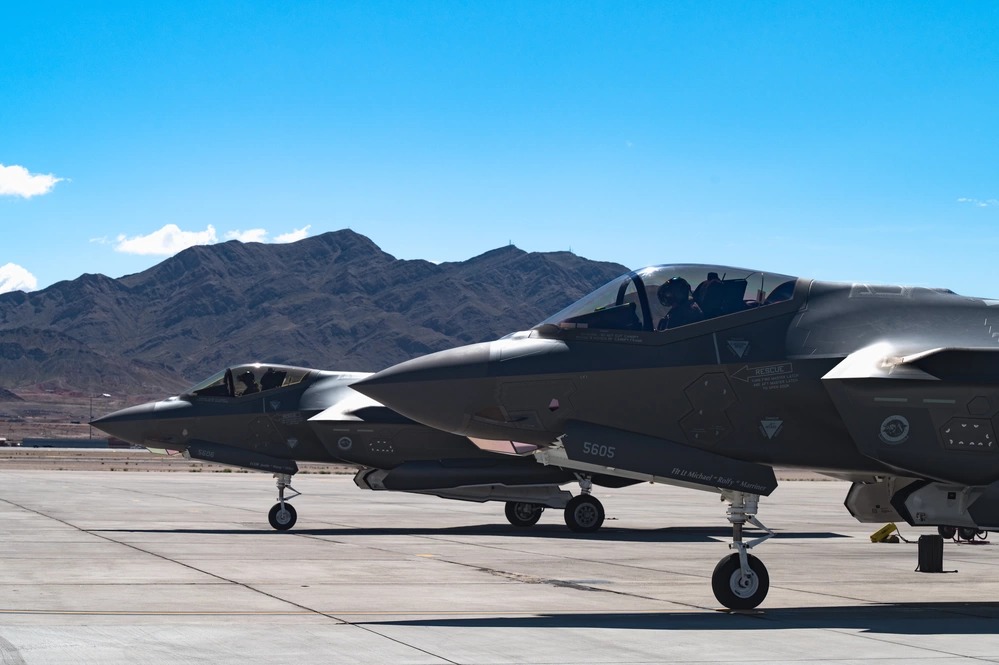
Since it was impossible to determine whether the aircraft was being flown by a pilot or had somehow gathered the speed and lift to fly unmanned, two F-15 Quick Reaction Aircraft (QRA) based at Soesterberg were scrambled to intercept this rogue fighter jet.
However, as American pilots J.D. Martin and Bill Murphy approached the MiG-23 from behind, they were shocked to find the aircraft not only unarmed but also unmanned. This was a sight that the two pilots had never expected to see in their lives, much less on Independence Day, and one that they could almost not believe.
“You know, you’re looking at a MiG-23 just like the pictures you’ve studied your entire fighter pilot life, but it just doesn’t add up. What’s he doing here? Why is he alone? And why is he traveling at 170 KCAS?” the pilots said in the book F-15 Eagle Engaged. The pilots later disclosed that it took them 20 minutes to convince the ground station that the aircraft was flying without a canopy and without a pilot.
The first MiG intercept occurred at 35,000 feet, but when the Soviet aircraft crossed the Netherlands and entered Belgian territory, it gradually climbed to 39,500 feet.
The American pilots and NATO personnel on the ground weren’t quite sure what to do with the aircraft, although they did know that the “Bogey” posed no immediate threat to them. So, they let it be, even as they continued to fly near it.

The Americans readied their jets and huddled to decide whether to shoot it down, a decision that was difficult to make in that high-stakes situation, considering that the falling jet could fall on the unsuspecting civilians on the ground.
With the MiG-23 now headed toward Lille, France, on the border with Belgium, they determined that the Flogger would probably fall a few miles short of densely populated areas. So, they let the unmanned aircraft continue its natural descent, hoping it would fall in a sparsely populated field.
However, the aircraft ultimately crashed in Belgium, killing an 18-year-old boy. The aircraft had flown about 900 kilometers from where it took off, a majority of that distance without a pilot—something that the world had never seen before.
Both the Soviets and the Americans expressed sincere regret for the incident’s outcome, which was obviously preventable. Colonel Nikolai Skurigin openly expressed regret for his choice to eject from the aircraft after learning that the Belgian boy had been killed by his MiG.
“If I could have foreseen such tragic consequences to this pilotless flight,” he said the following day, “I would have stayed in the plane to the end,” he stated.
This was one of the more bizarre Cold War incidents — a “ghost plane” drifting across NATO airspace on autopilot. It highlighted radar coverage, interception protocols, and the capabilities and quirks of the Soviet aircraft, which later locked horns with American fighters during the Iraq War in 1991.

The Soviet Union disintegrated in 1991, and the Cold War came to an end, but the “unmanned Flogger” incident remains etched in history and in the memory of aviation enthusiasts to this day.
This event drew comparisons to the 1989 Soviet MiG-23 “ghost plane” incident, even though the two had little in common.
The MiG-23 Flogger
The MiG-23 Flogger is a third-generation, swing-wing fighter jet that was among the first Soviet fighters equipped with beyond-visual-range missiles and the first to deploy the RP-23 Sapfir, a look-down/shoot-down radar.
The Flogger was based on a successful design concept that prioritized a light, single-engine, variable-geometry wing jet fighter that retained the agility of its predecessor, the MiG-21, while adding modern avionics, improved handling, increased range, a wider weapons selection, and more potent targeting capabilities.
With a maximum range of 1,150 kilometers, the MiG-23 was designed for short-range interception and air superiority missions. Its small size facilitated deployment from airbases lacking adequate facilities and made it difficult for adversaries to visually spot.
During its heyday, the MiG-23 swing-wings, single-engine turbojet fighter jet could out-accelerate most of the aircraft of the time. It had a fast acceleration time, especially at low altitudes, taking only 3-4 seconds to go from idle to full power and less than a second to ignite the afterburner.
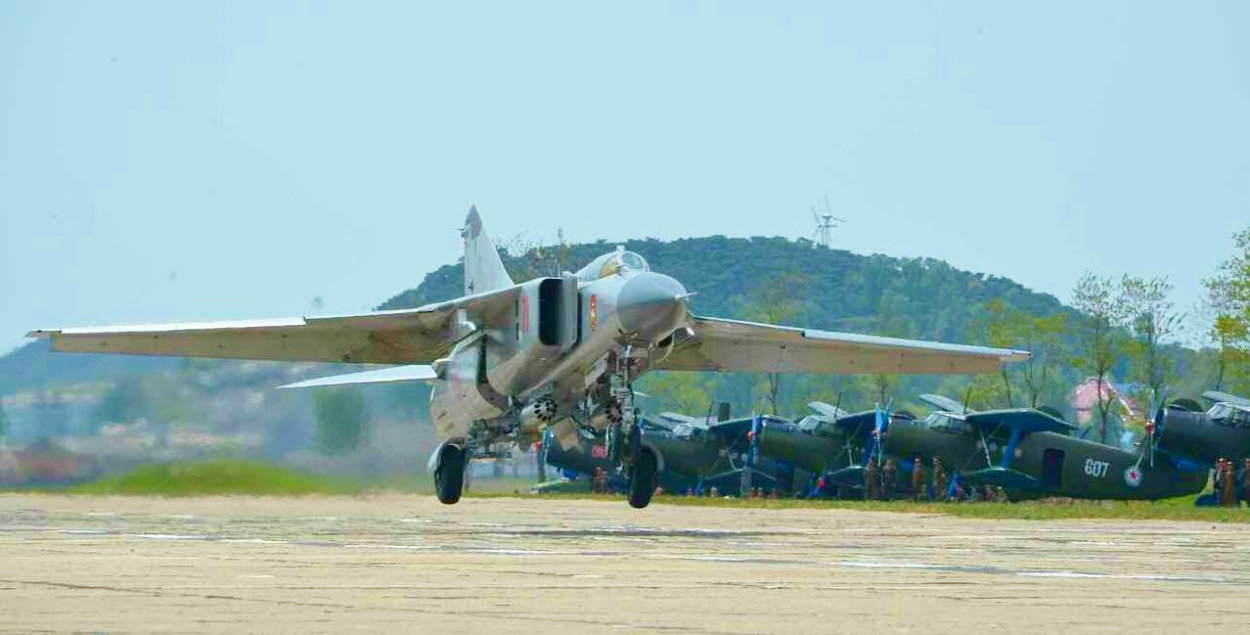
The MiG-23 MF was capable of carrying a variety of guided weapons, including bombs and missiles. The MiG-23 MF was capable of carrying a variety of guided weapons, including bombs and missiles. The fighter jet could move away by folding its wings during aerial combat. The aircraft’s robust design and versatile weaponry made it a popular choice for many air forces worldwide, particularly in battles that call for aircraft capable of striking a balance among performance, endurance, and reliability.
The aircraft had its fair share of troubles.
For example, test pilots frequently experienced yaw instability at higher speeds and difficulties landing in inclement weather. Additionally, the aircraft’s R-29 engine had a short lifespan and a tendency to overheat, and the fuel tank system in early versions was hampered by design flaws that were only corrected in later MiG-23 models.
Despite these issues, the aircraft was widely adopted by air forces globally and extensively used in combat.
The MiG-23 was the Soviet Air Force’s “Top Gun”-equivalent aggressor aircraft from the late 1970s to the late 1980s. The US Air Force, Navy, and Marine Corps fighter aircrew were trained to fly against the Soviet combat settings using the MiG-23 as part of Project Constant Peg.
“The Soviet-designed fighters were agile, too. In an engagement, the enemy’s first turn would be eye-watering- unless the model in question was a MiG-23. Then there was typically no turn at all. The MiG-23 would simply tear away so fast that it seemed like a Ferrari leaving Fords behind,” said an article after the US Air Force declassified the Constant Peg program.
While jets have now been decommissioned by most of their former operators, others, including North Korea, Cuba, Ethiopia, Angola, Sudan, and Libya, still operate them. Several of the jets were also seized by the Syrian rebels during the 2024 campaign that ousted Bashar al-Assad.
- Contact the author at sakshi.tiwari13 (at) outlook.com
- Follow EurAsian Times on Google News