In a first such experiment, the P-8A Poseidon was teamed with the MQ-4C Triton unmanned aerial vehicle, potentially laying the groundwork for a future manned-unmanned teaming (MUM-T) for the US Navy and allied maritime patrol, reconnaissance, anti-submarine, and surface warfare.
Northrop Grumman and Boeing conducted the first automated, manned-unmanned mission control collaboration between the P-8A Poseidon maritime patrol aircraft and the MQ-4C Triton unmanned aerial vehicle in a laboratory environment, demonstrating how the two systems can share intelligence, mission planning, and execution.
“A P-8A operator issued machine-readable, machine-actionable mission tasking to a simulated MQ-4C Triton using UCI [Universal Command & Control Interface] formatted messages,” Boeing stated in an official press statement. “The P-8A cued the Triton transit to a specific area. After receiving the request, the Triton autonomously planned and executed a transit to the area, employed sensors per the tasking, processed findings onboard, and reported results back to the P-8A Poseidon.”
This approach could reduce operator workload, speed up decision-making in a contested environment, and enable more dynamic in-flight tasking without always routing through distant ground control.
Meanwhile, Northrop Grumman emphasized the broader value of the standardized approach: “Using this standardized interface, Triton can collaborate with other U.S. or allied assets sharing the same interface—cutting operator workload and accelerating commander decision-making, making integration across platforms quicker and more cost-effective. The Universal Command and Control Interface is a machine-to-machine collaboration standard based on Open Mission Systems and Autonomy – Government Reference Architecture.”
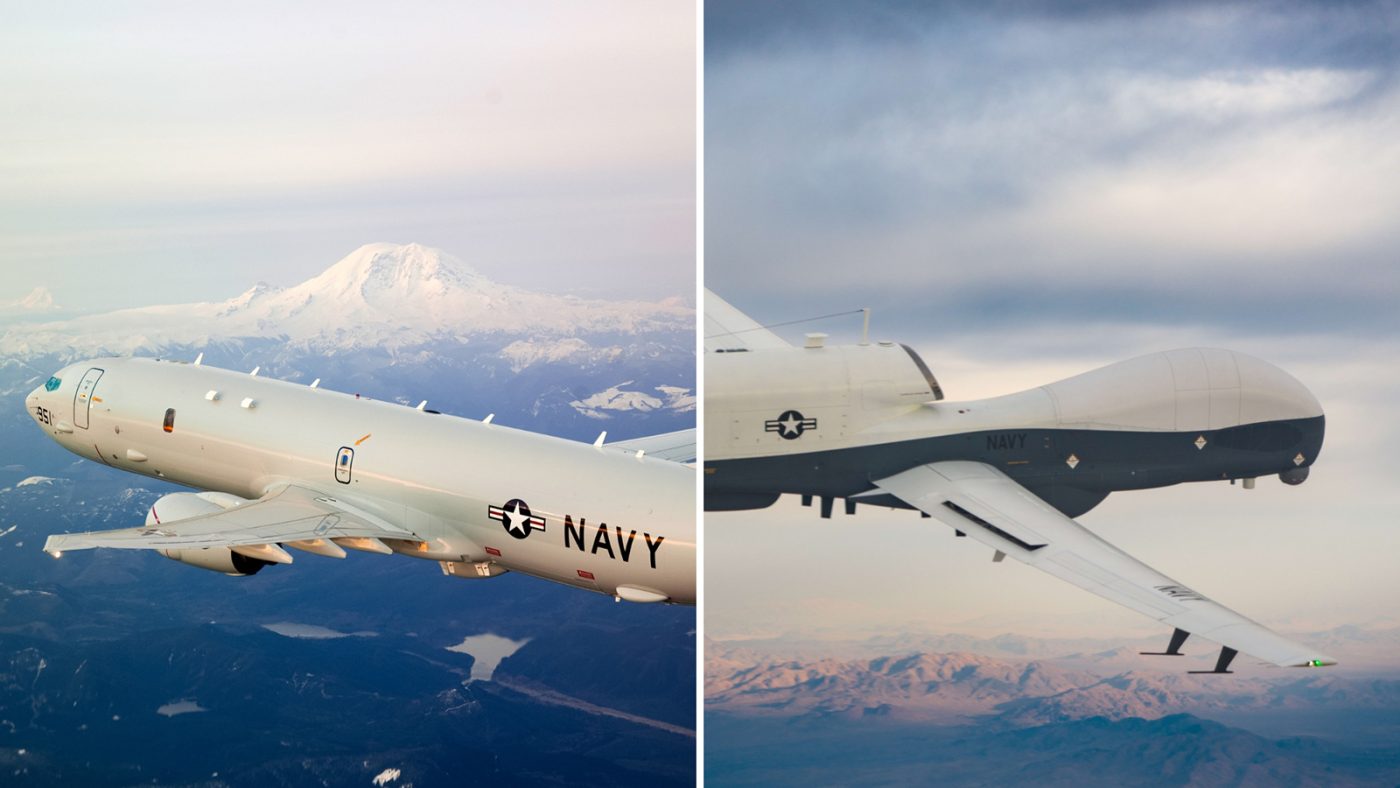
Notably, the MQ-4C Triton was originally designed to work closely with the P-8A. A maritime-optimized derivative of the RQ-4 Global Hawk, Triton offers 24-hour endurance and high-altitude, persistent surveillance over vast ocean areas with its 360° multi-function radar, electro-optical/infrared sensors, and other systems. It functions as an “unblinking eye” for continuous maritime domain awareness.
Meanwhile, the P-8A has comparatively shorter endurance but boasts higher speed and lower-altitude capability than the MQ-4C Triton. Furthermore, it is designed to conduct anti-submarine and anti-surface warfare, investigate contacts of interest, support search-and-rescue, and assist in kinetic operations, among other things.
Together, the two platforms cover more ocean more persistently than either could alone, improve the common operating picture, shorten the sensor-to-shooter timeline, and make better use of limited manned aircraft and aircrew.
As a core element of the Maritime Patrol and Reconnaissance Force, Triton transmits real-time data via satellite to ships, aircraft, and shore stations.
MUMT Between Poseidon & Triton
Until now, the two platforms have operated in a complementary but in a relatively separate manner. Triton provides broad-area maritime ISR and cues contacts of interest, such as ships or potential submarines, prompting a P-8A to investigate, prosecute, or engage.
The coordination between them has normally flowed through ground control stations, introducing latency, especially when stations manage multiple missions, operate across time zones, or sit at the end of long satellite communications chains. However, the new automated capability could essentially allow a P-8A crew to issue commands directly to the Triton, after which the drone can autonomously plan and execute the task.
This would expedite the response to unanticipated changes, such as potential threats or seemingly transient targets of interest. Moreover, automation and onboard AI handling of data collection or processing would free crews, both in the air and on the ground, to focus on higher-level decisions rather than routine tasking or sifting through raw sensor feeds.
“The key idea of teaming them is to let each do what it does best while reducing the workload on human operators. Instead of both independently searching the same ocean, the Triton can detect something unusual and automatically cue the Poseidon. It would reduce operator workload, speed up decision-making, enable more flexible and responsive manned-unmanned teaming, and leverage their complementary strengths for broader, more efficient maritime ISR and related missions,” Air Marshal Anil Khosla (retd), Indian Air Force veteran and military commentator, told the EurAsian Times.
“Triton handles the long-endurance, broad-area “look” mission persistently. Poseidon handles responsive, close-in, multi-mission work. Automated teaming lets them operate more seamlessly as a unit rather than operating in relative isolation or with slower human-mediated coordination,” he added.
In a hypothetical scenario, one manned P-8 could also team with one or more Tritons at a time, stretching limited manned aircraft hours and freeing up the Poseidon for high-value missions, such as anti-submarine warfare and responsive strikes in combat.
Only the United States and Australia currently operate both the P-8A and MQ-4C Triton. The P-8A, however, has been acquired by a wider group of nations, including the United States, India, the United Kingdom, Norway, New Zealand, the Republic of Korea, Germany, Canada, Singapore, and Denmark.
The UCI architecture that enables the latest P-8-MQ-4C teaming could also potentially enable Poseidon teaming with other uncrewed assets, as Northrop stated
Indian Air Force (IAF) veteran Air Marshal Anil Chopra (retd) told the EurAsian Times: “All advanced militaries are focusing on data and sensor fusion, and rapidly working on facilitating integration between different platforms, ranging from manned-manned teaming to manned-unmanned teaming, across domains. The P-8A and Triton’s MUMT merely reflect that larger pattern. The same logic extends beyond air-to-air or air-to-surface pairings into surface, subsurface, land, and space sensors and effectors. The goal is a resilient “kill web” rather than linear kill chains, with data moving freely enough that any suitable shooter or sensor can contribute.”
“In the future, the maritime surveillance aircraft could be similarly teamed with other drones, such as the Sea Guardian,” he added.
The SeaGuardian, a variant of the MQ-9 Reaper, is also designed for maritime surveillance and reconnaissance, and could be teamed with the Poseidon aircraft with some tweaks.
Earlier work has already shown related possibilities. A Boeing-led team virtually demonstrated that the MQ-25’s architecture can support ISR and tanking missions by other aircraft within the mission airspace without conventional communications to a ship-based ground control station. That demonstration included the E-2D Advanced Hawkeye, P-8A Poseidon, and F/A-18 Block III Super Hornet.
There are several other examples of the US military’s efforts aimed at manned-unmanned teaming between aircraft to perform a variety of tasks. In fact, sensor fusion, edge AI, open architectures, and seamless teaming are becoming baseline requirements for competitiveness in contested areas.
The P-8A–MQ-4C laboratory demonstration is clearly a step forward.
However, its actual impact in real conditions will probably depend on how quickly the capability moves from the lab to operational skies.
“MQ-4C Triton and P-8A are the backbone of the U.S. Navy’s maritime patrol and reconnaissance force, delivering complementary capabilities unmatched by any other platforms,” Jane Bishop, Vice President and General Manager of the Global Surveillance Division at Northrop Grumman, was quoted as saying in the official statement. “This demonstration underscores the flexibility of our systems, our unwavering industry investment, and the strength of our industry relationships. Our commitment to pushing the boundaries of advanced technology ensures that the U.S. and allied nations’ operators maintain an unparalleled edge against evolving maritime threats,” he added.
- Contact the author at sakshi.tiwari13 (at) outlook.com
- Follow EurAsian Times on Google News