In March 1971, a major crisis erupted in India’s neighborhood when the Pakistan Army launched Operation Searchlight to crush the Bengali nationalist movement in East Pakistan (today’s Bangladesh).
By the summer of 1971, there were roughly 10 million refugees in India, creating a major humanitarian crisis.
Still, India waited till December to launch its military operation to liberate East Pakistan.
India waited for many reasons, including the need to avoid the monsoon season, which would have made Indian military movement difficult, and the need to mobilize and train the Indian army before a full-scale war.
However, there was another reason: the China factor.
During winter, the Himalayan passes are closed, which would have made any Chinese intervention highly unlikely.
By next year, a new country had emerged on the world map – Bangladesh, which was friendly to India.
Bangladesh was almost always friendly with India, especially under now deposed Sheik Hasina.
China and Pakistan are leaving no stone unturned to bring Dhaka back into their camp as ties with India decline.
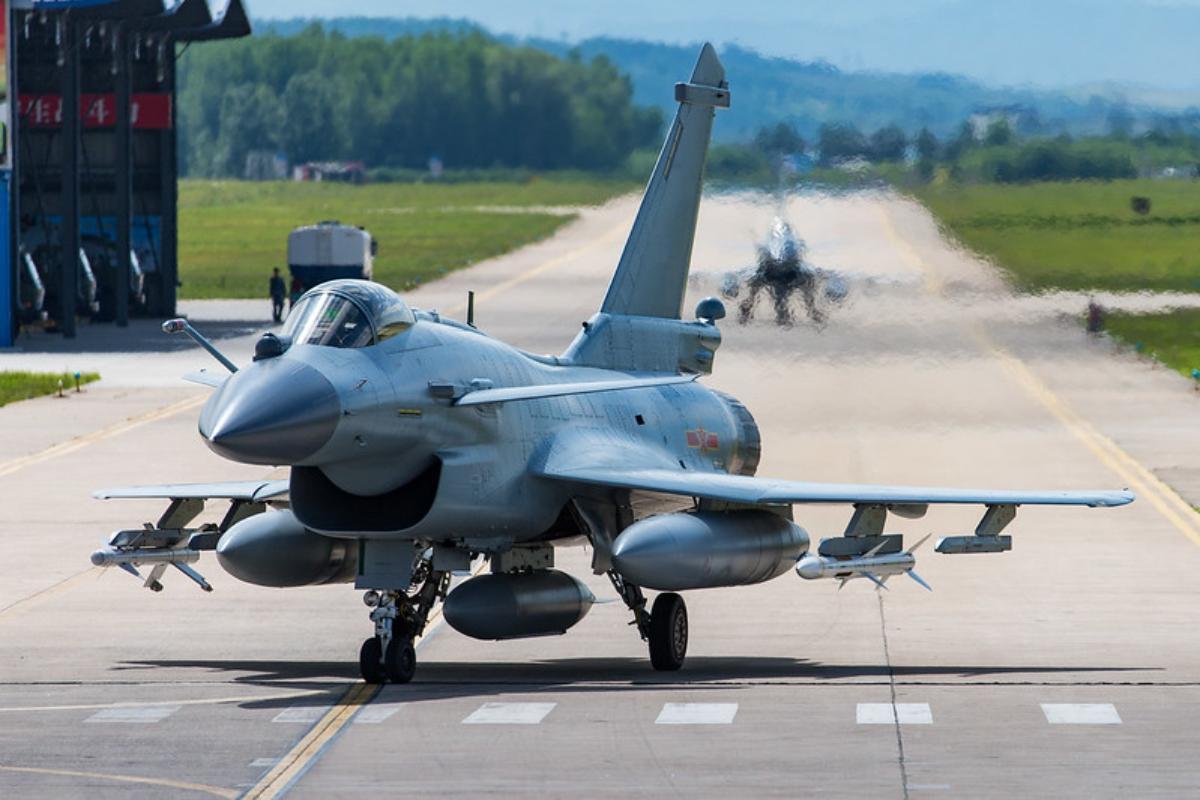
As per the latest reports, the Pakistan-China-Bangladesh nexus could reach new heights as Dhaka negotiates to acquire Chinese J-10CE fighter jets, which Pakistan also operates.
Bangladesh’s J-10C Deal
Bangladesh has been exploring the purchase of China’s J-10CE fighter jet to modernize its aging Air Force since 2024.
In October 2025, Bangladesh revealed that a deal for 20 J-10CE fighter jets could cost US$1.2 billion for the airframes alone. The complete package, including weapons, spares, and training, could cost US$2.2 billion.
Documents quoted by the Bangladesh media indicated that the payments are likely to be spread over 10 fiscal years, ending in the Financial Year 2035-36.
Canada: Are Trump & Putin Working Together or Separately to Break Up World’s Second Largest Country?
The procurement will be conducted as part of Bangladesh’s plans to modernize its armed forces under the Forces Goals 2030.
In addition to the Chinese J-10CE, Dhaka was also considering the French Rafale and the European Eurofighter Typhoon.
French President Macron pitched the Rafale to Bangladesh during his historic 2023 visit. However, the proposal has not progressed.
In December last year, Bangladesh signed a Letter of Intent (LoI) to initiate talks to purchase the Eurofighter jet, indicating that Bangladesh would join the long list of countries that did not select the J-10CE fighter jet after considering it.
Countries like Brazil, Egypt, Indonesia, Colombia, and Iran have all evaluated and negotiated deals with Beijing for the J-10C fighter jet; however, China has yet to win a confirmed second export customer for its fighter jet.
To date, Pakistan remains the only export customer for the J-10CE fighter jet. Islamabad inducted the aircraft in 2022.
One major advantage of the J-10CE is its price. The 4.5-generation fighter jet costs nearly half the price of the Rafale and the Eurofighter Typhoon.
Another factor could be Pakistani claims following its brief war with India in May last year. Islamabad claimed that it shot down multiple Indian fighter jets using Chinese long-range PL-15 missiles fired from Chinese J-10CE fighter jets.
India denied these assertions and claimed to have destroyed 12-14 PAF jets in the clash.
Notably, the Bangladeshi minister mentioned these Pakistani claims while speaking to the media about the government’s decision to draft an agreement to purchase the J-10CE fighter jet.
Rahman said that Dhaka had taken note of the Chinese aircraft’s reported strong performance during the conflict in its neighborhood.
He did not say how many fighter jets Dhaka plans to buy or how much the deal could cost. However, media reports in Bangladesh suggest the deal could involve the purchase of 20 or 24 J-10CE fighter jets.
The J-10C entered Bangladesh Air Force’s (BAF) wishlist after Air Chief Marshal Hasan Mahmood Khan visited China in 2024, where he expressed the force’s plan to acquire multirole combat aircraft and attack helicopters.
Discussions on the purchase got traction during former Prime Adviser Dr. Muhammad Yunus’s visit to Beijing in March 2025. Following the trip, an 11-member inter-ministerial committee—chaired by the Air Force chief—was formed to negotiate the deal, finalize the contract, and evaluate the G2G procurement process.
Notably, the BAF already has Chengdu J-7 fighter jets from China, reverse-engineered from the Soviet MiG-21, in its inventory. The BAF currently operates aging platforms such as the MiG-29 and J-7, which are becoming obsolete in modern combat scenarios.
Bangladesh has a long-standing defense relationship with China, which has supplied many of its weapons systems.
China-Bangladesh Defense Partnership
After Pakistan, Bangladesh is the second-largest importer of Chinese weapons, according to data published by the Stockholm International Peace Research Institute (SIPRI) in 2024.
In 2019–23, Bangladesh received 11% of China’s major conventional arms exports, behind Pakistan at 61%.
Chinese armaments account for more than two-thirds of the total inventory of Bangladesh’s Armed Forces. Critical weapons systems such as Ming-class submarines and MBT-2000 tanks are of Chinese origin.
In 2019–23, China supplied 72% of Bangladesh’s major conventional arms imports, followed by Türkiye at 9.7%, and the UK (5.5%), according to SIPRI.
Low cost and no-strings-attached are the primary motivations for purchasing Chinese weapons.
Key Chinese-origin equipment in service includes MBT-2000 and VT-5 tanks, Type 035G (Ming-class) submarines, Type 056 corvettes and other naval vessels, and J-7 fighters, making it the country’s largest source of military hardware.
In 2002, the two countries also signed a Defense Cooperation Agreement covering training, joint exercises, equipment supply, and defense production.
The rising defense cooperation between Dhaka and Beijing is a worrying sign for India, as it means that China is emerging as the main arms supplier to both India’s Western and Eastern neighbors.
Bangladesh Keen to Join the MECCA Pact
Apart from deepening defense cooperation with China, Dhaka is also considering joining the MECCA pact, a mutual defense agreement among Pakistan, Saudi Arabia, and Turkey, often referred to as the Muslim NATO.
India shares an adversarial relationship with both Pakistan and Turkey.
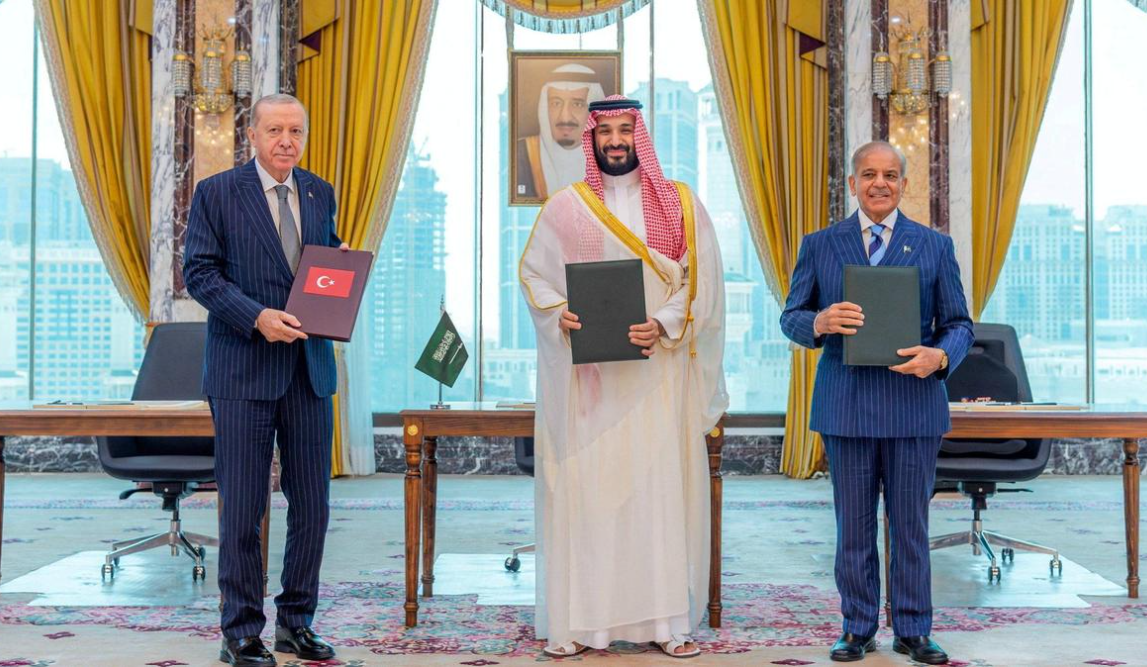
If Bangladesh joins the MECCA pact, it could complicate India’s neighborhood, as it would give countries like Pakistan and Turkey an opportunity to increase their influence in the country.
Dhaka has already purchased the Baykar Bayraktar TB2, a medium-altitude long-endurance (MALE) unmanned aerial and combat vehicle made in Turkey, and deployed it near the Indian border.
Notably, India shares its longest land border with Bangladesh, which is 4,096 km. The country is also critical for the security of India’s northeastern region.
A Bangladesh equipped with Chinese J-10CE fighter jets and submarines, Turkish drones, and exploring a Pakistan-Saudi-Turkey mutual defense agreement would give Islamabad a ready-made eastern front to foment trouble against India.
- Sumit Ahlawat has over a decade of experience in news media. He has worked with Press Trust of India, Times Now, Zee News, Economic Times, and Microsoft News. He holds a Master’s Degree in International Media and Modern History from the University of Sheffield, UK.
- He can be reached at ahlawat.sumit85 (at) gmail.com