

After years of delays, the US has reportedly fielded its first-ever hypersonic weapon, the Dark Eagle. narrowing the hypersonic gap with China and Russia and strengthening its combat posture.
The US Army’s acquisition leader for Fires, the Portfolio Acquisition Executive (PAE), confirmed that the service fielded its first Long-Range Hypersonic Weapon (LRHW), or Dark Eagle.
“It is fully fielded. It is ready to go,” Lt. Gen. Frank Lozano said. “It is a globally deployable and employable warfighting capability. Those soldiers and those units have everything that they need to employ, fight, and win.”
Lozano did not disclose the exact date or location of the deployment. He said some ground support equipment was delivered as early as 2021, making it difficult to pinpoint a single milestone date.
Nonetheless, this marks the first official confirmation that a US hypersonic battery has reached full operational status.
Hypersonic weapons travel faster than Mach 5, or five times the speed of sound, and are highly maneuverable, making them extremely difficult to intercept. Fielding its first-ever system matters because the United States has struggled for years to turn its hypersonic research and development programs into deployable weapons and has trailed its adversaries, mainly China and Russia.
The Army initially intended to field the first battery in 2023. However, the program repeatedly missed deadlines as engineers struggled to demonstrate the missile’s performance in an end-to-end flight test, reflecting missile-testing difficulties, quality-control issues, launcher-integration challenges, and production bottlenecks.
The Congress watchdog Government Accountability Office (GAO) later identified problems with production standards and industrial-level difficulties.
Despite sustained production woes and other challenges, Lozano’s confirmation shows Washington is moving beyond research, development, and testing to put this emerging technology into the hands of military units that could eventually use it in an actual conflict.
US Enters The Hypersonic Club With Dark Eagle
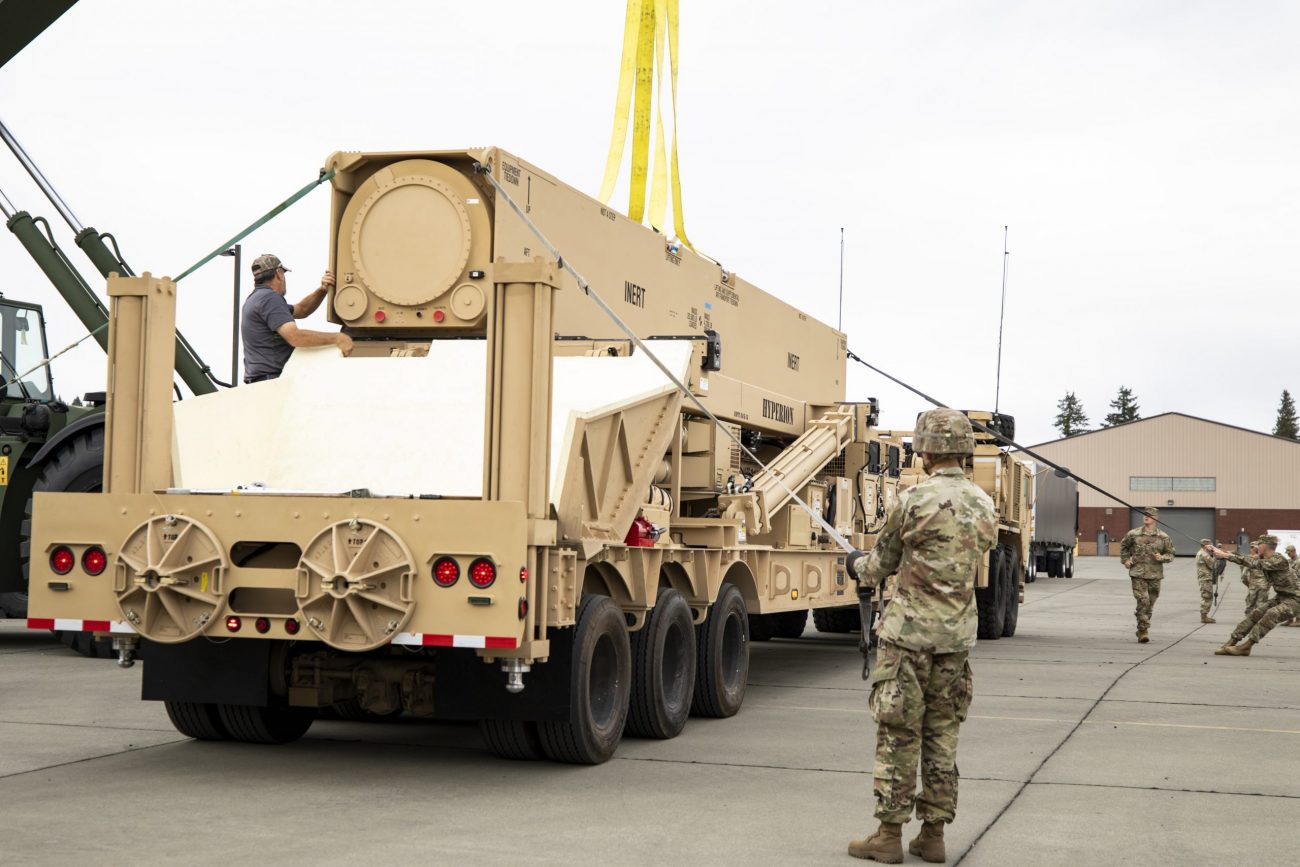
The Dark Eagle is a ground-launched hypersonic missile system, designed to strike high-value, time-sensitive, and heavily defended targets at long distances.
Notably, the US Army and Navy jointly developed the missile’s Common Hypersonic Glide Body (C-HGB). The Army’s LRHW and the Navy’s Conventional Prompt Strike (CPS) share major components, including the common glide body and associated booster technology.
Dark Eagle uses a two-stage solid-fuel rocket booster to accelerate the Common Hypersonic Glide Body to the required velocity. After the booster separation, the glide vehicle continues towards its target through the upper atmosphere.
It was previously reported to have a range of 2,776 kilometers, although Lozano said last year that it has a range of about 3,500 kilometers. The missile’s blast-fragmentation warhead contains a relatively small explosive charge—approximately 30 pounds (13.6 kilograms)—but incorporates a very large number of fragments.
Although Lozano refused to reveal the date or location of the first battery, we know the US Army activated Bravo Battery, 1st Battalion, 17th Field Artillery Regiment, 3d Multi-Domain Task Force, a unit fully designated to operate the Dark Eagle, in December 2025. The 3rd MDTF is structured to support US military operations in the Indo-Pacific.
The 3rd MDTF is particularly relevant because it is designed to support operations in the Indo-Pacific, where the US faces its most demanding military challenge from China.
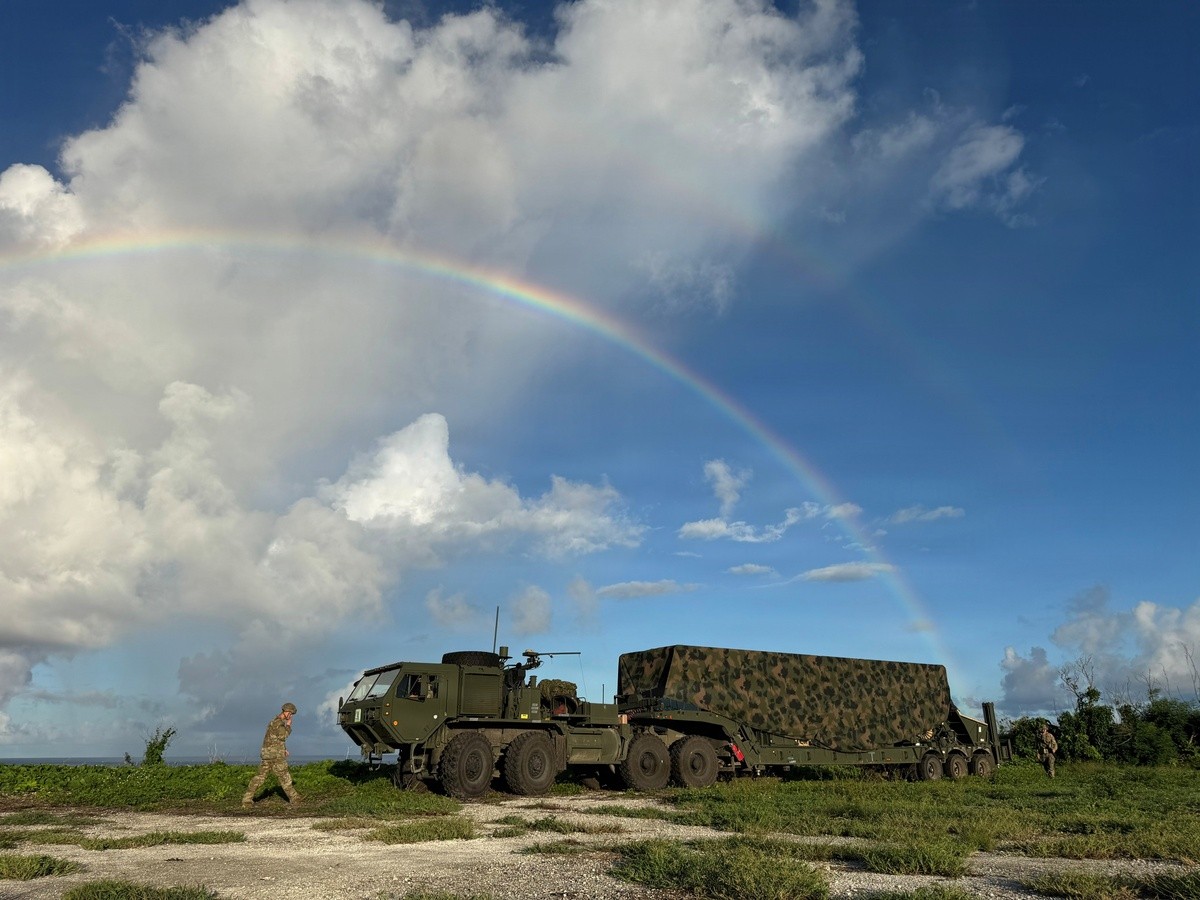
The system has already demonstrated expeditionary capability. It was earlier deployed to Guam for Exercise Valiant Shield 2026, a multinational warfighting exercise conducted in the Western Pacific earlier this year, as the EurAsian Times reported. Before that, the hypersonic system was deployed to Australia, a major ally in the contentious Indo-Pacific region, for Exercise Talisman Saber in August 2025.
If deployed to the Indo-Pacific, the first fully fielded hypersonic battery would mark a significant step in Washington’s efforts to strengthen its military posture vis-à-vis China.
Dark Eagle in the Indo-Pacific
The operational fielding of Dark Eagle comes as China continues to expand its missile arsenal and strengthen its anti-access/area-denial (A2/AD) capabilities.
Over the past two decades, Beijing has emerged as the world leader in hypersonic capabilities, amassing a massive inventory of hypersonic missiles, including the DF-17, the YJ-21 anti-ship missile, and the long-range DF-27 hypersonic weapon, among others.
China has invested in anti-access/area-denial (A2/AD) capabilities, leveraging its geographic advantages with layered sensors, air defenses, and long-range strike systems. These include missiles like the DF-26, which can reach as far as the US territory of Guam and is often referred to as the “Guam killer.”
This is meant to make it more difficult for American forces to move and deploy during a crisis, especially in a conflict involving Taiwan or the South China Sea.
The expansion in these capabilities has raised concerns in Washington about the vulnerability of American military bases, aircraft carriers, logistical networks, and other critical assets across the western Pacific.
One big complication is that US military operations in the western Pacific depend heavily on a network of bases, ports, airfields, and logistical facilities throughout the region. Thus, China’s ability to threaten those facilities with long-range precision missiles could make it more difficult for American aircraft, ships, and support forces to operate effectively.
This is where the Dark Eagle comes in. It is intended to address part of this challenge by giving the US Army a ground-launched, long-range conventional strike capability that could threaten key military targets at long range.
The Dark Eagle would be able to strike Chinese coastal targets within reach, including air defense radars, command centers, missile launch sites, ports, and logistics hubs. This would enable quick, accurate attacks on valuable, time-sensitive targets deep within China’s A2/AD network, which uses layered missiles, sensors, and defenses. For example, deploying the Dark Eagle battery to Guam would place parts of China’s southeastern coastline within the system’s reported range.
Earlier this year, a Congressional Research Service report stated that the missile is designed to strike heavily guarded sites in disputed areas.
Instead of relying exclusively on aircraft, bombers, naval vessels, and sea-launched weapons, the US Army can employ a mobile, ground-launched conventional strike system capable of reaching targets at considerable distances. This capability would give American commanders another way to generate long-range strike options and strengthen the ability to hold high-value, time-sensitive, and heavily defended targets at risk.
The Dark Eagle’s four most distinctive features are its extremely high cruise and terminal speeds, comparatively small size, excellent mobility, and its warhead’s wide but deadly dispersal pattern. Its unpredictable maneuvering, low flight altitude, and rapid cruise speed would significantly reduce detection and engagement windows.
Furthermore, the containerized missile’s relatively small size—comparable to the Chinese DF-17—combined with twin launch containers mounted on a semi-trailer would make pre-launch detection and counter-battery engagement extremely challenging, as EurAsian Times explained.
It is intended to be road-mobile for quick deployment and resistance to enemy targeting. It can be quickly flown around the world aboard the C-17 Globemaster III. This transportability matters in the Indo-Pacific, where American forces may need to move equipment across widely separated locations and operate alongside allied militaries.
The road-mobile configuration could complicate pre-launch targeting. Additionally, the shoot-and-scoot, mobile design will allow the launchers to move swiftly after firing, further reducing their susceptibility to Chinese counterattacks.
However, ground-based missile systems require secure deployment areas, logistical support, communications networks, and adequate protection.
Furthermore, deploying long-range strike systems in allied countries requires political agreement and careful consideration of the consequences for those countries.
For now, it is too early to conclude that the system will fundamentally alter the military balance in the Indo-Pacific. The US has fielded only its first battery—a single battery with a nominal complement of eight missiles—which does not provide the scale needed to sustain an extended, high-intensity missile campaign.
- Contact the author at sakshi.tiwari13 (at) outlook.com
- Follow EurAsian Times on Google News