After conducting historic drills against the Egyptian Rafales, the Chinese PLAAF (People’s Liberation Army Air Force) is now holding exercises with Emirati Mirage 2000-9 jets —an aircraft type still operated by two of Beijing’s key regional competitors, Taiwan and India.
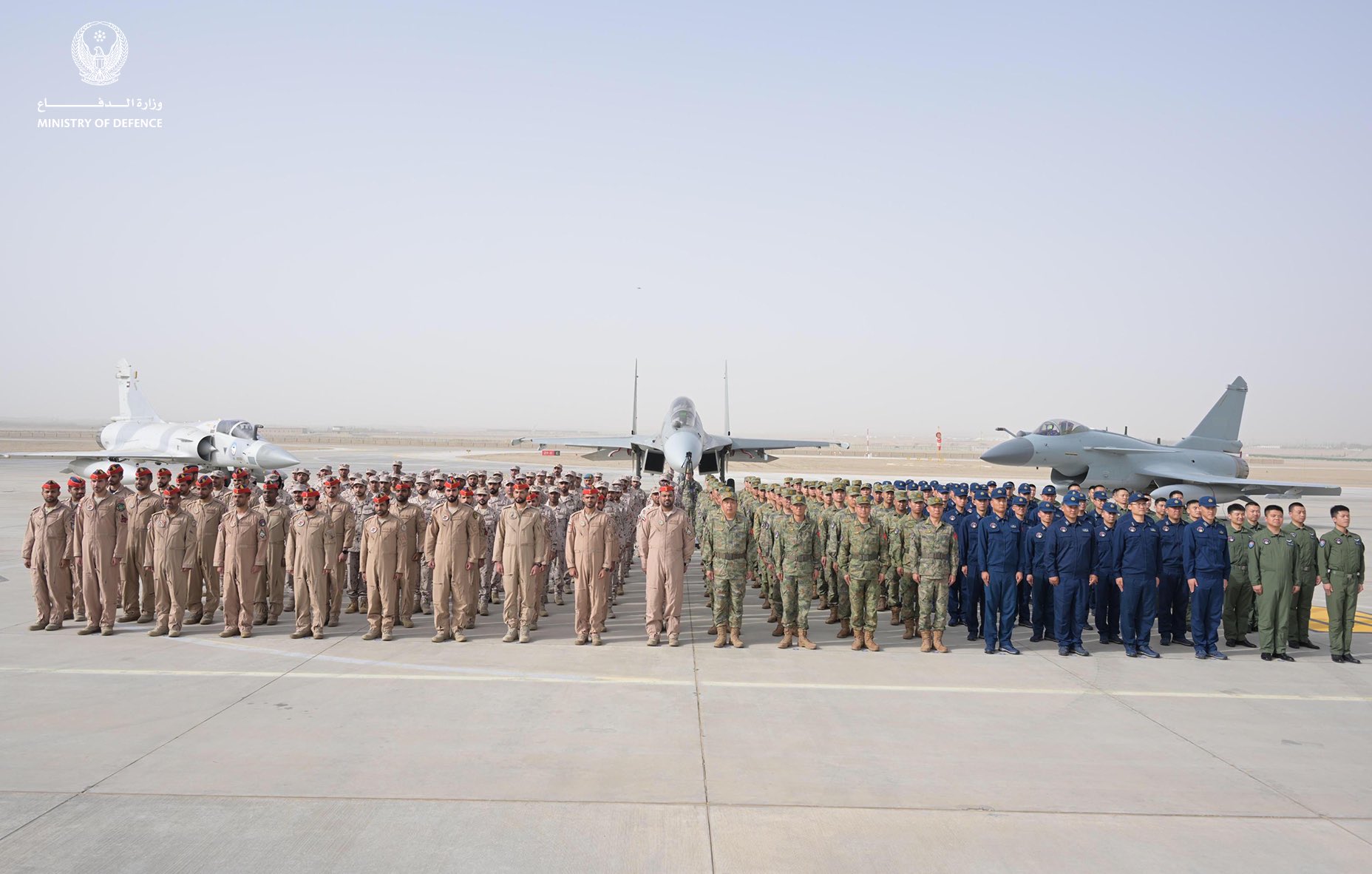
The PLAAF and the UAE Air Force kicked off the fourth edition of the “Falcon Shield 2026” military exercise in late August 2026 in Hotan, Xinjiang, according to the Chinese Ministry of National Defense (MND).
The drills are slated to run through mid-September.
On September 4, the UAE Ministry of Defense (MoD) released footage showing Mirage 2000-9s operating alongside Chinese aircraft. Although neither side has published a full order of battle, exact numbers, or unit details, open-source reporting suggests that the Emirati Mirages are practicing against the Chinese J-10C, J-16, and JH-7.
The Chinese MND stated that the joint exercise aims to enhance the tactical capabilities of participating units and deepen ties and practical cooperation between the two militaries. The two sides are conducting command simulations, flight training, and live-force exercises in mixed formations, according to the Defense Ministry.
Mirage 2000 in China:
Footage from @modgovae shows troops from the Chinese PLA Air Force and the United Arab Emirates (UAE) Air Force participating in "Falcon Shield 2026" Joint Training Exercise in Hotan, northwest China's Xinjiang Uygur Autonomous Region.
The exercise is… pic.twitter.com/ALJ8VSdI8T
— China Military Bugle (@ChinaMilBugle) September 4, 2026
The Falcon Shield has steadily matured since its maiden iteration in 2023, evolving from basic interoperability exercises to more complex joint operations.
The deployment of Emirati Mirage 2000-9s for the drills gives China yet another hands-on exposure to a Western-designed aircraft and allows it to build capabilities and tactics against a warplane that remains in service with Taiwan and India.
Interestingly, these drills come just days after the PLAAF’s J-16 conducted high-stakes exercises with another French-origin aircraft: the Egyptian Rafale, a mainstay of the Indian Air Force (IAF).
The J-16s engaged in both beyond-visual-range (BVR) combat and dogfighting, allowing the PLAAF pilots to familiarize themselves with the Rafale. The drills were hailed as historic, as Chinese pilots rarely receive live dissimilar training against cutting-edge Western jets.
No official kill ratios, scores, or “win or loss” tallies were released by official sources, but unverified claims on social media suggested that the J-16s beat Egyptian Rafales 7–1 on the first day of flying. In fact, some pro-China accounts on X went so far as to say that the one Rafale “kill” was gifted to Cairo as a courtesy, more for face-saving than anything else.
Notably, the exercise outcomes in dissimilar air combat training are heavily shaped by rules of engagement, simulated weapons or sensors, mission objectives, pilot proficiency, and supporting assets, as the EurAsian Times explained.
However, it would still have enabled Chinese pilots to assess the Rafale’s flight characteristics, basic weapon configurations, medium- and close-range mobility, sensor behavior in engagements, and how its tactics interact with Chinese systems under realistic conditions. This could be crucial in combat.
It is not much different for the Mirage 2000-9.
China Practicing Against Mirage-2000 Jets
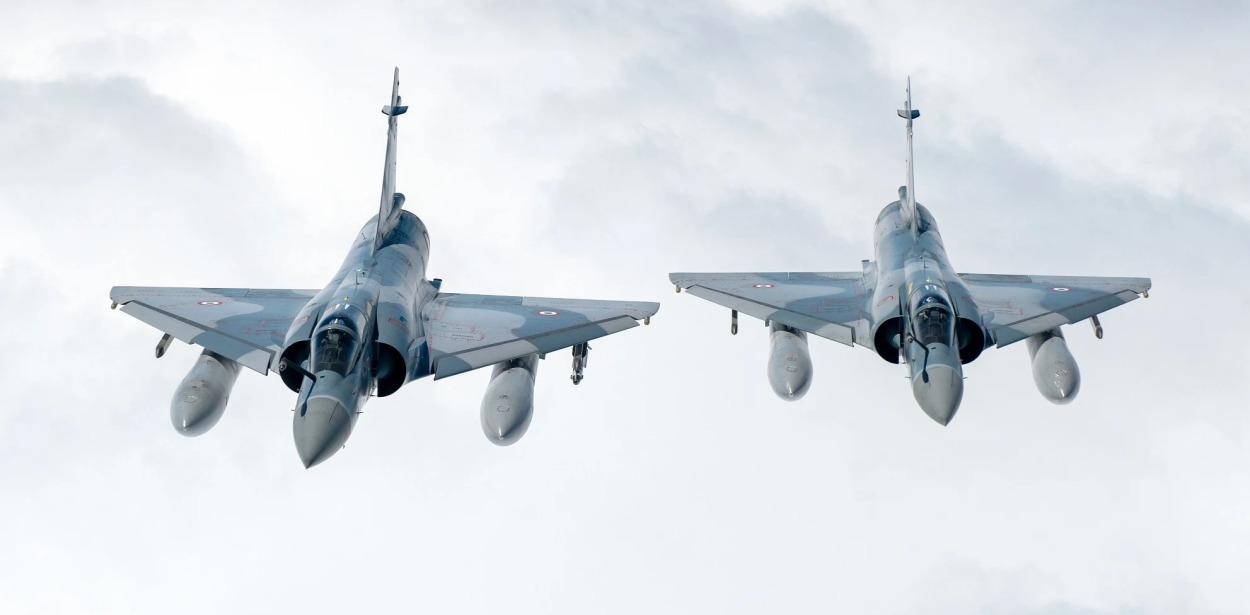
The Mirage 2000-9 is a UAE-specific, highly upgraded multirole variant of the French Dassault Mirage 2000 family, derived from the 2000-5 Mk 2 standard.
This single-engine delta-wing fighter offers strong air-to-air, deep-strike, and reconnaissance performance, reaching speeds of about Mach 2.2 and boasting excellent agility. The aircraft is equipped with the Thales RDY-2 multimode radar—which can track multiple targets and perform synthetic-aperture mapping—along with modular avionics derived from the Rafale, an advanced glass cockpit compatible with night-vision goggles, the IMEWS electronic warfare suite, and weapons including MICA air-to-air missiles, the Black Shaheen (SCALP-derived) cruise missile, and precision-guided munitions.
When these aircraft train in China, the PLAAF can observe and collect data under controlled, repeatable conditions that are otherwise hard to obtain.
Training with the Mirage 2000 will allow Chinese ground radars, airborne early-warning aircraft such as the KJ-500, fighter radars, infrared systems, and electronic-support measures to record radar cross-section behavior, thermal or infrared signatures, engine emissions, acceleration profiles, formation geometry, and electronic emissions under controlled, repeatable conditions.
Analysts note that this can help refine Chinese radar modes, electronic support libraries, and missile-seeker performance against a Mirage-class target.
This could be inimical to the interests of Taiwan and India: Taiwan operates Mirage 2000-5s, whereas India flies upgraded Mirage 2000I variants alongside its Rafales. Both countries regard the French fighter as a core element of their airpower and have invested in fleet sustainment and upgrades, as the EurAsian Times has reported over the years.
China claims Taiwan as a renegade Chinese province and has vowed to occupy it, with force if necessary. Analysts predict that Beijing could launch an all-out invasion of the self-ruled island state before the end of this decade. Notably, the Taiwanese Mirages are part of the first line of defense against PLAAF incursions, tasked with northern air defense and interception near the Taiwan Strait.
The relationship between China and India has thawed in recent times, but the two countries remain embroiled in a border dispute that has erupted into confrontations in the past. Notably, the location of the UAE-China drills is itself close to India’s northern borders and in a region used for broader Western Theatre Command operations.
The Mirage-2000 is a key precision-strike platform, and currently forms the mainstay of the Indian Air Force alongside the Rafale and Su-30MKI.
The Chinese have been keen on building tactics against the Mirage 2000s for quite some time. In 2023, a CGI video appeared on Chinese social media showing the PLAAF’s J-11s downing IAF Mirage 2000 jets during a dogfight, as EurAsian Times reported. The video was posted to Weibo along with a caption describing a scenario where the IAF launched an attack on China while Beijing was preoccupied with annexing Taiwan.
The dissimilar combat training between Chinese J-10C and Mirage 2000s means that Beijing has the opportunity to train against a real platform rather than just simulators.
This would allow Chinese pilots to practice against the aircraft’s actual flight characteristics, turn performance, energy management, and typical Western-style tactics as flown by UAE crews. That information would, in turn, be used by Beijing to feed into simulator models, training scenarios, and the development of rules of engagement.
It is worth mentioning that China conducted exercises against the Emirate Mirage 2000 in 2024, as EurAsian Times reported at the time. However, these repeated exercises could compound China’s advantage over time by allowing the PLAAF to convert these observations into better electronic threat libraries, more realistic adversary replication in training, and improved sensor or missile tuning that could be instrumental in combat.
Since Taiwan and India use different variants of the Mirage 2000, there may be some differences in weapons configuration, electronic warfare suites, pilot training, and support systems. Nonetheless, any real-world data on performance and tactics is useful even if incomplete, which may benefit the country in combat against operators of the jet.
In theory, steady improvements in Chinese understanding of Mirage performance or detection characteristics could help the PLAAF prepare for scenarios involving Taiwanese or Indian Mirages.
For example, Taiwan relies on its Mirage fleet as part of its air-defense posture near the mainland, and improved Chinese ability to detect and track Mirages at longer ranges or under electronic attack could reduce the warning time available to Taiwanese pilots and ground controllers during an invasion.
However, it is important to remember that practicing with fighter jets from a rival country is hardly rare. India, for instance, has conducted training against and alongside the F-16 fighters, which Pakistan operates.
“It is the man behind the machine that matters. We beat the US F15s in air combat in the first-ever exercise between IAF & USAF. They decided to accelerate the F-22 to beat us. It was all over the US press,” IAF veteran and military commentator, Group Captain Johnson Chacko (retd), recently told the EurAsian Times.
Nonetheless, the China-UAE exercises mark a deepening of defense cooperation between the two countries at a time when the UAE is diversifying away from an exclusive reliance on the West, and China is seeking partners and buyers for its equipment in the Middle East.
- Contact the author at sakshi.tiwari13 (at) outlook.com
- Follow EurAsian Times on Google News