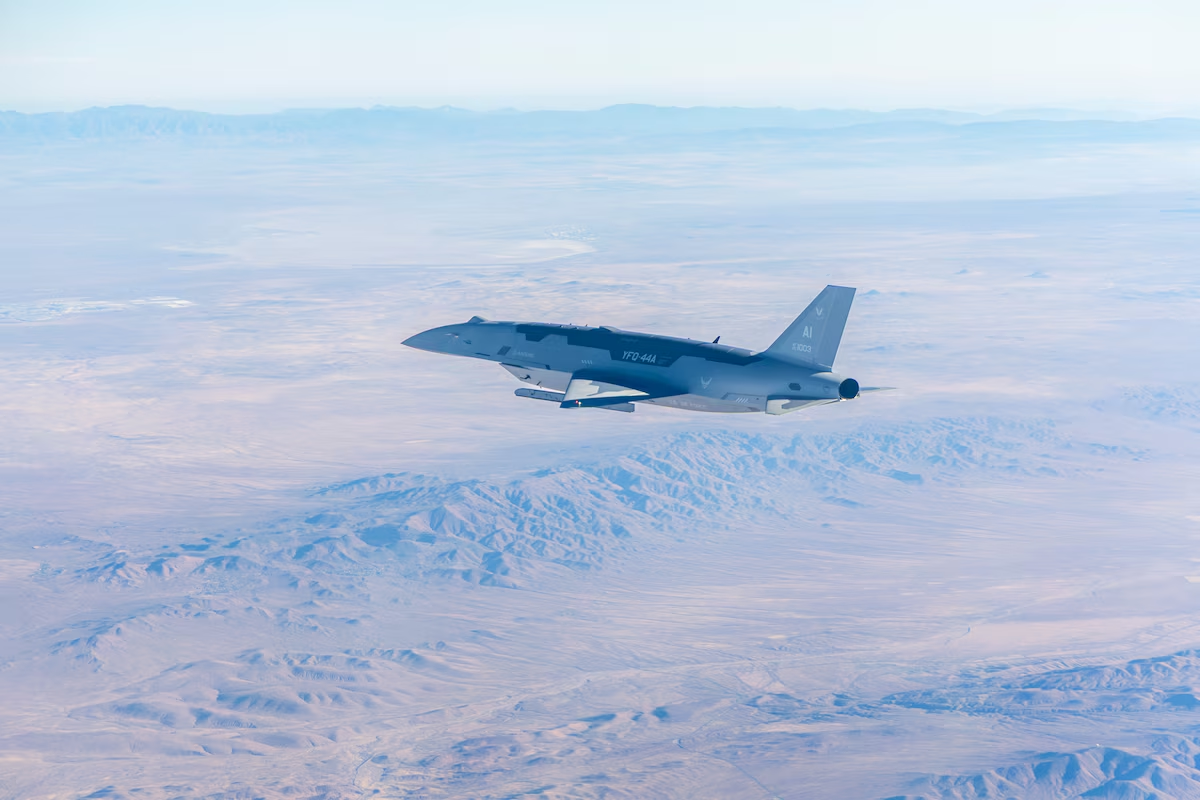
A US Air Force (USAF) pilot flying an F-22 Fighter Jet controlled an Anduril YFQ-44A Collaborative Combat Aircraft (CCA) from the Raptor’s cockpit earlier this month, the service announced on Thursday.
The F-22 pilot served as an airborne “quarterback,” issuing high-level tactical directives to a single YFQ-44A.
The YFQ-44A’s onboard autonomy software interpreted and executed those directives in real time, conducting dynamic flight maneuvers and simulated combat tasks.
“This achievement demonstrates what is possible when we are aligned with industry on a shared imperative: delivering capability to the warfighter at unprecedented speed,” said Secretary of the Air Force Troy Meink.
“We are driving urgency into every part of acquisition from rapid integration and flight learning to disciplined assessment, so we can turn promising technology into combat capability at the pace the threat demands.”
The event brought together personnel from the 412th Test Wing, 422nd Test and Evaluation Squadron, 309th Software Engineering Group, Experimental Operations Unit, F-22 System Program Office and the CCA Software Autonomy and Teaming Branch.
The Department will use data from this test milestone to inform continued software integration, developmental testing, and the Air Force’s future CCA concepts.
“This flight shows the power of crewed-uncrewed teaming and the advantage it provides our warfighters,” said Air Force Chief of Staff Gen. Ken Wilsbach. “We must test often, learn fast and give commanders what they need, when they need it.”
Mark Shushnar, Anduril’s vice president of autonomous airpower, said: “The US Air Force’s CCA program is the fastest-moving, most mature CCA program anywhere in the world, and will be the first to field operational aircraft,” Shushnar said. “Getting there demands that Anduril and the U.S. Air Force work together to prove out the capability, define the operational procedures, and build trust between operators and their semi-autonomous wingmen.”
USAF Takes Delivery of Fury and Vengeance Drones
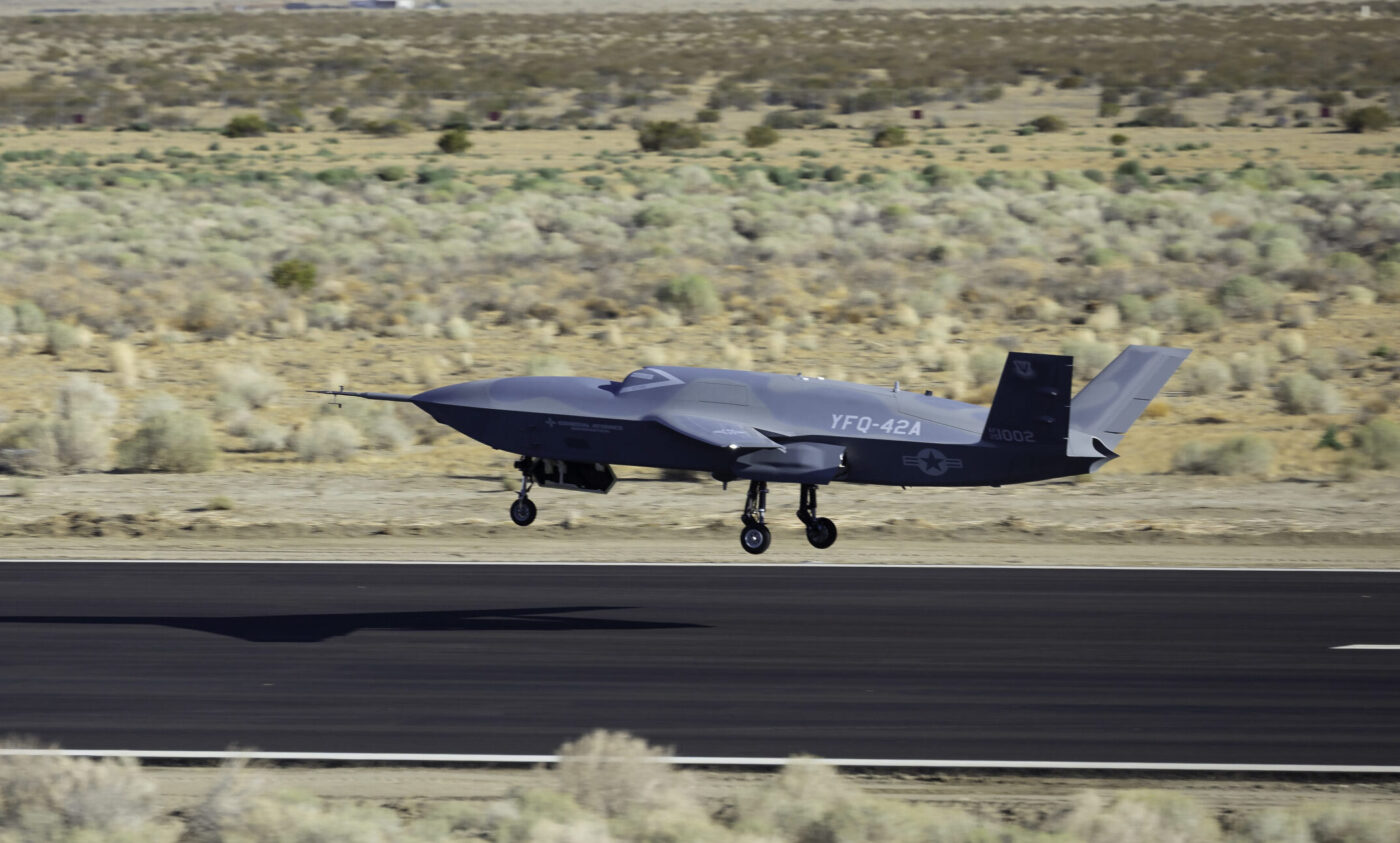
Earlier, as EurAsian Times reported, the USAF took delivery of its first two CCAs, Anduril’s FQ-44 Fury and General Atomics’ FQ-42 Vengeance, and sent them to the Experimental Operations Unit at Creech Air Force Base, Nevada.
The aircraft, developed under prototype designations YFQ-44A and YFQ-42A, will now test how uncrewed, semi-autonomous jets can fly with crewed fighters and add cheaper mass in contested airspace.
“Anduril delivered the first CCA, the YFQ-44A, to the Experimental Operations Unit [EOU] last month, and General Atomics delivered the YFQ-42A last week,” the USAF announced on September 24. The aircraft were delivered at Creech Air Force Base, Nevada, and will now support Air Combat Command-led operational experimentation to refine how CCA will be employed alongside crewed aircraft in contested environments, the USAF added.
Earlier, Meink highlighted the significance of putting the systems in Airmen’s hands: “Putting CCA in the hands of Airmen is how we build the operational future of this program. Anduril’s Fury and General Atomics’ Vengeance deliveries show we can move at incredible speed, compete, and deliver cost-effective combat power to the force.”
The sentiment was echoed by the Chief of Staff, Gen. Ken Wilsbach, who said, “We’re thrilled to welcome Fury and Vengeance to the experimental operational unit. Our Airmen are excited to see what Collaborative Combat Aircraft can do.”
The program secured deliveries in just over two years after the service down-selected the two contractors in April 2024, and within a year of the two aircraft’s maiden flights.
In July, an Anduril YFQ-44A fired an AIM-120 AMRAAM at a simulated target over the Mojave Desert after taking off from Edwards Air Force Base. The Air Force called it the first CCA live-fire event; some accounts said the missile was inert.
A human operator retained weapons-release authority throughout the demonstration. That month, the Air Force also conducted an Agile Combat Employment exercise with both Collaborative Combat Aircraft designs at Creech Air Force Base, Nevada, shifting the platforms from controlled test conditions into more realistic operational use, as the EurAsian Times reported.
More recently, Meink said the service aims to have at least 500 CCAs in service by 2032, speaking at the Air & Space Forces Association’s 2026 Air, Space & Cyber Conference. “Today, the first FQ-42 and FQ-44 increments are already rolling off the assembly line,” he said. “They’ll be performing many of the same missions that we do with manned fighters today,” he added.
CCA Gathers Pace
The CCA program is a flagship USAF initiative to develop a new generation of uncrewed “fighter drones” to fly alongside manned jets. The CCAs, or “loyal wingmen,” are designed to boost air superiority in contested environments like the Indo-Pacific or even the Middle East.
They are intended to boost the USAF’s combat capabilities by carrying extra air-to-air munitions, extending sensor coverage, and executing missions that would otherwise put human pilots at risk.
Reports have indicated that these CCAs will primarily serve as airborne “missile trucks” in their initial deployment, flying in formation with crewed jets to provide additional firepower. However, their roles could be expanded to include electronic warfare, intelligence gathering, surveillance, reconnaissance, and, in the future, fully autonomous missions.
The Pentagon plans to mass-produce these CCAs at a significantly lower cost than conventional fighter jets. The USAF-developed CCA drones are estimated to cost between US$25 million and US$35 million each, about one-third the cost of an F-35.
USAF officials report that the service plans to order about 150 drones in Increment 1. However, the service is seeking about 1,000 of these aircraft over several iterative development cycles. This large number may also drive design modifications and evolution over time.
Earlier, Frank Kendall, the former United States Secretary of the Air Force and who launched the CCA program, said the USAF is working to acquire what could ultimately be a fleet of multiple CCA drone types through iterative development cycles.
“I don’t regard CCAs as expendable. They’re not munitions. … we don’t send them all to die,” Kendall said. “So there needs to be enough survivability in them – the combination of how you equip them, design them, plus tactics so that you can have reasonable attrition in most areas – but they are things that you are willing to let a few of die to gain an advantage”.
Earlier, Kendall explained in 2022: “These have got to be cheaper platforms, and one of their features is that they’re at least attritable, if not expendable. That opens up a whole range of tactics that we currently would not contemplate because we’d be sacrificing manned aircraft, and we’re not going to do that.” (2022) “We need to imagine a world in which fighter planes aren’t the dominant platform, and that the CCAs are not just there to help the fighter planes; they’re actually there to win the war.
You’ve got to free your mind of the idea that there will always be a fighter pilot.” On building trust through exercises: “I think that’s going to be fascinating when we start using CCAs at Red Flag. When the guys with the CCAs are beating the crap out of the guys without them, and not losing any manned fighters, that’s going to be pretty obvious, right?” He also recounted asking a pilot why there wasn’t more resistance: the answer was, “Sir, these things are going to save our lives.”
Lt. Gen. Christopher Niemi, Air Force Chief Modernization Officer and Deputy Chief of Staff for Strategy, Design and Requirements, made an interesting remark in May 2026: “I have a lot of experience with that program [CCA]. My prior job was out at Nellis Air Force Base, where [we were] standing up the Experimental Operations Unit. And I’m very enthusiastic about the opportunities of the future for CCA-type aircraft. It’s one of the primary platforms that we will use to explore practical use for AI.
There’s no doubt in my mind that we’ll find some disappointments and nasty surprises, but we’re also going to discover some opportunities as we fly the aircraft in an operationally representative environment…
I would also add that there are adversaries that are working very aggressively to field their own autonomous CCA-like capabilities, and I don’t think we can predict when this will happen, but I think most of us, based on what we’ve seen from artificial intelligence, would assess that there will come a point where a robot fighter is better than a manned fighter. And I say this as a person who identified and grew up professionally in the fighter pilot community.
The question is, when will that happen? And I think it would be a tragic shame if the United States didn’t have a better answer if we were facing robot fighters that were better than our manned fighters. So for all these reasons, I’m very bullish on CCAs, but it’s going to take decades to develop.”
“I can imagine a day in the future, 10 years [from now], maybe more, where a CCA autonomy algorithm does a better job flying a fighter airplane than I did as a captain. That hurts my ego a little bit. But at the same time, I see that this trend is happening, and we’ve got to find a way to do that… As you institutionalize these capabilities, it’s not too surprising that maybe fighter pilots are not too enthusiastic about the idea of fielding a capability that will start to replace some of what they do—how they define themselves.”
Mail us at: editor (at) eurasiantimes.com