Ukraine’s intelligence officials have claimed that Russia’s Zircon (Tsirkon) missile is not a sustained-hypersonic cruise missile, which Russian President Vladimir Putin and the Kremlin have repeatedly described as “invincible”
The Defense Intelligence of Ukraine (DIU) published a detailed technical assessment of the Zircon missile on 31 August. The package includes an interactive 3D model of the missile, along with information on its components, manufacturers, and foreign-origin parts recovered from the debris.
Originally developed as a sea-launched anti-ship weapon for nuclear submarines and Project 22350 frigates equipped with 3S14 vertical launchers, the Zircon has been adapted for land-based Bastion coastal systems. In fact, Moscow has intensified the use of this missile, along with the Kinzhal and other missiles, to exploit gaps in Ukraine’s air defense coverage and to strike high-value targets inside Ukrainian cities.
Russia has claimed that the Zircon is a hypersonic missile capable of reaching speeds of Mach 8–9 with a range of up to 1,000 kilometers, and is designed for both anti-ship and land-attack missions.
Positioning the missile as an invincible weapon that could not be intercepted by Western air defenses, Russia maintains that Zircon’s high speed is designed to squeeze defenders’ reaction times and complicate interception compared with conventional subsonic or supersonic cruise missiles.
Russian analysts have repeatedly claimed that the missile’s extraordinary speed would make it an effective weapon against larger warships, such as aircraft carriers. Such confidence in the Zircon is evident as Russia is arming major surface vessels and submarines with 3M22 Zircon missiles.
It is pertinent to highlight that the new DIU claims are in stark contrast to earlier Ukrainian assessments—especially after the first confirmed uses and intercepts in early 2024—which treated the 3M22 Zircon as a true hypersonic missile powered by a ramjet or scramjet.
The Kyiv Scientific Research Institute of Forensic Expertise (KNDISE) had earlier reported that the missile used a jet engine rather than a solid-fuel rocket motor.
At the time, Ukrainian outlets claimed that Russia had developed a hypersonic ramjet engine for the Zircon, which would allow sustained hypersonic speeds reported to cruise around Mach 5.5, with higher peaks, during the midcourse at high altitude, distinguishing it from purely ballistic systems like the Kinzhal, which only briefly reaches high speeds on a solid-fuel rocket.
Ukrainian analysts described it as a hypersonic cruise-type missile with higher sustained speed than Russia’s air-launched hypersonic missile, Kinzhal.
Zircon is Hype, Not Hypersonic?
The DIU assessed that the Zircon is not a “hypersonic cruise missile” as Russia has previously stated, and could be best classified as a quasi-ballistic missile.
The DIU describes the missile as a two-stage design that follows a high-altitude trajectory with elements of quasi-ballistic or boost-glide behavior, rather than sustained powered cruise.
Hypersonic missiles travel at speeds of five or more times the speed of sound and are highly maneuverable in flight, making them difficult to intercept.
The Ukrainian intelligence agency claims that the missile is slower than previously thought and has a smaller warhead than Russia’s S8000 Banderol cruise missile.
According to the DIU, the warhead designated 3G22, manufactured by GosNIImash/GOSNIIMASH, weighs approximately 120 kilograms. The agency stated that this is extremely low for what is described as Russia’s most expensive strike missile, emphasizing that even the smaller Banderol cruise missile carries a 150-kilogram warhead.
The missile employs a combined guidance system with two primary phases: an inertial navigation system during the midcourse, followed by an active radar seeker in the terminal phase, the DIU stated. Furthermore, the DIU states that the maximum recorded speed does not exceed Mach 6.8 — as opposed to Russian claims of Mach 8-9 —and that this speed is not sustained throughout the flight.
The DIU claims that onboard computation and control are handled by the Baget-83 digital computing system, a module standard across most Russian ballistic missiles. Meanwhile, electro-hydraulic steering actuators and deployable aerodynamic control surfaces in the tail section manage maneuvering.

One of the DIU’s most significant claims concerns Zircon’s propulsion.
Russia has maintained that the Zircon has an air-breathing propulsion system that burns liquid propellant and can maintain hypersonic flight.
In contrast, the DIU states that the Zircon missile’s propulsion system uses solid-fuel rocket motors, not a scramjet or a liquid-fuel ramjet. It states that both the booster and sustainer stages use solid propellant — after launch from a container on a ship or coastal system, the booster motor ignites to accelerate the missile to the required altitude and speed. It then separates, allowing the main sustainer motor, identified as the 3L2211 and manufactured by NPO Iskra, to take over.
This directly contradicts years of Russian claims involving a scramjet engine and high-energy liquid fuel, such as “decylin.”
The publicly available images and videos of the missile do not clearly show an air intake, which a scramjet- or ramjet-powered missile needs to draw in atmospheric oxygen. Moreover, no Russian patent related to the missile’s detachable launch cap shows a clear intake arrangement.
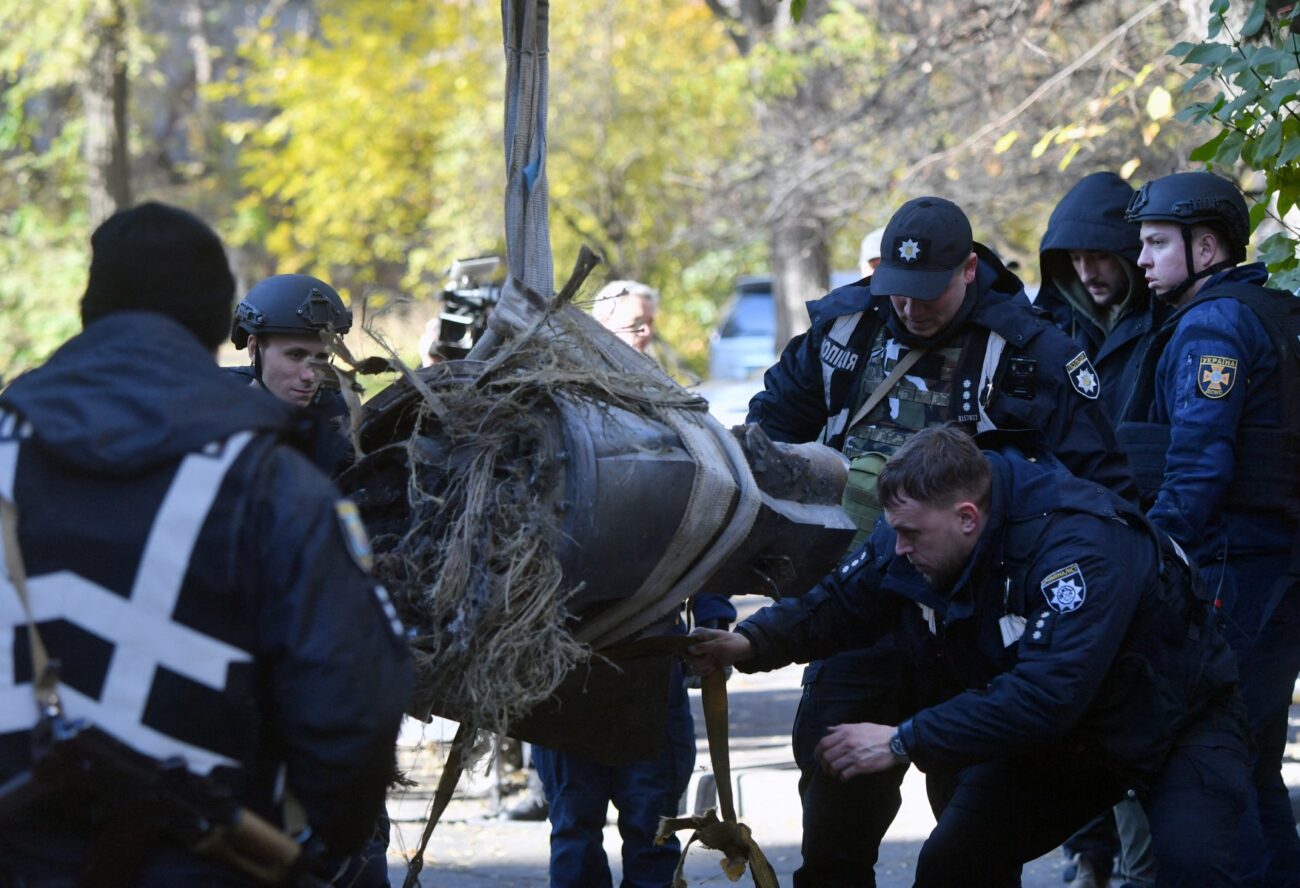
The Scientific Research Institute of Forensic Expertise in Ukraine examined a circular metal structure believed to be a component of a solid-propellant rocket motor. The hardware appears linked to the Zircon’s second stage rather than solely to its launch booster—the element a genuine hypersonic cruise missile would use to reach operating speed. This points to a two-stage design in which each stage relies on a solid-propellant rocket motor.
Nonetheless, the findings do not prove beyond reasonable doubt that the missile lacks an air-breathing engine.
When asked about the Ukrainian claims that Zircon is a ballistic missile or a cruise missile as earlier claimed by Russia, Indian Air Force (IAF) expert Squadron Leader Vijainder K. Thakur told EurAsian Times, “A ballistic missile flies a predictable ballistic trajectory. A cruise missile follows a less predictable flat trajectory that keeps it below adversary radar horizon for most of its flight. The Zircon is a cruise missile, as indicated by its trajectory characteristics.”
Thakur says, “There are some doubts about whether the Zircon is rocket-powered or scramjet-powered. The doubts stem from reports stating that it uses solid-propellant engines for both its boost & cruise phases. The doubts are fueled by the fact that most people do not readily appreciate that both a rocket motor and a scramjet engine can use solid propellants. The Zircon is a cruise missile.”
Thakur still classes Zircon as a cruise missile and notes that solid propellant does not automatically rule out a scramjet. That is a minority reading against the 2026 file: no clear intake, two named solid motors, Baget-83, high-altitude profile. A low-level cruise missile stays under the radar horizon. Zircon, as described by both Moscow and Kyiv, does not.

Notably, some open-source intelligence analysts have called attention to the images of the Zircon’s radar seeker published by the DIU.
The presence of a dedicated active radar seeker may indicate that the Zircon does not rely solely on pre-programmed inertial or satellite guidance, as is common on pure ballistic missiles. It has a genuine terminal homing capability designed for precision engagement of moving targets. This supports its original anti-ship mission while also allowing secondary use against land targets, which is how Russia has employed it in Ukraine.
The DIU also identified 70 companies that either supplied components for the missile or were involved in its production. According to the GUR report, these include a TGA2704 amplifier, originally associated with TriQuint Semiconductor (now part of Qorvo), and an Altera Cyclone II EP2C5T144I8N field-programmable gate array (FPGA), from Altera Corporation (now part of Intel), both listed as originating in the United States. This shows that Russia’s development of advanced weapons remains linked to global supply lines.
Notably, Russia has not refuted Ukrainian claims at the time of writing this report, but it continues to use Zircon while emphasizing that it is a formidable hypersonic weapon.
The DIU assessment does not prove every detail beyond doubt, but the evidence now points in one direction. No clear air intake, solid-fuel booster and sustainer, a computer suite typical of Russian ballistic systems, and a high-altitude profile all point away from a true air-breathing hypersonic cruise missile.
In a nutshell, Russia calls the Zircon a hypersonic missile and has not responded to Ukrainian claims so far. According to reports from the Ukrainian Air Force and military analysts, Zircons are more interceptable than the “invincible” label, and Ukraine has brought many down. The constraint is no longer the physics. It is how many PAC-3 MSE rounds are left.
- Contact the author at sakshi.tiwari13 (at) outlook.com
- Follow EurAsian Times on Google News