Germany has test-fired an Israeli ballistic missile from one of its key warships in the North Atlantic, as the country pushes ahead with a major military modernization drive.
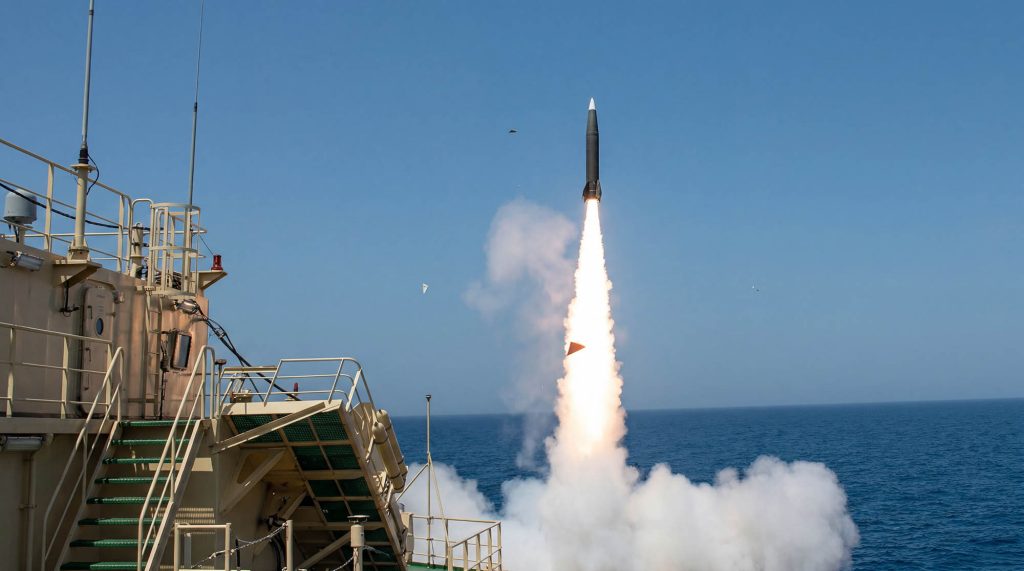
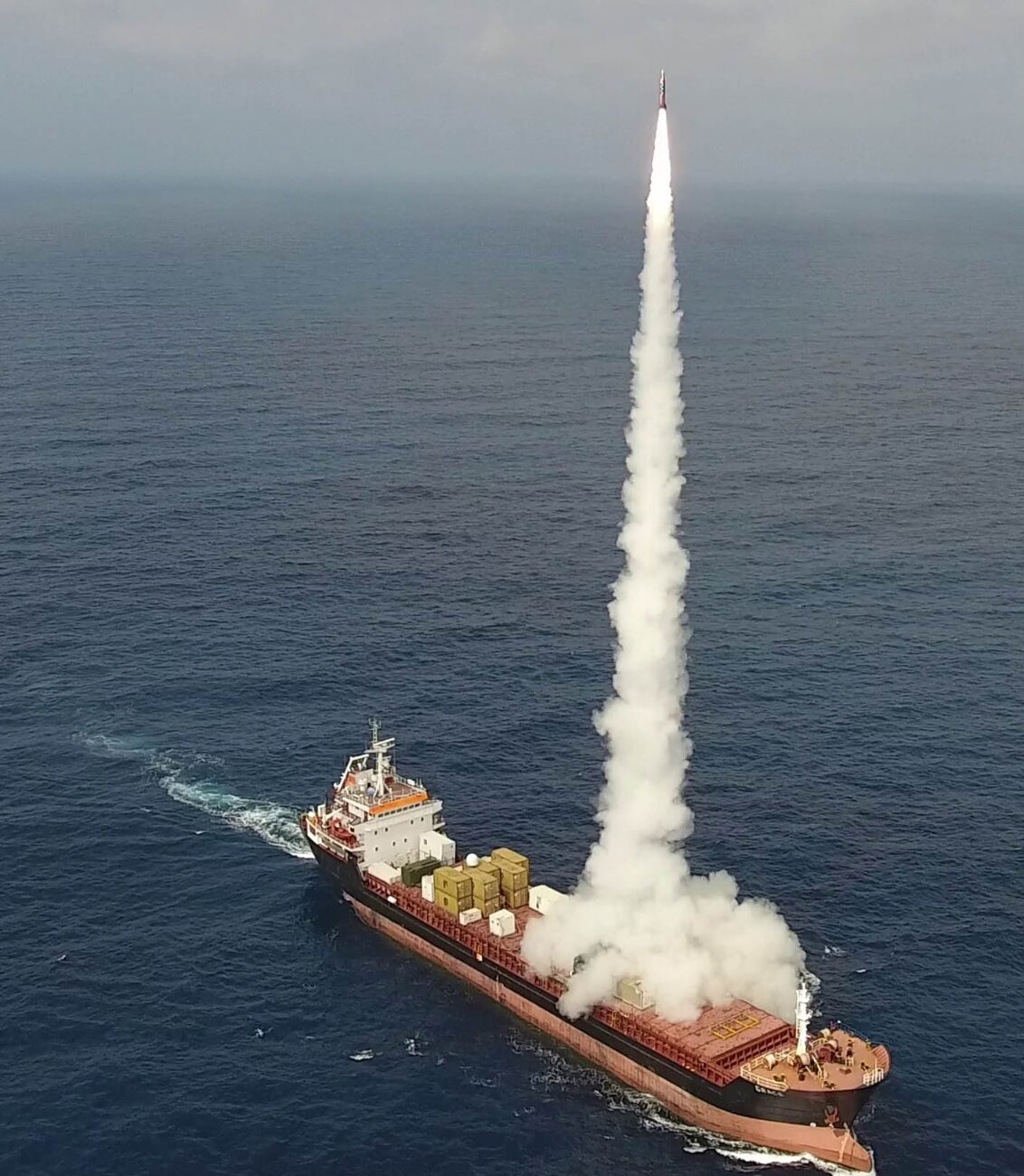
The German Navy announced on September 2, 2026, that it conducted an overnight test of a naval Long-Range Artillery Weapon System (LORA). It stated that two German frigates were sent to the waters between Ireland and Iceland for the “secret” test of the Israeli LORA ballistic missile produced by the Israel Aerospace Industries (IAI).
The firing ship has been identified as the F125 frigate Sachsen-Anhalt (Baden-Württemberg class), with two LORA canisters on the flight deck. A second German frigate escorted the test between Ireland and Iceland.
Preparations for the test were largely secret, but German media said shipping and air traffic were warned 45 days in advance.
LORA was fired from canister launchers and an embarked command unit on Sachsen-Anhalt’s flight deck — a modular, containerized fit that needs no VLS cell and no permanent hull cut.
It does not require a dedicated vertical launch system (VLS) or permanent ship modifications, as many modern naval missiles do. “Under both scenarios, the missile was launched along its trajectory, navigated to the target, and struck it with utmost precision. Both the weapon system and the missile successfully met all the trial’s objectives,” the IAI said in a press statement.
German Navy test-fires an Israeli-made LORA ballistic missile from a Baden-Württemberg-class frigate. pic.twitter.com/ozqp4Zmr5r
— Fabian Hinz (@fab_hinz) September 2, 2026
The German Navy conducted the live-fire trial under its OPEX (Operational Experimentation) program, supporting the “Marine 2035 and Beyond” modernization plan, the German Navy’s strategic force posture and modernization vision.
The vision calls for long-range strike options, alongside the acquisition of advanced frigates and corvettes, an expanded submarine force, auxiliary ships, and a host of other things, to bolster combat readiness against near-peer adversaries.
Hailing the test as a success, German Navy chief Vice Adm. Jan Christian Kaack said, “With the successful launch of a ballistic missile last night in the North Atlantic, we made naval history. I am extremely satisfied with this achievement.”
“Our units can successfully deploy the system, and its potential range exceeds anything we have seen before. In terms of protecting Germany and our allies, this test marks a new chapter in deterrence and maritime defense readiness,” he further added.
The German Navy subsequently published footage of the missile test, which has since been widely shared on social media.
The live-fire testing of LORA is significant, as Germany seeks long-range missiles to counter Russia, which it sees as the biggest security threat since the invasion of Ukraine.
In fact, the German Navy announced the LORA test just hours after it formally accused Russia of being behind an attempted drone attack at Leipzig/Halle Airport last month and ordered countermeasures in response, including closing the Russian consulate in Bonn.
As of now, Berlin’s longest-range strike option is the air-launched Taurus cruise missile, which has a range of over 500 kilometers — it has about 600 Taurus missiles in its inventory. Additionally, it is currently developing an upgraded version of its Taurus cruise missile, with production scheduled to begin in 2029.
The latest testing has also grabbed headlines because Germany currently lacks ballistic missiles. LORA is a quasi-ballistic or short-range ballistic missile with a reported range of up to 430 kilometers. Notably, German Navy chief Kaack described the missile’s potential range as exceeding “anything we have known before.”
The LORA missile system comprises a long-range ballistic missile, a unique launcher, and a command-and-control system, according to the manufacturer.
The missile is 5.2 meters long, about 624 mm in diameter, and weighs 1.6 tonnes. “Capable of striking strategic targets deep in enemy territory from mobile or maritime platforms, it delivers high-explosive warheads with a CEP of 10 m, using a shaped-trajectory flight mode and a sealed canister for low maintenance, enabling rapid strikes within minutes of launch,” states IAI’s official website.
The missile has been reportedly acquired by Azerbaijan, which purportedly used it during the 2020 Nagorno-Karabakh War with Armenia to cut off supply lines and stop Armenian reinforcements from reaching the enclave.
More notably, though, India is believed to be actively pursuing the air-launched variant (Air LORA), with previous reports suggesting that discussions are at an advanced stage. India’s state-owned company, Bharat Electronics Ltd (BEL), signed a Memorandum of Understanding (MoU) with IAI for domestic manufacture and supply of the LORA Weapon System in February 2023.
Although a formal agreement has not yet been publicized by either side, previous reports in Indian media suggested that New Delhi was keen on acquiring the missile, especially after the May 2025 conflict with Pakistan, in which the Indian Air Force deployed the Israeli-origin Rampage missile to strike Pakistani targets.
Air LORA would enhance the IAF’s long-range precision-strike options against well-defended targets while reducing risk to the missile-strike platform.
Germany’s Growing Defense Cooperation With Israel
Although the number of missiles that Germany seeks to purchase is unknown, the purchase itself likely builds on its close ties and existing defense cooperation with Israel.
“This trial demonstrates Israel’s technological strength and the unique cooperation between Israel and Germany. It marks another significant achievement alongside the deployment of the Arrow 3 system on German soil, further strengthening Germany’s defense and deterrence capabilities and deepening the strategic partnership between our two countries,” IAI’s chief, Boaz Levy, was quoted as saying in the press release.
Germany has acquired a host of weapons from Israel since Russia invaded Ukraine in February 2022, bringing back conventional war to Europe.
The most prominent of these is the Arrow-3 ballistic missile defense system, which forms a key pillar of the German-led European Sky Shield Initiative (ESSI). Germany signed a deal to acquire this system in 2023, and the first battery was officially commissioned into service in December 2025, as the EurAsian Times reported at the time.
Germany declared in April 2022 that it was buying 140 Heron TP armed drones from Israel, and the first of these drones flew in Germany in May 2024. The German Heron TP (GHTP) received a type certificate from the German Military Aviation Authority in late 2022. The Israel-origin UAS has been tailored to the German Air Force’s needs.
In January 2025, Germany reportedly secured parliamentary approval to purchase five Precise and Universal Launching System (PULS) rocket artillery systems from Israeli contractor Elbit Systems.
In August 2025, the German parliament authorized the procurement of 90 advanced fifth-generation targeting and reconnaissance pods for the German Air Force’s Eurofighter Typhoon fleet. Meanwhile, it also reportedly ordered the Israeli Spike anti-tank missiles in a huge $2.3 billion deal.
Meanwhile, Israel has also purchased significant quantities of weapons and military equipment from Germany in recent years, with Germany consistently ranking as one of Israel’s top arms suppliers.
Germany’s ThyssenKrupp Marine Systems (TKMS) has built Israel’s entire modern submarine fleet. In fact, the Israel Defense Forces (IDF) and Defense Ministry announced on September 1 that the Israeli Navy’s sixth submarine, INS “Drakon,” acquired from Germany, is now en route to Israel.
- Contact the author at sakshi.tiwari13 (at) outlook.com
- Follow EurAsian Times on Google News