A single war can change the very nature of a region. The horrors of the Second World War transformed Europe into the continent of peace.
In the next five decades, internal borders in Europe disappeared, and the continent enjoyed the ‘peace dividend’ for the rest of the century.
Now, more than seven decades later, a single war is again fundamentally changing the continent.
Conscription is back in many European states, and the region has emerged as one of the world’s highest defense spenders.
Europe is the New Defense Engine of the World
According to the latest report by the Stockholm International Peace Research Institute (SIPRI), Europe collectively spent US$864 billion on defense in 2025, just marginally behind the US’s US$954 billion defense spending.
However, over the last decade, the US share of global defense spending has stagnated or even declined, whereas Europe has ramped up its defense spending several-fold.
For instance, at US$954 billion, US military expenditure in 2025 was 7.5 percent lower than in 2024.
Furthermore, the USA’s share in global defense spending has declined steadily since 2020 and fell by 4.3 percentage points between 2024 and 2025, reflecting both a year-on-year reduction in US spending and widespread increases elsewhere.
On the other hand, Europe’s defense spending increased by 14% compared to last year.
Similarly, compared to 2016, the US defense budget increased by a paltry 11 percent. However, during the same period, Europe’s defense budget increased by a massive 102 percent.
This massive jump has also increased Europe’s share in global defense spending. While the US accounts for 33% of global defense spending, Europe’s share now stands at 30%, just marginally behind the US.
The massive increase in global defense spending, the SIPRI report says, “reflects the growing geopolitical instability in the region, mainly related to the Russia–Ukraine War and the uncertainty over the US security guarantees for European members of the North Atlantic Treaty Organization (NATO).”
Furthermore, most European NATO members now spend over 2% of their GDP on defense.
“Military spending by the 29 European NATO member states totalled $559 billion in 2025. According
to SIPRI’s methodology, 22 of these member states allocated 2.0 percent or more of their GDP to military expenditure in 2025 (the NATO spending target agreed in 2014),” the SIPRI report said.
Further, two European NATO member states spent more than 3.5% of their GDP on defense.
Poland had the highest military burden among all NATO members, allocating 4.5 percent of its GDP to the military in 2025. Latvia had the next highest, at 3.6 percent.
However, not surprisingly, the list is topped by Russia and Ukraine, the two countries at war since February 2022.
According to the SIPRI report, Russia spent 7.5% of its GDP on defense, whereas Ukraine spent 40% of its GDP on defense, the highest share by any country, anywhere in the world.
European states also saw some of the largest increases in military spending between 2024 and 2025.
At the top of the list is Belgium, which registered a 59% increase in its military spending between 2024 and 2025, the highest increase in a year, anywhere in the world.
Belgium is followed by Spain, which registered a 50% increase in its military spending between 2024 and 2025.
Similarly, Norway witnessed a 49% increase, Denmark a 46% increase, Germany a 24% increase, Sweden a 24% increase, Poland a 23% increase, Ukraine a 20% increase, Italy a 20% increase, and the Netherlands a 14% increase in its military spending between 2024 and 2025.
Within Europe, Germany has the largest defense budget. Berlin spent US$114 billion on defense in 2025, making it the fourth-largest defense spender in the world, behind the US (US$954 billion), China (US$336 billion), and Russia (US$190 billion).
India is in fifth spot, spending US$91.1 billion on defense.
Together, these five countries accounted for 58% of global military spending.
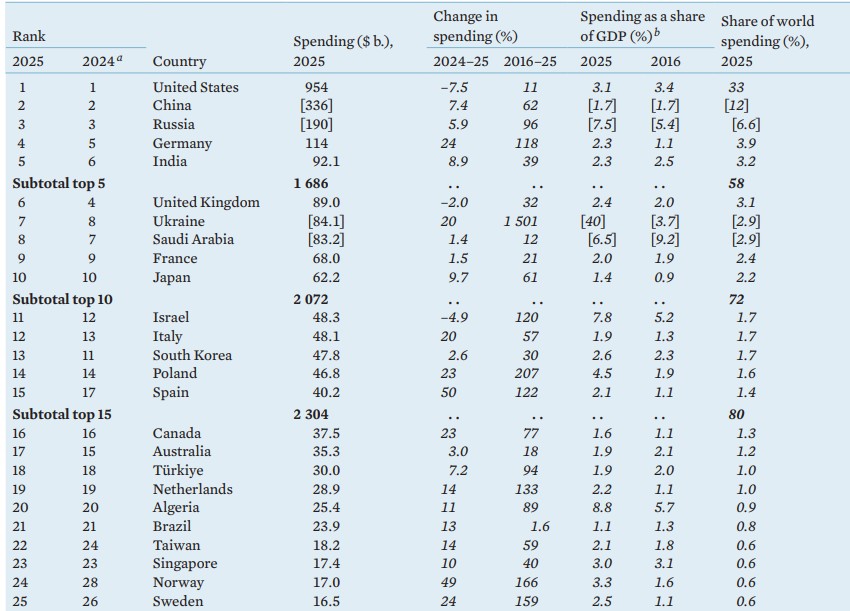
“Global military expenditure is highly concentrated among a relatively small group of states: the top 15 spenders accounted for US$2304 billion or 80 percent of world military spending in 2025. Taken together, spending by the top five—the USA, China, Russia, Germany, and India—reached US$1686 billion, equivalent to 58 percent of the global total,” the report said.
Nine of the top 20 defense spenders are European countries.
European states have, in the last decade, increased their defense spending by 102 percent; however, the capacity of Europe’s defense-industrial complex has not expanded correspondingly. This means that most European states are dependent on imports for their weapons needs.
In fact, Ukraine is the world’s largest arms importer, and seven European countries are among the world’s top 20.
Europe Tops Global Arms Imports
According to the SIPRI database for 2021-2025, Europe has overtaken Asia and the Middle East as the largest importer of weapons.
Between 2016 and 2020, Asia and Oceania accounted for 42% of global arms imports, followed by the Middle East at 32%, while Europe accounted for only 12%.
However, the global arms trade has completely changed in the last four years. Between 2021 and 2025, Europe topped the list with 33% of the global arms imports, followed by Asia and Oceania at 31%, and the Middle East at 26%.
In just four years, the European arms imports have almost tripled, from 12% to 33%, a direct impact of the Russia-Ukraine War.
Even within Europe, Ukraine and Poland top the list for arms importers, underlining how fears of Russian aggression are fueling militarism in Eastern Europe.
In fact, Ukraine is now the world’s largest arms importer.
Between 2016 and 2020, Ukraine accounted for just 0.1% of global arms imports; however, over the next four years, its share jumped to 9.7%, an increase of 11,896 percentage points.
“Threat perceptions concerning Russia, compounded by uncertainties over the USA’s commitment to defending its European allies, have boosted demand for arms among European countries,” the SIPRI report said.
Similarly, Poland’s share jumped from 0.4% in 2016-2020 to 3.6% in 2021-2025, an increase of 852%.
Arms imports by the 29 current European NATO states grew by 143 percent between 2016–20 and 2021–25. Well over half of these imports (58 percent) came from the USA in 2021–25.
Notably, at the 2025 NATO Summit in The Hague, all 32 NATO member states (except Spain) committed to a new target of investing 5% of their annual GDP in defense and security-related spending by 2035.
This initiative, known as “The Hague Investment Plan,” aims to bolster security against long-term threats, such as Russia.
The 5% goal consists of at least 3.5% for core defense (salaries, training, weapons) and up to 1.5% for security-related investments, such as infrastructure.
Apart from Ukraine and Poland, five other European countries also feature in the list of the world’s top 20 arms importers: the United Kingdom, the Netherlands, Germany, Greece, and Norway.
The Netherlands’ share of global arms imports jumped from 0.9% in 2016-2020 to 1.8% in 2021-2025, a 111% increase.
Similarly, Germany’s share jumped from 0.2% to 1.7% over the four-year period, a 914% increase.
Greece’s share jumped from 0.4% to 1.5%, a 295% increase.
Denmark’s share in global arms imports jumped from 0.2% to 1% over the four-year period, registering a 348% increase.
Belgium’s share in global arms imports has also increased by 1141%.
Europe’s turn towards militarism can have far-reaching consequences.
Both World Wars were essentially European wars that engulfed the entire planet. The period from 1945 to 2020, which saw no major war in Europe, was an exception for the continent known for its violent history.
The SIPRI arms transfer data suggests that Europe, once again, is dangerously moving towards militarism.
- Sumit Ahlawat has over a decade of experience in news media. He has worked with Press Trust of India, Times Now, Zee News, Economic Times, and Microsoft News. He holds a Master’s Degree in International Media and Modern History from the University of Sheffield, UK.
- VIEWS PERSONAL OF THE AUTHOR.
- He can be reached at ahlawat.sumit85 (at) gmail.com