Oscar Wilde, a well-known British dramatist, once remarked, “It is clear that humour is far superior to humor”.
This clever, witty remark not only emphasized that Britons have a distinct, dry, and almost ironical sense of humor but also highlighted Wilde’s assertion that ‘British humor’ is superior to ‘American humor’.
This witty and dry sense of British humor was on full display on April 29, when the UK’s King Charles III delivered a light-hearted yet sharp-witted history lesson at the White House dinner during his two-day royal visit to the US.
Playfully roasting US President Donald Trump, King Charles suggested that without British intervention in North America, Americans might well be speaking French.
“Indeed, you recently commented, Mr President, that if it were not for the United States, European countries would be speaking German,” the King said.
“Dare I say that, if it wasn’t for us, you’d be speaking French…!”
#WATCH | King Charles III says, "You recently commented, Mr President (Donald Trump), that if it were not for the United States, European countries would be speaking German. Dare I say that if it wasn't for us, you'd be speaking French…"
(Source: Unrestricted Pool via Reuters) pic.twitter.com/r2bUSI8VIG
— ANI (@ANI) April 29, 2026
This was a witty, light-hearted historical retort by King Charles III to Trump’s repeated claims that, without US involvement in World War II, Nazi Germany would have dominated Europe and that most Europeans, particularly the French, would still be speaking German.
Trump first made these remarks in 2018, during his first presidency.
In response to French President Emmanuel Macron’s call for a “true European army,” Trump wrote on Twitter: “Emmanuel Macron suggests building its own army to protect Europe against the U.S., China, and Russia. But it was Germany in World Wars One & Two — How did that work out for France? They were starting to learn German in Paris before the U.S. came along. Pay for NATO or not!”
Emmanuel Macron suggests building its own army to protect Europe against the U.S., China and Russia. But it was Germany in World Wars One & Two – How did that work out for France? They were starting to learn German in Paris before the U.S. came along. Pay for NATO or not!
— Donald J. Trump (@realDonaldTrump) November 13, 2018
Again, in 2025, White House Press Secretary Karoline Leavitt repeated these remarks.
Rejecting a call by a French member of the European Parliament for the return of the Statue of Liberty, Leavitt said, “My advice to that unnamed, low-level French politician would be to remind them that it’s only because of the United States of America that the French are not speaking German right now, so they should be very grateful to our great country.”
Trump repeated these remarks in January this year during the World Economic Forum in Davos, Switzerland.
“After the war, which we won, we won it big, without us, right now, you’d (Europeans) all be speaking German and little Japanese perhaps,” Trump said.
King Charles replied to these repeated remarks by referring to the colonial-era rivalry between Britain and France, when the two European powers battled for influence and territorial dominance in North America.
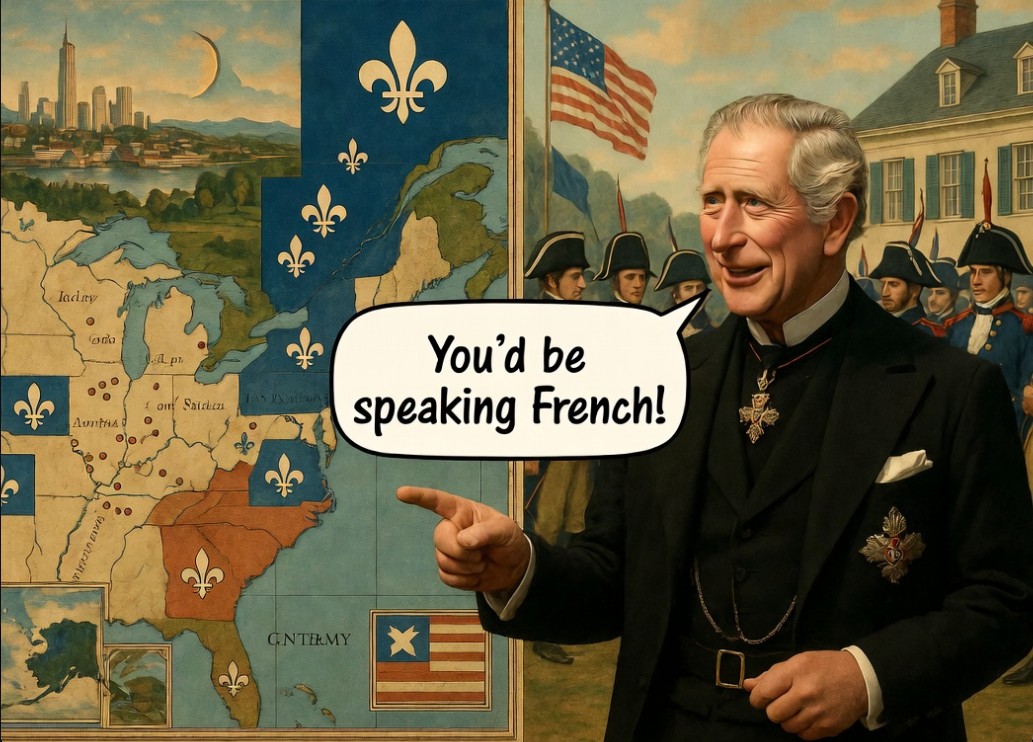
Though today the French colonial Empire in North America is largely forgotten, at one point in the 18th century, the French were firmly entrenched in Canada and America and had a larger presence on the continent than even the British.
France’s Forgotten Empire in North America
Today, if an American were to have a casual glance at the map of North America in the middle of the 18th century, he would be shocked by what he would see.
While the thirteen British colonies clung precariously to a narrow strip of land along the Eastern coast, the French dominated much of the hinterland.
This French Empire in North America, called ‘New France,’ stretched across much of the continent, from the icy shores of Canada in the north, down the Mississippi River to Louisiana, to the warm waters of the Gulf of Mexico in the south, French territories, forts, and trading posts dotted the entire continent, and controlled vital interior waterways.
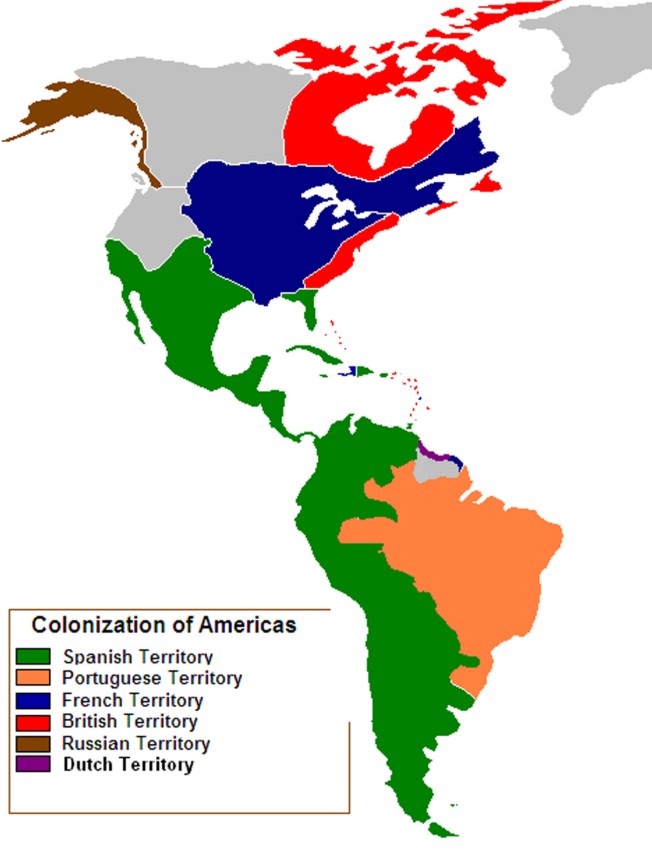
Additionally, the French enjoyed excellent relations with most native tribes, making their position in the New World much more secure than the British, who dominated only the Eastern coastline and were often at war with native tribes.
The French presence in North America goes back to the 16th century.
Jacques Cartier, a French maritime explorer, had claimed the St. Lawrence valley for France in the 1530s. Cartier was also the first European to describe and map the Gulf of St Lawrence and the shores of the St Lawrence River, which he named “Canada.”
The name “Canada” is derived from the St. Lawrence Iroquoian word kanata, meaning “village,” or “settlement.” Cartier documented this word in 1535 when Indigenous people used it to direct him to the settlement of Stadacona (present-day Quebec City).
Then, Samuel de Champlain planted the first permanent French settlement at Quebec (Canada) in 1608.
By the late 1600s, the French had navigated down the Mississippi River and claimed the entire Mississippi basin. The French named this territory — La Louisiana (Land of Louis) — after the then reigning French King Louis XIV.
The French built a chain of forts and trading posts that linked Canada to Louisiana: Detroit, Michilimackinac, Fort Chartres, Vincennes, and New Orleans. These forts commanded the rivers that served as the continent’s highways.
By 1750, the French controlled an area (New France) in North America that was several times larger than the 13 British colonies.
The French also dominated the lucrative fur trade.
However, the British had one decisive advantage: their numbers.
Despite controlling a territory several times larger, there were fewer than 100,000 French colonists in North America, compared to nearly 1.5 million British colonists in the 13 colonies.
The French and British clashed multiple times in North America, and mostly the French, in alliance with native tribes, dominated the conflict. In fact, British colonists repeatedly warned London that they were being encircled by the French and that Britain could lose its 13 North American colonies if decisive action was not taken against New France.
However, the decisive clash occurred during the Seven Years’ War (1756-1763), an intense conflict between European powers fought across the globe, including in Asia, Africa, and the Americas.
Due to the years-long, intense, and global nature of the conflict, many historians also refer to it as the First World War.
During the Seven Years’ War, Britain and Prussia (Germany) fought against the alliance of France, Austria, Russia, and Sweden.
In the American theatre of war, initially, the French had the upper hand. It appeared that France was destined to dominate North America.
But Britain, under Prime Minister William Pitt the Elder, poured massive resources into the theater. The Royal Navy cut French supply lines across the Atlantic.
British forces captured Louisbourg in 1758, Quebec in 1759 after the epic Battle of the Plains of Abraham, and Montreal in 1760. France’s small colonial population and overextended supply lines could not match Britain’s numerical and naval superiority.
The Treaty of Paris in 1763 marked the end of French North America. France ceded Canada and all territory east of the Mississippi to Britain. Louisiana west of the river went to Spain as compensation.
Now, Britain was the dominant power in North America.
However, the long years of war also bankrupted the European powers. Great Britain emerged victorious and now dominated North America, but it was also heavily indebted.
To tackle this debt, Britain taxed the colonies much more ruthlessly. This harsh taxation directly fueled the American Revolution, just 12 years after the Treaty of Paris.
France, humiliated during the Seven Years’ War and still coping with the loss of lucrative North American colonies, aided the rebels against Britain.
The United States declared its independence on July 4, 1776.
However, even now, many regions in North America have a strong French influence. For instance, Quebec, Ontario, and New Brunswick in Canada, and Louisiana, Michigan, and Missouri have substantial French speakers.
If France had not been defeated in the Seven Years’ War, it is entirely possible that many more North Americans would be French-speaking today.
King Charles’s statement, therefore, is not totally implausible.
- Sumit Ahlawat has over a decade of experience in news media. He has worked with Press Trust of India, Times Now, Zee News, Economic Times, and Microsoft News. He holds a Master’s Degree in International Media and Modern History from the University of Sheffield, UK.
- VIEWS PERSONAL OF THE AUTHOR.
- He can be reached at ahlawat.sumit85 (at) gmail.com