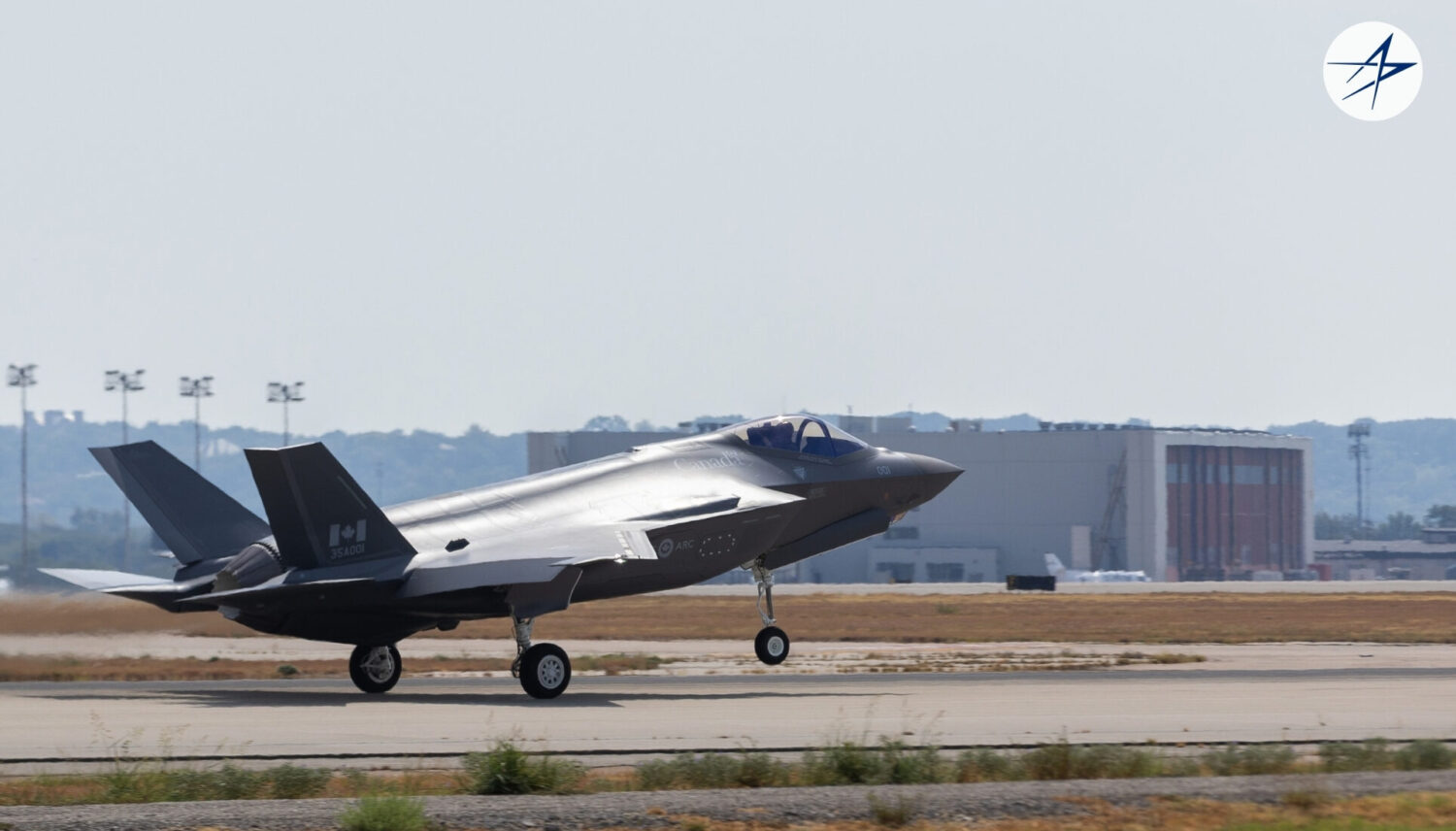
Canada’s first official F-35 (designated CF-35A) completed its maiden flight at Fort Worth, Texas, on September 23, 2026. The development comes as Ottawa reviews its remaining F-35A acquisition amid tensions with the Trump administration.
The jet, production number AR-1, lifted off from Lockheed Martin’s Fort Worth line with an F-35C as a safety chase. It already wears bilingual RCAF–ARC titles.
The first eight Canadian jets are due at Luke Air Force Base, Arizona, in 2026–27 for pilot training. The first aircraft is scheduled to reach Cold Lake in 2028, with initial operational capability in 2029.
Earlier, as EurAsian Times reported, to guard these warplanes, the RCAF is creating a new military occupation known as Security Forces, or SecFor.
“The Royal Canadian Air Force (RCAF) is establishing a new military occupation, Security Forces (SecFor), to deliver a dedicated force protection capability. The new occupation will help support the RCAF as it introduces advanced air and space systems that require higher levels of security,” the service said in an official announcement last month.
The RCAF has noted that recruitment for the initial cohort, primarily non-commissioned members led by a small number of officers, is already underway. The position is open to eligible Regular Force and Primary Reserve members across the Canadian Armed Forces.
Members of the new security force will begin training in October this year, with the USAF’s 343rd Training Squadron at Joint Base San Antonio and Camp Bullis. Most of the trained personnel will then be stationed at 4 Wing Cold Lake in Alberta and 3 Wing Bagotville in Quebec, though some will be deployed to RCAF division headquarters.
Canada has already paid for 16 F-35 jets. It had originally planned for 88 aircraft but is reviewing the remaining 72. Ottawa was also evaluating Saab Gripens, the original competitor to the F-35 for the RCAF deal.
The question is: despite immense tensions with the Trump administration, will Canada cancel the F-35 deal for 72 jets and operate a mixed fleet of US and European warplanes? How will the US, the core security provider to the world’s second-largest country, respond?
NORAD, the binational security framework, gives Ottawa and Washington shared radar, warning, and fighters ready to challenge Russian Tu-95 Bears, Tu-142s, and the occasional Su-35 escort when they push into the Alaskan and Canadian Air Defense Identification Zones.
NORAD has been scrambling mixed packages of American F-35s, F-22s, F-16s, and Canadian CF-18s to identify and escort Russian warplanes off Alaska and the Arctic.
In March 2026, for instance, one of the larger recent responses put F-35s, F-22s, and Canadian CF-18s up together to intercept two Russian Tu-142 maritime reconnaissance aircraft entering the Alaskan and Canadian Air Defense Identification Zones (ADIZ).
This was the largest NORAD response since July 2024, when Russian and Chinese bombers flew a joint patrol off the coast of Alaska, the first such mission ever. American F-16s and F-35s and Canadian CF-18s intercepted the bombers then. It was also the first time in recent years that F-35s and F-22s were scrambled together.
The threat to Canada is real, especially when it’s openly supporting Ukraine.
A future Canadian fighter, such as the Saab Gripen, that does not fit into NORAD could jeopardize this crucial security arrangement.
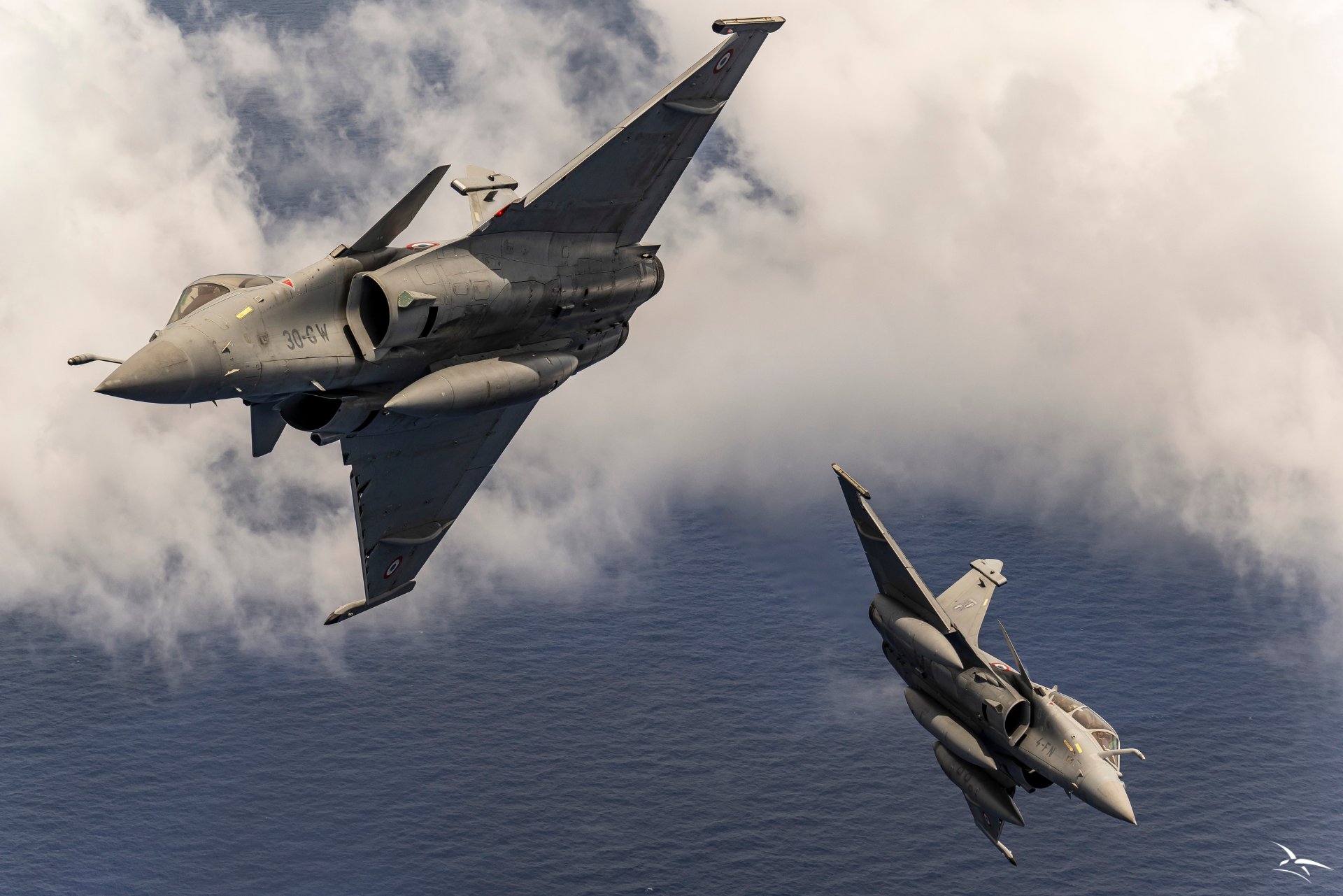
The advantage of Canadian F-35s is simple and clear: common sensors, common data, common tactics with the American jets that will seemingly fit into NORAD. This is exactly why France’s Dassault Aviation (Rafale) withdrew from the Canadian fighter jet deal.
Ottawa had approved Dassault for the competition. However, the company reviewed the draft Request for Proposal (RFP) and concluded that the Canadian requirements—interoperability and intelligence data sharing, especially with the US forces—would be challenging to meet.
Ottawa confirmed the withdrawal after the news report became public. “On November 8, the French government officially notified Canada of its withdrawal from the competitive process to replace Canada’s fighter jet fleet,” said Public Services and Procurement Canada spokesperson Rania Haddad in 2018.
“We will continue to work closely with the remaining eligible suppliers to ensure they are well-positioned to participate in the ongoing competition.”
Walking away from the remaining F-35 deal would not, by itself, tear up the 1958 NORAD pact. However, Canada appears to be keeping the F-35 deal on the back burner, probably until Donald Trump clears his presidential term, or using it as a bargaining chip with the US.
Earlier, Canadian PM Mark Carney–responding to US officials alleging that Canada walked away from the F-35 deal for political reasons– said, “I don’t think, with all respect, appointed, unelected cabinet members in the United States are experts on Canadian politics.”
While Canadian military experts have strongly supported the F-35 deal and hinted it would clear all hurdles, the head of the Defense Investment Agency said the Canadian public would not welcome sole-source military contracts for US firms under the current conditions.
“That’s just me reading the room,” Stephen Fuhr, secretary of state for defense procurement, said in an interview. “I think that would be a very difficult thing to do, especially after this last week. I think that people would not be happy about that.”
Although Fuhr considers the US a critical defense partner, he emphasized that Canada has realized the dangers of “putting all our eggs in one basket” and said Ottawa must build new strategic partnerships or become more independent in military manufacturing.
Since returning to office, Trump has treated Canada, like many other allies, with sheer disdain, like calling it the 51st American state, floating “economic force” to get it there, posting maps that swallow the country, and telling Ottawa it already enjoys “the benefits of being a state, without being one.”
After trade talks collapsed in August 2026, he threatened to rename Lake Ontario “Lake America,” then signed an executive order forcing US agencies to use that name.
Trump has piled on tariffs, including a 50 percent levy on tens of billions of dollars in Canadian goods; demanded concessions on the Gordie Howe bridge; refused to treat the North American trade deal as settled; and, according to Congress’s own researchers, reportedly threatened a 1908 boundary treaty. He has called Canadian leaders “clowns,” told them to “fall in line,” and warned the consequences would be “far WORSE.”
The question remains: will Trump now threaten NORAD?
- Nitin J Ticku holds a double master’s degree in Journalism and Business Management from the University of Glasgow. He has over 20 years of global experience in MARCOM, Journalism, and Digital Marketing, and has worked & traveled widely across Europe, the Americas, and Asia. Nitin is the Editor of the EurAsian Times.
- He can be reached at editor (at) eurasiantimes.com