“What does a THAAD air defense interceptor have in common with a Corvette (an iconic American two-door, two-seater sports car manufactured by General Motors)?” Lockheed Martin COO Frank St. John asked.
“Both of them are highly engineered, both of them are precision manufactured, both of them have broad and diverse supply chains, and both of them are produced at rate.”
With these words, Lockheed announced General Motors’ entry into defense manufacturing.
Across the Atlantic, something similar was happening in Europe, where Renault, one of France’s oldest and most successful automakers, announced a partnership with defense technology firm Thales.
Renault will build Thales’ Toutatis remotely operated loitering munitions at one of its factories, with production of 1,000 units a month starting as early as next year, and targeting mainly overseas markets.
Together, the re-entry of these two automakers into the defense sector evokes powerful memories of the Second World War, when many of today’s leading automobile manufacturers shifted from making cars to producing tanks, armored vehicles, and ammunition.
In fact, automobile makers have a rich history of defense production.
During the Second World War, many of today’s renowned automobile makers, including Japan’s Mitsubishi and Toyota, Germany’s Volkswagen and Daimler-Benz, France’s Renault, the UK’s Rolls Royce, Italy’s Fiat, and the US’s Ford, General Motors, and Chrysler, were deeply involved in defense manufacturing, producing everything from tanks and aircraft engines to armored vehicles, munitions, and military utility trucks.
In the post-World War era, many of these companies returned to civilian automobile manufacturing; however, some companies, such as the UK’s Rolls-Royce, maintained active defense production units.
Following Russia’s invasion of Ukraine and the recent US-Iran War, nations are once again confronting a harsh reality: the peacetime defense production levels maintained since the end of the Cold War are woefully inadequate for sustaining prolonged, high-intensity conflicts.
Consider, for instance, the nearly 40-day-long US-Iran war and how it has depleted US stockpiles.
According to a Center of Strategic and International Studies (CSIS) report, before Operation Epic Fury began on February 28, 2026, the U.S. held roughly:
- 3,100 Tomahawk Land Attack Missiles (TLAMs) — Over 1,000 were fired (about one-third of the stock).
- 400 THAAD interceptors — 190–290 used.
- 2,500 Patriot interceptors — 1,060–1,430 fired.
- SM-3 and SM-6 missiles — Heavy use (250+ SM-3s out of ~400; 190–370 SM-6s).
- JASSM cruise missiles — Over 1,100 used out of more than 4,000.
- PrSM (Precision Strike Missile) — A newer system with fewer than 100 before the war. 40–70 used.
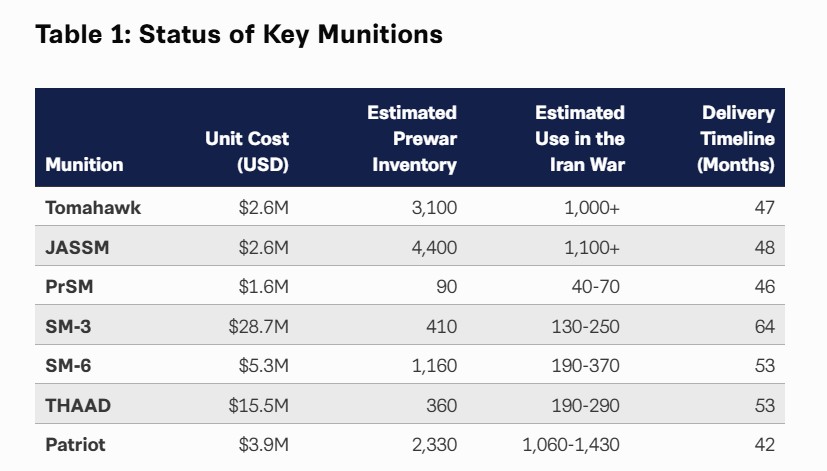
If the world’s preeminent military power can deplete one-third to nearly half of its stockpiles of critical precision missiles in just 40 days — in a conflict involving no ground invasion — it raises a deeply uncomfortable question: Can Washington sustain a prolonged, high-intensity war against a peer adversary such as China or Russia?
As a result, nearly eight decades after World War II, governments are once more turning to the automotive industry to rapidly scale up defense manufacturing.
Lockheed, GM Announce Partnership To Bolster Defense Production
On June 16, Lockheed Martin and GM Defense announced a new collaboration to strengthen America’s manufacturing and defense industrial base. The agreement was facilitated by the U.S. Department of War (DoW).
The collaboration will harness Lockheed’s expertise as the world’s largest defense contractor in defense production and GM’s advanced industrial capabilities in high-rate commercial manufacturing and engineering.
The collaboration will focus on three areas: strengthening defense supply chains, advancing manufacturing and design capabilities, and evaluating opportunities to expand production capacity through commercial manufacturing expertise and infrastructure.
The companies revealed few specifics about the agreement, but The Wall Street Journal reported that they are in talks for GM to produce “commonly used parts” that could help Lockheed as it scales up munitions production.
Notably, the agreement was announced on the same day President Trump invoked the Defense Production Act (1950) to address constraints in munitions production.
“I hereby find that conditions exist which may pose a direct threat to the national defense or its preparedness programs. In particular, systemic constraints in the munitions industrial base, including limited production capacity, fragile supply chains, long-lead dependencies, and related production bottlenecks, may impair the ability of the United States to produce, sustain, and expand the availability of munitions, missiles, and equipment required for the national defense,” said a presidential memo released on June 16.
The memo further directs the Secretary of War to “provide for the making of voluntary agreements and plans of action to help provide for the national defense.”
Commenting on the memorandum of understanding (MOU) signed between Lockheed and GM, Frank St. John, COO, Lockheed Martin, said, “America’s security depends not only on developing advanced technologies, but on our ability to produce them quickly, reliably, and at scale.”
“This collaboration brings together two leaders in American manufacturing and innovation to explore new ways to strengthen the defense industrial base, expand production capacity, and accelerate delivery of critical capabilities for the United States and its allies.”
“By combining commercial and defense expertise, the companies aim to identify opportunities that can accelerate production timelines while maintaining the quality, performance, and reliability standards required for mission-critical systems,” Lockheed Martin said in a statement.
The partnership will help Lockheed meet the Pentagon’s request to triple and quadruple production rates of PAC-3 Missile Segment Enhancements and THAAD interceptors over the next several years by leveraging GM’s supply chain expertise, St. John said.
Notably, a Munitions Acceleration Council was established in 2025 to increase production of 12 critical weapons, including Patriot and THAAD interceptors and Long-Range Anti-Ship Missiles (LRASMs).
In fact, six of the 12 missiles and interceptors mentioned in the ‘Munitions Acceleration Council’ effort are manufactured by Lockheed, including PAC-3 MSE and THAAD interceptors, PrSMs, JASS/JASSM-ER, LRASM, and AMRAAMs.
GM’s extensive industrial base and well-established supply chains should help Lockheed to boost production of these critical munitions.
Meanwhile, across the Atlantic, Renault signed an agreement with Thales to produce drones.
Renault Teams Up With Thales To Boost France’s Drone Production
On June 16, Renault announced that it will produce military drones with defense technology firm Thales.
The two will jointly develop and industrialize the large-scale production of Thales’ TOUTATIS loitering munition.
Notably, this will be the second defense cooperation project between them, as the two are already developing an innovative 4-TROOP tactical vehicle, unveiled earlier this week.
“This strategic partnership combines Thales’ cutting-edge defense expertise with Renault Group’s industrial engineering and manufacturing capabilities to establish a sovereign, agile, and competitive drone industry in France, fully aligned with the requirements of the wartime economy,” Renault said in a statement.
“Through this collaboration, production of loitering munition could begin as early as 2027, with manufacturing capacity of 1,000 units per month from the first year, marking a significant ramp-up in France’s industrial capacities in this strategic field,” it added.
Thales currently produces around 100 units of the Toutatis drone per year. So, the plan is to scale up production from less than 10 drones per month to around 1,000 drones per month.
The TOUTATIS is a short-range loitering munition that can be deployed by dismounted soldiers and launched from a variety of platforms, including combat vehicles, aircraft, and naval vessels.
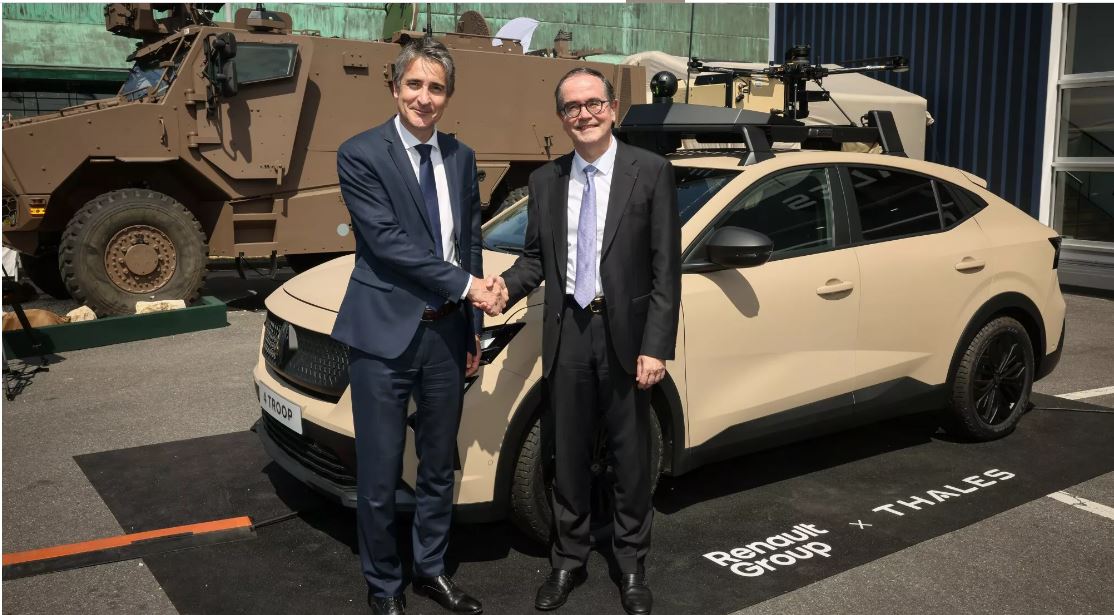
Resistant to electromagnetic jamming and equipped with a mission-configurable warhead, TOUTATIS can neutralize targets such as combat vehicles while keeping human operators in the decision-making loop.
Renault is already working on the Chorus program with drone maker Turgis Gaillard to develop a long-range model.
A demonstrator drone is expected by the end of this year, and around 600 drones are expected to be manufactured per month by next year.
Last June, Renault announced it was considering reentering defense production after an 80-year hiatus.
In fact, during the First World War, Renault produced trucks, stretchers, ambulances, shells, and even the famous FT17 tanks that made a decisive contribution to the final victory over Germany.
During the war, Renault also became a major supplier of aircraft engines. It built more than 5,300 V12Fe (300-320 hp) aircraft engines, which were widely used in bombers and reconnaissance planes.
The company also produced aircraft engines during the Second World War.
Renault produced over 30,000 aircraft engines between 1907 and 1944, making it one of the most prolific manufacturers in France.
After the war, Renault modernized its plants and built new production facilities. However, the company now primarily focused on building cars.
However, Russia’s invasion of Ukraine made European countries aware of their multipronged shortcomings in defense production, and they’re now exploring the spare capacity of automobile makers to boost defense production.
The US and France are reviving a World War II-era model by enlisting major automakers’ high-rate manufacturing expertise and supply chains.
However, it remains to be seen how far this experiment of enlisting automakers will strengthen the defense-industrial base and scale up production at a time when the world is facing multiple conflicts.
- Nitin J Ticku holds a double master’s degree in Journalism and Business Management from the University of Glasgow. He has over 20 years of global experience in MARCOM, Journalism, and Digital Marketing, and has worked & traveled widely across Europe, the Americas, and Asia. Nitin is the Editor of the EurAsian Times.
- He can be reached at editor (at) eurasiantimes.com