With the GlobalEye, Swedish defense manufacturer Saab has transformed the sleek, long-range luxury business jet into a cutting-edge airborne early warning and control (AEW&C) platform, creating one of the most remarkable transformations in military aviation.
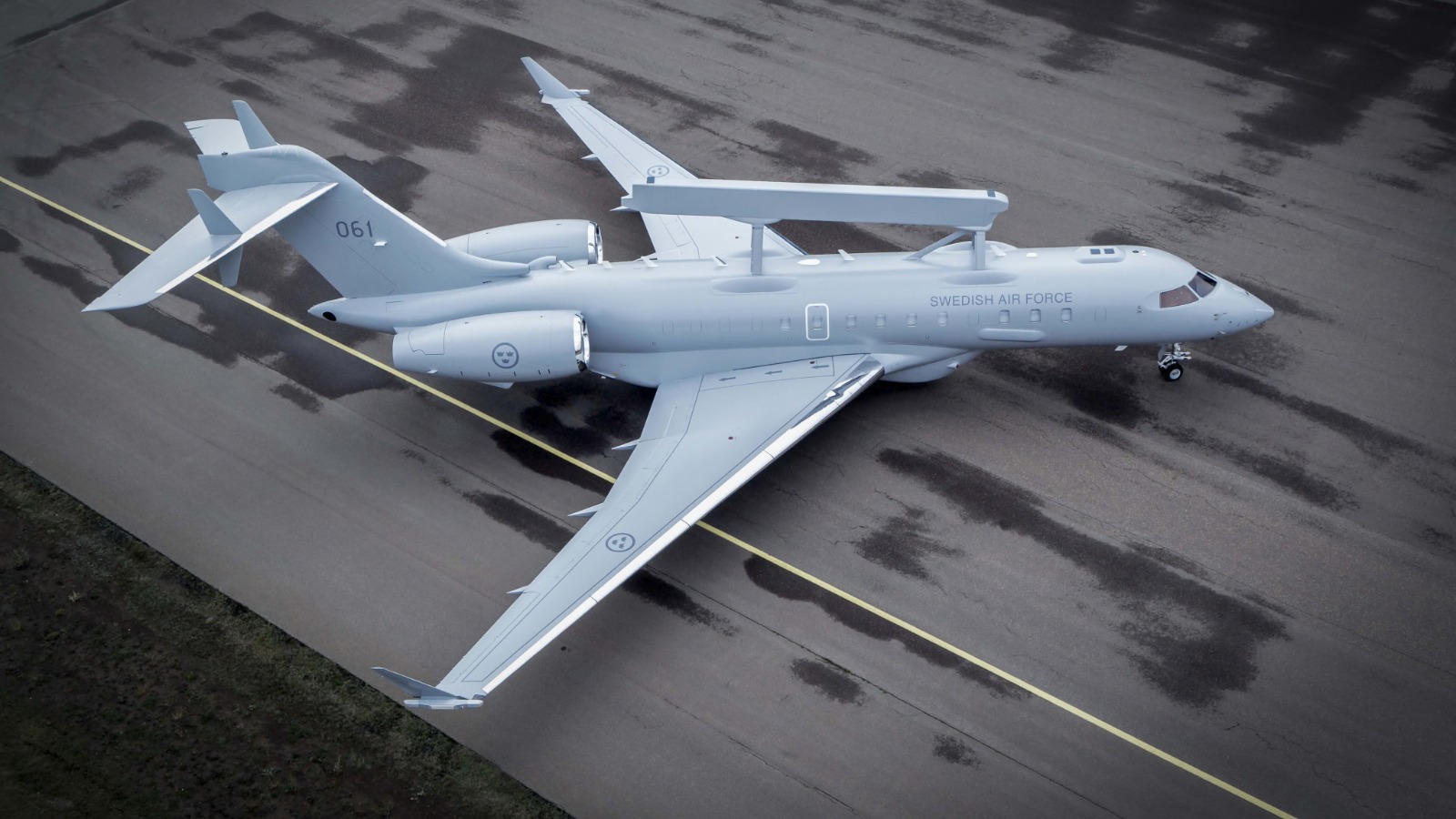
Amid the global surge in GlobalEye’s popularity, Saab unveiled the first AEW&C aircraft for the Swedish Air Force (SwAF) on October 15.
The AEW&C aircraft will give the Air Force long-range surveillance capability, strengthen its operational picture across the air, land, and maritime domains, and bolster its overall combat capability.
“The presentation of Sweden’s first GlobalEye marks an important milestone for both Saab and the Swedish Armed Forces. As the program progresses towards delivery, GlobalEye will provide Sweden with a powerful capability for airborne surveillance and situational awareness,” Micael Johansson, President and CEO of Saab, said in the official statement.
The Swedish Defense Materiel Administration (FMV) ordered two GlobalEye AEW&C aircraft for about SEK 7.3 billion ($738.2M) in June 2022, making it the second customer after the UAE. Later, in 2024, it exercised an option for a third aircraft after it donated its older Saab 340-based ASC 890 aircraft to Ukraine.
The manufacturer says the newly unveiled aircraft will now enter testing and verification before its first flight and delivery to the customer. Deliveries of these jets are expected to begin in 2027 and could conclude by or before 2029.
To speed the aircraft’s introduction into the Swedish Air Force, Saab is expected to deliver the first two GlobalEyes in an interim configuration and later upgrade them to full capability, while the third will arrive in the final configuration. However, neither Saab nor the Swedish Air Force has yet publicly detailed the differences between the two standards.
Notably, the unveiling of GlobalEye comes amid a rapid surge in orders.
For example, 11 NATO states announced in July 2026 that they would jointly procure Saab GlobalEye aircraft as NATO’s new Airborne Warning and Control System (AWACS). Meanwhile, France ordered the aircraft in December 2025, and Canada and the Netherlands are also moving quickly toward a purchase.
Saab also announced in late July 2026 that an undisclosed Middle Eastern state had ordered the GlobalEye, as the EurAsian Times reported. Although Saab has not officially disclosed the latest customer, it offered the aircraft to Saudi Arabia and Qatar last year.
GlobalEye’s success is striking: it is one of modern military aviation’s most ambitious conversion projects, transforming Bombardier’s ultra-long-range Global business jets into a multi-domain surveillance aircraft.
The Enviable Transformation
By the mid-2010s, Saab had decades of experience with its Erieye radar family, which had flown successfully on platforms such as the Saab 340 and Embraer R-99.
However, there was a catch: typically, these traditional AEW&C aircraft were large platforms with rotating rotodomes. This meant that although they were powerful, they were also expensive to operate. Furthermore, they required long runways and were becoming increasingly vulnerable in modern threat environments.
To simplify things, Saab scrambled to find a platform that offered superior capability at a lower cost. In the process, it concluded that a “high-performance business jet” offered higher altitude, endurance, and speed; lower operating costs; and the ability to operate from shorter runways. The company needed a platform that could carry a large, advanced radar while providing excellent crew conditions for long missions.
Interestingly, Saab’s previous surveillance platforms, such as the Saab 340, Saab 2000, and the Embraer R-99, had one thing in common: they were regional commercial or military-derived airframes, not high-end luxury business jets. However, with the GlobalEye contours now planned, Saab turned to the Global 6000 family of luxury business jets.
“Saab’s engineers and technical experts searched comprehensively for the best platform on which to build GlobalEye. Saab’s decades of engineering know-how led them to the Bombardier Global 6000 and 6500 business jet aircraft platforms. These jets are optimally sized with class-leading flight range and endurance,” the manufacturer says on its website.
At the Dubai Air Show in November 2015, the UAE announced a $1.27 billion contract with Saab for two aircraft under what was then called the Swing Role Surveillance System (SRSS), the program that became GlobalEye.
With this, the UAE became the launch customer for this now-coveted surveillance jet, and Saab officially launched the GlobalEye program in February 2016. The deal with the UAE reportedly covered two Bombardier Global 6000 business jets, which Saab would extensively modify with the new Erieye ER radar and other sensors. At the time, Emirati officials noted that they chose the Global 6000 after “a huge evaluation of different platforms.” The platform decision was part of the contract announcement itself.
The Global 6000 and Global 6500 were already ultra-long-range, twin-engine business jets designed for intercontinental VIP travel. These aircraft offered about 6,000 to 6,600 nautical miles of range, high cruise altitudes, and modern avionics.
Saab recognized that, with the right modifications, they could become ideal special-mission platforms.
Bombardier, a Canadian business jet manufacturer, delivered the Global 6000 or 6500 airframes to Saab in Linköping, Sweden, where they were transformed into one of the world’s most advanced surveillance aircraft.
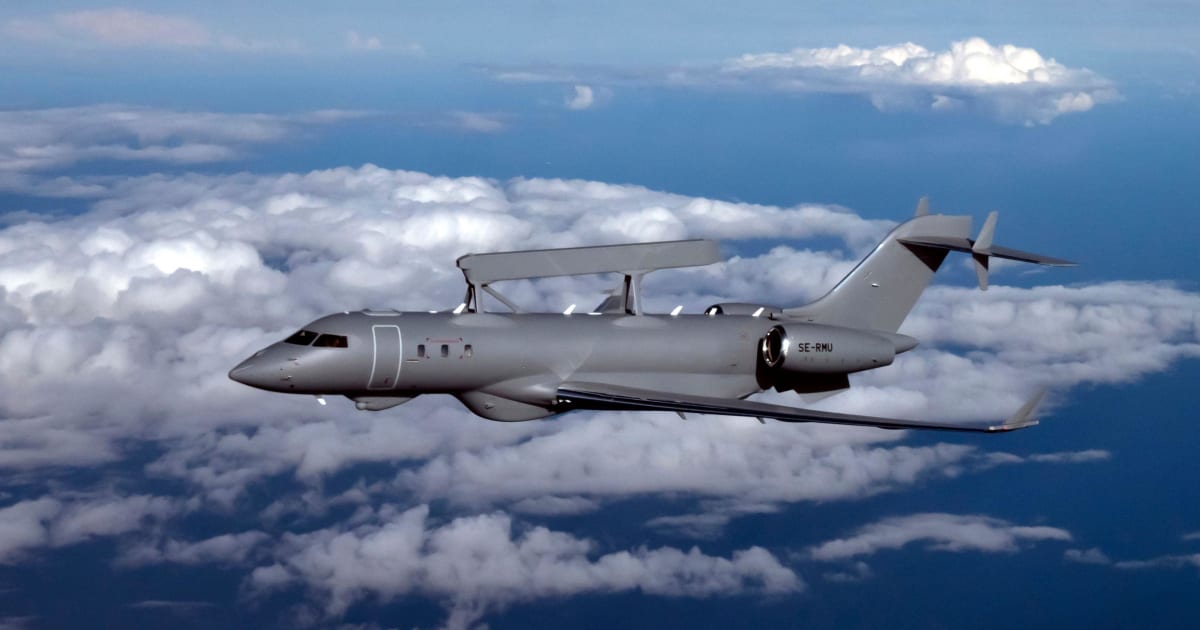
Saab now describes the GlobalEye as a sophisticated, multi-domain AEW&C system that uses a variety of active and passive sensors to detect and identify objects long-range on land, at sea, and in the air.
It improves situational awareness and enables early threat detection by providing Air Force, Army, and Navy units with access to real-time information. According to Saab, the GlobalEye “combines excellent flight performance with low maintenance costs” and can remain airborne for over 11 hours.
Saab’s Erieye ER radar, which delivers a significant performance leap over earlier Erieye versions using gallium nitride, is at the heart of this early warning aircraft. It reportedly increases the detection range by 70% against challenging targets.
Furthermore, even though Saab classifies this aircraft as an AEW&C, the Leonardo Seaspray 7500E radar and the FLIR (Forward Looking Infrared) Systems Safire electro-optical system, installed in pods beneath the fuselage, enable it to conduct both land and sea surveillance.
The system can identify small targets, like drones, and offer ground-moving target indication (GMTI), which is essential in contemporary warfare, particularly in the Middle East, where the usage of inexpensive, one-way attack drones has been observed to increase exponentially.
Moreover, GlobalEye excels at identifying low-observable, stealthy threats such as drones and ballistic and hypersonic missiles, even in contested environments with heavy electronic jamming.
GlobalEye can collect, analyze, and distribute data to all authorities and resources, including airborne forces. It also facilitates efficient information exchange between platforms. It can also manage and guide other assets, such as fighters, and direct them on when and where to act—a critical requirement in modern, networked combat.
GlobalEye succeeds by combining proven commercial airframe efficiency with Saab’s expertise in radar, systems integration, and multi-domain operations.
Compared with many larger dedicated advanced early warning platforms, it offers lower lifetime costs, greater operational flexibility, and the ability to produce a comprehensive real-time image for national authorities and combined forces, whether in high-intensity war, crisis response, or peacetime monitoring.
It wouldn’t be an exaggeration to say that developing the GlobalEye has allowed Saab to re-enter the global AEW market, building on the success of its previous early warning aircraft.
More importantly, what began as a luxury business jet designed to fly executives has become one of the most capable and sought-after airborne surveillance systems of its generation, thanks to Saab’s vision and engineering.
- Contact the author at sakshi.tiwari13 (at) outlook.com
- Follow EurAsian Times on Google News