The UAE carried out attacks on Iran in April 2025, according to reports in the Wall Street Journal. The EurAsian Times had reported last month about the suspected use of Emirati Mirage-2000-9 jets in the attack.
In an article on Monday, WSJ said the UAE’s attacks targeted a refinery located on Iran’s Lavan Island and took place “around the time” US President Donald Trump was “announcing a cease-fire in the war” after a five-week air strike campaign. The US has quietly welcomed the Emirati strikes and any other Gulf states that want to join the fight, the paper reported, citing one unnamed source.
On the morning of April 8, Iranian state broadcaster IRIB said: “missile and drone attacks on the Emirates and Kuwait have taken place a few hours after the targeting of Lavan island oil facilities in Iran.”
The state broadcaster said the Lavan facility “was subjected to a cowardly attack.”
Earlier Report by EurAsian Times
Both the US and Israel denied their role in the strikes on Iran. However, following the attack on Lavan, some reports began circulating on social media, claiming that the strike was carried out by a Mirage 2000-9, which is operated by only one country in the world: the UAE.
The images attributed to the Mirage 2000-9 were also published on social media, but their veracity could not be independently established. Subsequently, analysts pointed out that the aircraft type was both operationally confirmed as active that morning and was also technically suited for this kind of mission.
However, reports citing the UAE Ministry of Defense stated that the Mirage had been deployed to intercept incoming Iranian missiles and drones.
Neither the UAE nor official sources in Iran have commented on these allegations at the time of writing this report. However, posts on X by popular accounts have triggered a frenzy, with some going so far as to allege that the UAE launched the attack in collaboration with Israel, because both countries do not want the US to walk away from the war.
🇮🇷🇦🇪 Iranian media claims the attacks on Iran’s refineries in the Persian Gulf earlier today were carried out by UAE Mirage 2000-9 fighters.
If true, this is very significant and very concerning.
Source: @Spectator_MENA pic.twitter.com/w4TKJseIHH https://t.co/AaIAdN9foh
— Mario Nawfal (@MarioNawfal) April 8, 2026
On its part, the United Arab Emirates—which has repeatedly come under attack since the war began—said Iran should pay for damage caused by its attacks. It also asked for clarity on how the ceasefire will ensure that Tehran stops attacking the Emirati territory and unconditionally opens the Strait of Hormuz, whose de facto closure has held the global oil prices and economy hostage.
Interestingly, the claims surrounding the UAE’s role in the strike on Lavan came days after the wreckage of a Wing Loong II drone was recovered in Iran, as reported by the EurAsian Times at the time.
The Chinese-origin drone is operated only by the UAE and Saudi Arabia in the region, and its discovery sparked speculation that either of these two US allies had directly entered the war, likely to provide ISR (Intelligence, Surveillance, and Reconnaissance) support to the US forces in the region.
The Lavan refinery, located near the Strait of Hormuz, processes approximately 55,000 barrels of oil per day and is a high-value civilian facility.
Mirage 2000-9 Jets
Developed specifically for the United Arab Emirates (UAE) Air Force, the Dassault Mirage 2000-9 is the most sophisticated export version of the French Mirage 2000 family. It’s a single-engine, fourth-generation multirole fighter jet based on the Greek Mirage 2000-5 Mk 2 but incorporates significant UAE-specific enhancements.
The Mirage 2000-9 is often referred to as the “peak” of the Mirage 2000 lineage due to its superior air dominance, deep interdiction, precision strike, and reconnaissance capabilities.
The UAE had already ordered 36 older Mirage 2000s in 1983. However, to further modernize its air power capabilities, the Gulf country signed a major contract with Dassault Aviation, Snecma, and Thales during a 1997 visit by French President Jacques Chirac to the Emirati kingdom.
“To strengthen relations between the UAE and France, pursue the development of the UAE AF & AD, and continue to occupy a leading position in the 21st century, the decision to forge ahead with the Mirage 2000-9 program was approved in 1997 and announced at the time of President Chirac’s visit on 17th December 1997. Following a series of technical, operational, and financial discussions, the contract was signed in 1998,” states Dassault Aviation, the manufacturer of the Mirage 2000 series.
The contract included 32 new-build aircraft and the upgrade of older UAE Mirage 2000s to full Mirage 2000-9 standard. Some reports state that Mirage 2000-9 was not a minor upgrade but a near-complete redesign of the avionics and mission systems while retaining the proven Mirage 2000 airframe. It retains the core delta-wing, fly-by-wire design of the Mirage 2000 family for excellent high-speed performance and maneuverability.
It had both single-seater and two-seater trainer variants.
The aircraft features modular avionics, a new RDY-2 multimode radar, a digital terrain tracking system, new IMEWS countermeasures, a Thomrad radio with improved encoding and frequency evasion, a glass cockpit with new LCD visualization and compatibility with night vision goggles, a data-link, a gyro-laser inertial navigation system, and a navigation Forward Looking Infrared system (NAHAR), to name a few.
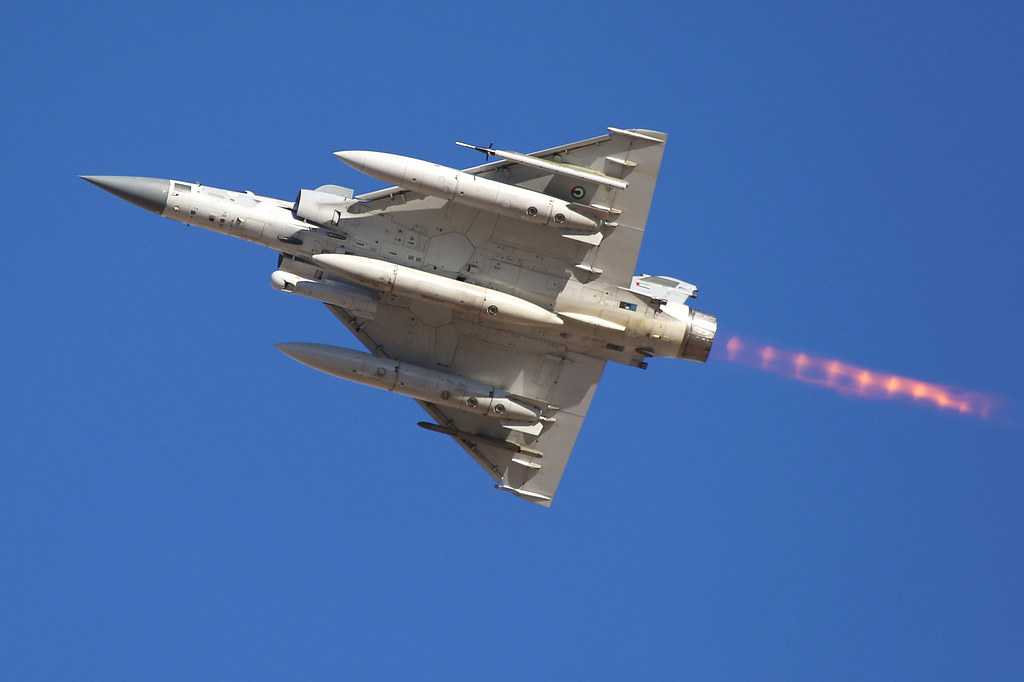
The aircraft has the Thales RDY-2 multi-mode pulse-Doppler (X-band), an evolution of the RDY with synthetic aperture radar (SAR) mapping, and provides up to 15% greater detection range than older Mirage 2000 variants. It can track up to 24 air targets and engage at least 4 simultaneously. Additionally, the Mirage 2000-9 supports in-flight refueling, oversized drop tanks, autothrottle, and has low operating costs.
The aircraft has nine hardpoints plus two internal 30 mm DEFA 554 cannons. For air-to-air strikes, it could carry up to six MBDA MICA missiles. Meanwhile, for air-to-ground strikes, Black Shaheen cruise missile, an UAE-specific variant of the SCALP EG, laser-guided bombs, conventional bombs, cluster munitions, and rocket pods.
According to Dassault, “In this program, two specifications are particularly worth mentioning in view of their unusual nature: modular avionics and countermeasures. Apart from the Mirage 2000-9, only the Rafale, F-22, and F-35/JSF are to be equipped with this pioneering “core system” IT architecture. When it comes to countermeasures, they break new ground by adopting interferometry technology.”
The Mirage 2000-9 also has the IMEWS, which is purportedly a classified integrated countermeasures suite comparable to ICMS Mk3. It uses advanced interferometry and digital RF memory (DRFM) for jamming, decoying, and threat analysis. Additionally, it is fully integrated with radar and a mission computer for real-time response.
The UAE Mirage 2000 fighter jets, including the Mirage 2000-9 variants, were not extensively deployed during the Gulf War but were later dispatched to enforce no-fly zones over Libya and to participate in the 2015 Yemen intervention.
The French firm Thales was given a life-extension contract for these aircraft, and a $489.5 million deal with Dassault was announced in November 2019 to further improve this fleet.
The aircraft will fly into the 2030s and will eventually be replaced by Dassault Rafale 4+-generation fighters, under a contract the UAE signed in December 2021. Meanwhile, the UAE plans to sell its upgraded Mirage 2000-9 jets to other interested buyers.
- Contact the author at sakshi.tiwari13 (at) outlook.com
- Follow EurAsian Times on Google News