OPED by Mark Fulton
Despite receiving a highly competitive offer for Lockheed Martin’s HIMARS to replace aging multiple-rocket launchers, France’s Armed Forces Minister Catherine Vautrin revealed on the opening day of the Eurosatory defense expo that “We are currently in exclusive negotiations with a sovereign consortium of Safran and MBDA.”
The Thundart offer also beat two domestic options, but European defense sovereignty advocates see the rejection of the American system as a major win.
Europe is adjusting to a new international norm in which the U.S. no longer considers guaranteeing European security a strategic priority. They are also adapting to the practical challenge that America’s defense industry is tied up filling the Pentagon’s orders for the next decade following the Iranian war.
As a result, Europeans face increasing pressure to become self-sufficient across the widest range of capabilities, from a “simple” armored vehicle to the most sophisticated hypersonic missile defense system.
Autonomy Through “Political Prioritization” and “Industrial Coordination”
The Sparta 2.0 paper published by renowned experts at the Kiel Institute argues that “Independent European agency and European conventional deterrence and defense are not a matter of cost or technological capability; they are a matter of political prioritization and leadership, industrial coordination, and the willingness to leave behind the inefficient fragmentation of European defense.”
Choices such as the one France just made show that political will is moving towards European autonomy, but have industrial actors put competition aside to cooperate on replacing reliance on American products?
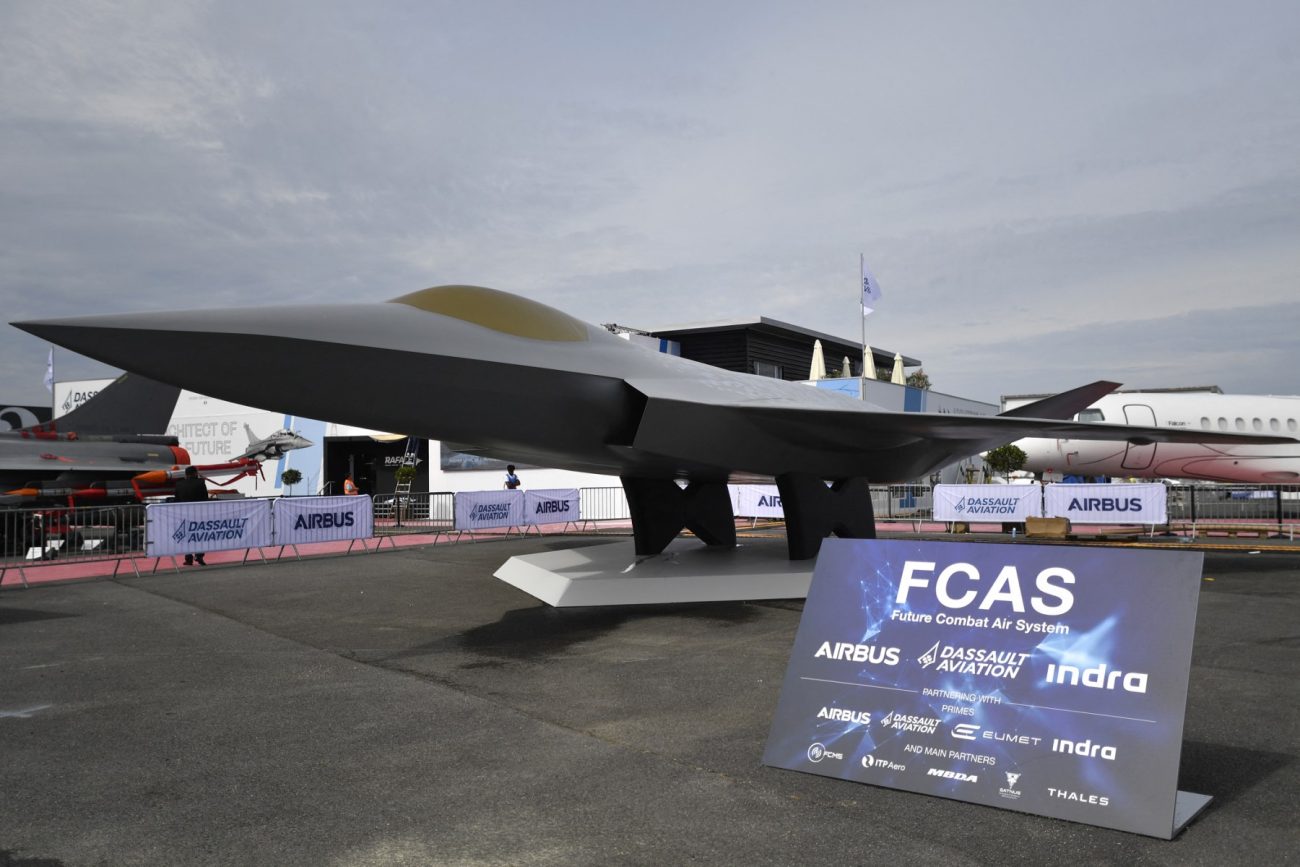
The very public failure of FCAS stemming from disputes between Germany’s and France’s industrial leaders would lead some to answer no. But the European defense industrial model has historically been based on promoting national champions, and FCAS failed primarily because the program was a political choice, not one made by industry, and that particular arranged marriage was not compatible.
The FCAS headlines unfortunately overshadow many successful examples of defense industrial partnerships across Europe, as transnational industrial champions prioritize developing sovereign military products over competitive tendencies.
Particularly for developing next-generation systems and inexistent technologies, EU-level and national leaders as well as major actors from the European defense technological and industrial base (EDTIB) recognize that “no one national state in Europe can support alone the costs and the risks of highly innovative products required by the present and future battlefields and no one has the innovation capabilities and the market scale to go alone.”
Modelling Cooperation
MBDA, Thundart’s co-developer, is a pan-European defense company with affiliates in Germany, France, the UK, Spain and Italy that operate semi-autonomously, coordinating with both ‘host’ nations and other branches. The transnational company also cooperates with various ‘outside’ industrial partners.
In January, MBDA CEO Eric Béranger signed Letters of Intent with Swedish Saab’s CEO Micael Johansson for future collaboration after successful partnerships on the Taurus cruise missile and Meteor air-to-air missile program. Béranger recently explained, “Looking longer term, we believe that achieving our goals depends on collaboration. Collaboration drives innovation, and innovation will enable us to provide our armed forces with the capabilities they need to meet future threats and effectively protect us and our freedoms.”
This assertion was recently demonstrated by the European HYDIS consortium, whose goal is to produce Europe’s first air defense system and interceptors capable of intercepting hypersonic threats (the U.S. doesn’t have the technology yet either).
MBDA is the coordinator and recently announced the newest evolution in this endeavor, called HYDIS2dp, aimed at answering the European Defense Fund’s (EDF) EATMI2 tender this year.
Under HYDIS2dp, MBDA France coordinates a consortium of 28 industrial partners and 20 subcontractors from 18 countries, each bringing a specific skill set to develop sovereign technology for hypersonic defense. In practical terms, this includes system-of-systems integrators such as Thales Netherlands and the Swedish firm Saab, as well as research institutes: Polish (Witu) or Czech (Uzlu), as well as leading SMEs in their respective fields such as Novian (specializing in AI algorithms, in Lithuania) or Crosshill (cybernetics, in Finland), to name just a few.
In another move to strengthen the EU’s industrial base and technological advances, the European Investment Bank just approved a €3 billion loan to Europe’s other transnational champion: Airbus. Funding will support the company’s R&D across the continent, including for aerospace technologies and security and defense, with EIB President Nadia Calviño explaining, “This is a flagship operation… which shows that Europe can move with speed and at scale to support its champions and reinforce its position in the emerging geopolitical landscape.”
Today’s Airbus was born 26 years ago when French, German and Spanish national aerospace champions set aside natural competitive tendencies to become one company, or a “genuinely pan-European industrial giant” with 87% of employees located in Europe, to surpass its American rival. This spirit of cooperation over competition to achieve technological advances motivated Airbus to join industrial forces with BAE Systems and Leonardo to create the Eurofighter Typhoon fighter jet program with Germany, Spain, the UK and Italy as partner nations and users.
Eurofighter is not Airbus’ only collaboration with Leonardo – a company considered more of a ‘national champion’ as the Italian government owns a 30.2% stake, but demonstrating its dedication to European sovereignty through various partnerships.
Like with the Leonardo-Rheinmetall Military Vehicles joint venture uniting Leonardo’s expertise with turrets and ammunition with German Rheinmetall’s Lynx and Panther tanks. David Hoeder, the JV’s executive chairman, explained the motivation: “Cooperation is not optional anymore — it is the very essence of our European strategic sovereignty.”
But Leonardo’s new venture with Airbus and Thales to pool space efforts (both civil and military) to compete directly with Starlink’s satellites is gaining the most attention. The initiative, called Bromo, was announced last October, and partners are waiting for Brussels to approve their pan-European space merger.
A few smaller European satellite companies criticized the move, but EU Defense and Space Commissioner Andrius Kubilius supports the effort, arguing that “scale and size” is needed for Europe to compete globally and, “That is exactly what Bromo offers. How to maintain a competitive environment domestically is always a question, but I think it should not be an obstacle for us in expanding some of our leaders.”
The Ecosystem Needs Champions
Leonardo’s CEO, Lorenzo Mariani, further explains that having a strong European champion is beneficial to the whole space and defense ecosystem because: “The only way to develop the whole supply chain is to build this champion. If we build this champion, also the European supply chain will be promoted and protected…”
The argument holds true for Europe’s other large programs, like HYDIS2dp’s efforts for hypersonic air defense, that rely on pan-European champions that can lead a web of industrial partners and subcontractors needed for their specific expertise.
Anne Fort, Deputy Head of Kubilius’ Cabinet, explained that the EDF selects industries based on their excellence and that the industrial reality means not all companies are capable of leading projects, but “that a balance is needed within the large projects led by large European industries that must include smaller companies or SMEs in the technological niches.”
Most of Europe is urgently trying to reduce reliance on America’s military capabilities and ultimately achieve a high level of European defense sovereignty. Transnational defense leaders like MBDA, Airbus, and Leonardo are proving that the best way to achieve that is to identify and cooperate with European industrial partners, regardless of size or flag, that bring needed expertise to the table.
- Mark Fulton studied geopolitics, with a particular focus on defense policy. He has worked as a senior consultant and research director for companies and professional groups, focusing for the last three years on the situation in Ukraine and its implications.
- The views and opinions expressed here are those of the author and do not necessarily reflect the editorial position of The EurAsian Times.