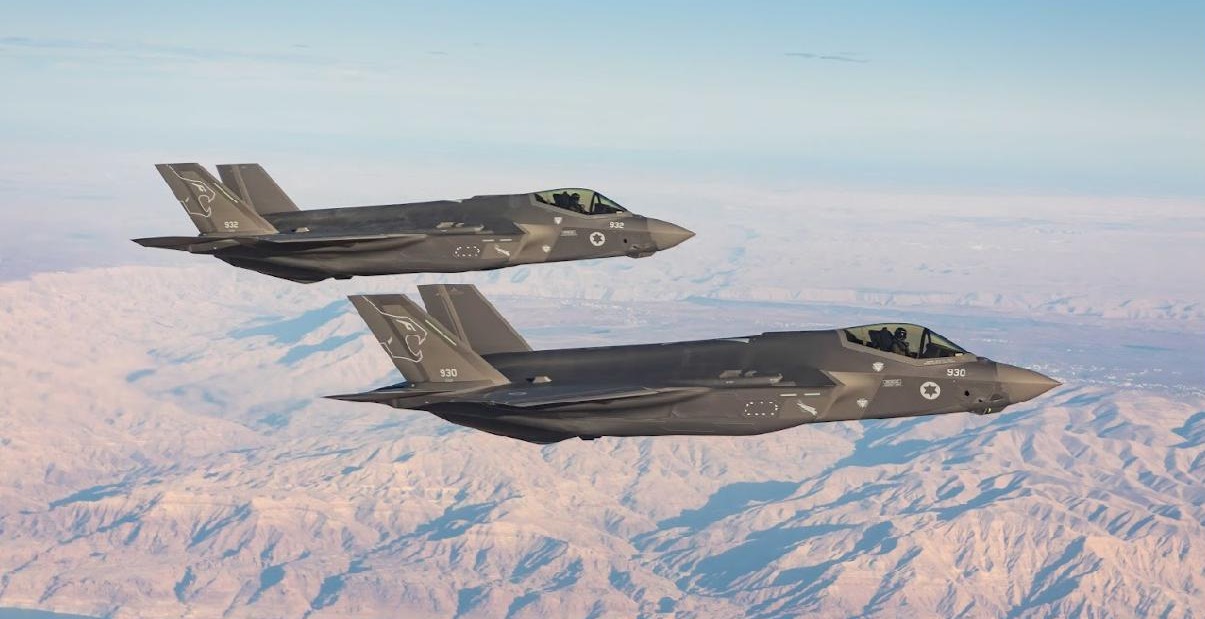
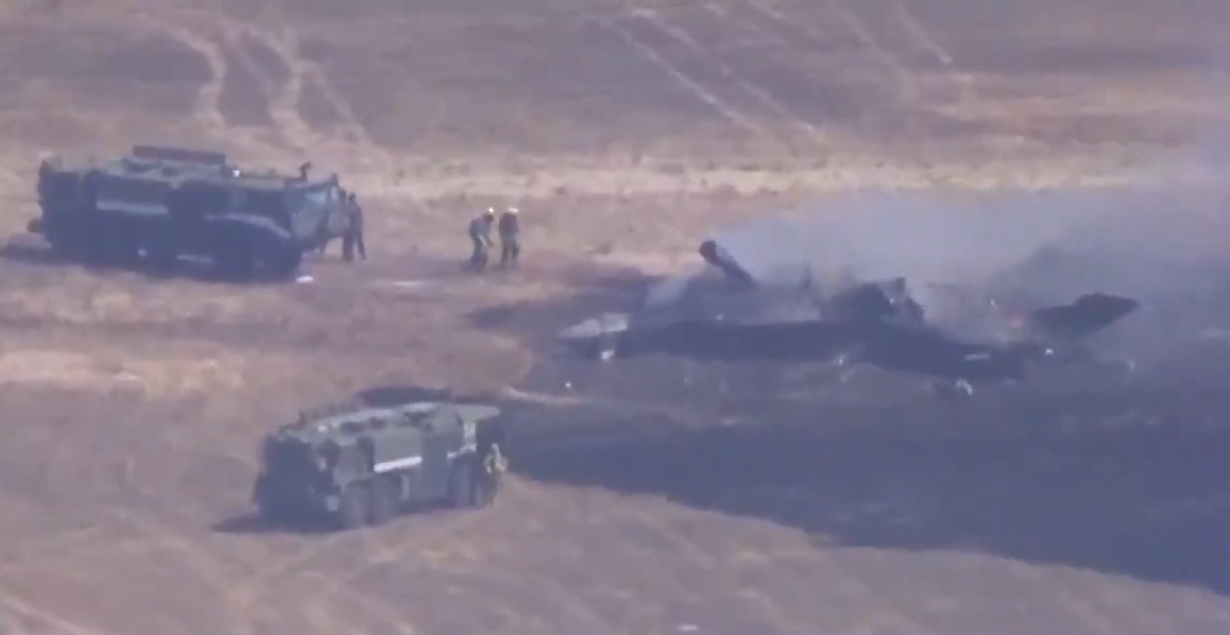
A US Marine Corps (USMC) F-35B fighter jet crashed and erupted into flames near Marine Corps Air Station Miramar in San Diego on Friday morning, officials said. The pilot ejected safely before impact and suffered minor injuries.
USMC said: Emergency personnel responded this morning to an aircraft mishap on the flightline of Marine Corps Air Station Miramar at approximately 10:00 a.m. local time today, involving an F-35B assigned to Marine Aircraft Group 11, 3d Marine Aircraft Wing. The pilot ejected, was transported to a local medical facility in stable condition for evaluation and treatment of non-life-threatening injuries.
The single-seat F-35 went down at approximately 10:00 am local time in the vicinity of the base’s flight line, south of Miramar Road near Mitscher Way, the Marine Corps said in a statement.
“There was an aviation mishap involving a Marine Corps F-35B in the vicinity” of the air station, base officials confirmed, classifying the incident as a Class A mishap — the military’s most severe category, typically involving the destruction of an aircraft, damage exceeding $2.5 million or the permanent disability or death of personnel.
No cause for the crash has been released, and officials have not identified the pilot.
MCAS Miramar, located about 14 miles north of downtown San Diego, is a major hub for Marine aviation and was once home to the US Navy’s elite “Top Gun” fighter weapons school, made famous by the 1986 film starring Tom Cruise.
The F-35B is the short take-off and vertical landing (STOVL) variant of F-35 Lightning II, a fifth-generation stealth fighter designed for the US Marine Corps. It is also operated by the UK and Italy.
Unlike the conventional F-35A variant used by the Air Force or the carrier-based F-35C, the B model is equipped with a shaft-driven lift fan behind the cockpit and a swiveling rear exhaust nozzle that can redirect thrust downward.
This propulsion system, powered by a Pratt & Whitney F135 engine producing more than 40,000 pounds of thrust, allows the aircraft to operate from short runways, amphibious assault ships or austere forward bases without needing full-fledged airstrips.
The F-35B has an approximate flyaway cost of $109 million, making it the most expensive of the three F-35 variants.
The crash is among several F-35 accidents in recent years involving various variants, though officials highlighted the aircraft’s safety systems as pilots managed to eject each and every time.
Earlier F-35B Crashes
On September 28, 2018, in South Carolina, the first crash of any F-35 variant was recorded. An F-35B from Marine Fighter Attack Training Squadron 501 crashed during a training flight. The pilot ejected safely. Investigators determined a manufacturing defect caused an engine fuel tube to fail.
The entire F-35 fleet was temporarily grounded for inspections.
Two years later, on September 29, 2020, an F-35B from Marine Fighter Attack Squadron 121 collided mid-air with a Marine Corps KC-130J tanker during aerial refueling near Naval Air Facility El Centro.
The pilot ejected, but the aircraft was destroyed. The KC-130 made an emergency landing, and all its crew members survived.
A year later, on November 17, 2021, a British F-35B crashed into the Mediterranean Sea shortly after takeoff from Queen Elizabeth aircraft carrier. The pilot ejected safely and was later recovered. An inquiry later found that an engine intake blank had been left in place, causing the loss of thrust.
On December 15, 2022, at NAS Joint Reserve Base Fort Worth, Texas, an undelivered F-35B undergoing production flight testing crashed during a failed vertical landing attempt. The test pilot ejected while the aircraft was still on the ground and was not seriously injured. The jet was written off.
Next year, on September 17, 2023, an F-35B from Marine Fighter Attack Training Squadron 501 experienced an electrical malfunction during a training flight in heavy rain and instrument meteorological conditions. The pilot ejected near North Charleston.
The unmanned aircraft continued flying for approximately 11 minutes and 21 seconds under its automatic flight-control systems before crashing in a rural area.
The aircraft’s debris was not discovered for more than a day. A Marine Corps investigation later attributed the mishap to pilot error, while noting the electrical failures and display malfunctions as contributing factors.
On May 28, 2024, an F-35B, a developmental test aircraft being flown by an Air Force pilot, crashed shortly after takeoff following a refueling stop en route from Fort Worth, Texas, to Edwards Air Force Base, California. The pilot ejected at low altitude, sustained serious injuries, but survived. The aircraft was completely destroyed.
Despite all these crashes, the pilots managed to eject and survive, though some sustained injuries.
By ET Desk