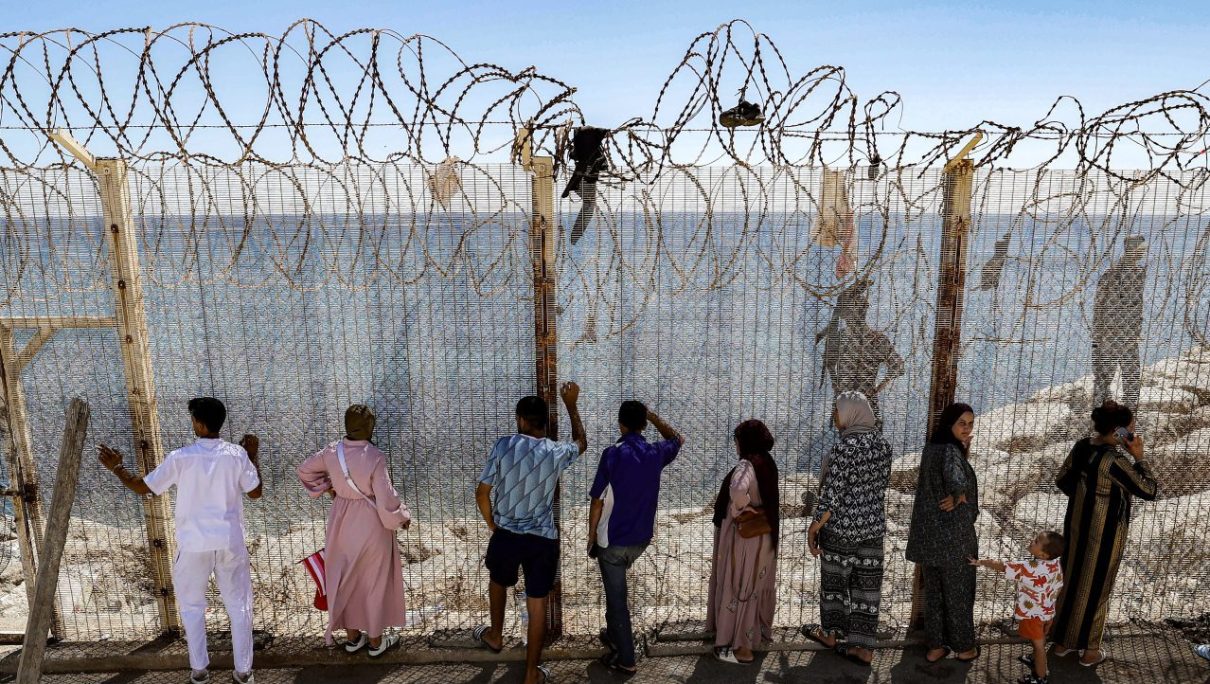
Nearly 50,000 of the 60,000 young Moroccans who had entered Ceuta, Spain’s 7.5-square-mile enclave on Africa’s coast, on July 29-30, 2026, by swimming around border barriers, may have returned to their country. But the global headlines they were responsible for have had geopolitical impacts on the rest of Europe and the United States.
Prime Minister Pedro Sanchez of Spain called the event “a violation of Spain’s territorial integrity”. But then the fact remains that his left-wing government’s series of liberal migration policies, coupled with the Spanish Supreme Court’s ruling last month that migrants arriving by sea could not be summarily returned, prompted such a massive migration, for which the country was perhaps not ready.
Of course, this was not the first surge from Morocco. As many as 10,000 from Morocco were said to have entered Spain in 2021. But the scale on July 29-30 made it the largest not only in Spain but also in the history of the European Union(EU).
After all, Ceuta, the small Spanish exclave on the North African coast, has a permanent population of just 84,000. Obviously, swarms of 60,000 outsiders totally overwhelmed the locals.
The crisis forces 3 questions: What drove it? What does Spain’s approach mean geopolitically? And how does the debate over religion, demography and identity shape it?
As pointed out above, the influx was possibly triggered by a ruling by Spain’s Supreme Court that a law allowing the prompt handing back of migrants who breach frontier barriers at Ceuta and Melilla, another Spanish exclave, does not apply to those who arrive by sea. (Those who swim, the court reasoned, do not technically breach frontier barriers, since there are none in the water.) Word of this got around on social media in Morocco, prompting the stream of swimmers.
It may be noted that historically, Morocco has contested Spanish sovereignty over Ceuta and Melilla, just 13 to 14 kilometers from its shores through the Strait of Gibraltar. This has led some analysts to believe that Rabat “deliberately did little to prevent the crossings”.
They cite the similar opening that was made in 2021. But this is a minority view, given that Morocco has already facilitated the return of 50,000 of its people and is doing so even now.
The 2021 episode was a little different. That time Morocco allowed its people to wade into Ceuta, as an expression of its anger that Spain had allowed the leader of Polisario, a group that has long fought for the independence of Western Sahara, to come to Madrid for medical treatment. Morocco, incidentally, had annexed two-thirds of Western Sahara, a former Spanish colony, in 1975.
However, over the last four years, diplomatic parleys between Madrid and Rabat have stabilized the bilateral ties. Spain now backs Morocco’s autonomy plan for Western Sahara in exchange for Rabat policing the coast and taking back illegal migrants.
In 2024, Spain started a program to legalize 900,000 undocumented migrants already in Spain (most of them Moroccans) to bring them into the tax and social security. It decided to issue “Labor visas”, under which fast-track permits to address Spain’s rapidly falling population.
The Sanchez regime has tried to legalize immigration as much as possible under what it calls a “human rights and labor needs” approach that envisages expanded regularization programs, bilateral cooperation with Rabat, and faster work permits for migrants in agriculture, tourism, and elder care.
Apparently, Spain has become the EU’s largest entry point for irregular migration, overtaking Italy and Greece. The vast majority of arrivals were from Morocco and the likes of Malians and Senegalese, who crossed through Morocco by sea. So much so that Spain now has the largest Moroccan diaspora in the EU — over 800,000 people of Moroccan origin, as per Spanish data.
Reportedly, the UN projects Spain needs 200,000 net migrants per year to maintain workforce size. And 10 million foreign-born people for the first time in Spain’s history; they now constitute a fifth of the country’s total population, about 50 million.
At 1.1 million, Moroccans happen to be the largest single nationality of all the foreign nationalities. Birth rates among Moroccan-origin residents are said to be higher than those of native Spaniards, but converge to the Spanish average of 1.6 percent by the second generation, per demographic studies.
In other words, Spain’s population would be shrinking without immigration.
However, the geopolitical reactions to what happened in Spain are quite different, particularly on both sides of the Atlantic.
The incident provided armor to President Donald Trump and all his supporters in their fight against what they say is illegal immigration into the US.
As images spread, Trump posted that the Ceuta scenes “vindicated” his wall and deportation policies, arguing Europe was now facing what the US faced in 2019. US conservative media amplified the Ceuta footage as evidence for border closure.
“I saw Spain yesterday, and I watched the catastrophe that took place,” Trump told a meeting of his cabinet at the presidential Camp David retreat in Maryland. “It looks like an invasion of a country by hundreds of thousands of people, and that same thing’s going to happen to us if the Republicans don’t get elected, except worse, much bigger.”
Tech billionaire Elon Musk also commented on the situation in Spain, writing on X that “Spain’s entire budget will be destroyed by illegal migrants” and arguing that offering benefits to migrants would create a “forcing function” for large-scale migration.
There were similar reactions from right-wing parties and EU centrists across Europe, demanding tougher immigration policies.
Far-right Alternative for Germany (AfD) co-leader Alice Weidel claimed in an X post that “Ceuta was left in ruins overnight” by the mass influx from Morocco. She argued that Germany is “likely the destination for most of these migrants”, adding “Germany must prepare itself: borders must be secured and rejections rigorously enforced”.
Italian Prime Minister Giorgia Meloni described the scenes in Ceuta as evidence that “uncontrolled illegal immigration poses a concrete threat to the security of Europe’s borders,” saying Italy was prepared to take “extraordinary measures” to defend its borders and the safety of its citizens, including the possible suspension of the Schengen Area with Spain.
The right-wing ruling coalition in Finland also called for excluding Spain from the European visa-free zone as a result of the situation. Czech Prime Minister Andrej Babis said the Ceuta situation was caused by Spain’s policy of offering hundreds of thousands of migrants already in the country a legal status.
In fact, the weekend incident in Spain is said to have accentuated the political turbulence in Europe and strengthened forces, including even conservatives and liberals, to end what was hitherto a “Liberal Consensus” on a liberal immigration policy.
That explains why on Saturday, Denmark’s Prime Minister Mette Frederiksen, German Chancellor Friedrich Merz, and Italian Premier Meloni initiated a letter that got signed by 22 member states, calling for immediate EU action.
“The bloc cannot allow uncontrolled mass crossings, the instrumentalization of migration or other hybrid threats to create the perception that illegal entry into the European Union is possible,” they wrote.
It may be noted here that for years Germany was the face of liberal asylum policy under Chancellor Angela Merkel. Now it has really reversed that under immense political pressure.
The AfD nearly doubled its vote share, especially in eastern Germany, by campaigning on immigration and crime linked to asylum seekers. As a result, the new CDU-SPD coalition started last year the policy of “Stricter border checks” and a “de facto entry ban” for undocumented migrants, including asylum seekers.
Even the British leadership labeled the developments in Spain deeply concerning while highlighting that the UK’s own restrictive operational measures are yielding lower overall small-boat crossing numbers compared to prior tracking periods.
Moving away from past perceptions of a liberal framework to stem the rise of populist Reform Party UK, the ruling Labour Party is now systematically tightening rules through higher salary thresholds, bans on dependents for most students, restrictions on overseas care worker recruitment, and shorter temporary protection grants for refugees.
And still its government is facing intense but growing popular pressure for mass deportations, rigorous enforcement and digital pre-departure checks.
Incidentally, the growing fears in Europe over uncontrolled and illegal immigration seem to have an angle of the fear of “Islamisation”. It may not be the main driver of policy changes, but it is a major factor in the political turbulence around immigration, particularly in Germany, the UK, and France.
There is a growing Muslim population in these countries due to immigration and higher birth rates among the immigrants.
Reportedly, there are 5.5 to 6.5 million Muslims in France, making it the largest Muslim minority in Western Europe. This group makes up about 8% to 10% of the country’s total population. The majority of them have roots in North Africa (Algeria, Morocco, and Tunisia), with smaller groups from Turkey and Sub-Saharan Africa.
Germany’s Muslim population is estimated to be between 5.5 and 7 million, which makes up roughly 6.5% to 8.5% of the country’s total population. The largest group has Turkish heritage, dating back to the guest worker program in the 1960s. Recent growth comes from refugees and migrants arriving from countries like Syria, Afghanistan, and Iraq.
The Muslim population in the United Kingdom is approximately 4 million people, making up about 6.0% to 6.5% of the total population. Islam is the second-largest religion in the country.
The largest share, as much as 66 percent, of British Muslims trace their family roots to the Indian subcontinent, with many arriving in waves during the 1950s and 1960s to fill postwar labor shortages. The rest came mainly from Somalia, Nigeria, Libya, Morocco, Algeria, Afghanistan, Iran, Turkey, and Cyprus.
In these three leading countries, considered to be the engines of Europe, the Muslim immigrants have created what are called economic, cultural, and political concerns over their running parallel societies, sharia law, religious schools, mosques, headscarves, and value clashes over free speech, gender, and LGBTQ issues.
Besides, there are problems relating to issues concerning economics, housing, asylum backlog, crime (the rise of extremism in Islam), and border control.
As it is, the Netherlands, Sweden, and Denmark have already passed laws on face veils, foreign funding of mosques, and “ghetto” laws. Denmark’s Social Democrats explicitly said they wanted “fewer Muslims” to protect their welfare state.
But then, as seen in Spain, these countries also face acute labor shortages, for filling up which most of these Muslims, like others, migrate. In any case, apart from the UK, in no country have Muslims become politically active to endanger the native whites. They do not have high-paying jobs like the skilled and highly educated immigrants, though they are doing very well in the sporting arena.
Therefore, if they are being seen with suspicion, it is because of the changes they have made to mainstream culture.
For many center-right and working-class voters in Europe, that includes concerns about mosques, religious schools, and values. That is why even left-wing parties like UK Labour and German SPD are now tightening controls. They have realized that if one does not address the cultural anxiety, one loses to parties who do or will.
In sum, what the weekend’s episode in Spain seems to have done is raise two questions: whether a liberal-immigration model of Europe will survive by combining open labor markets with credible borders; and whether Europe will still debate culture without dehumanizing people.
- Author and veteran journalist Prakash Nanda is Chairman of the Editorial Board of the EurAsian Times and has been commenting on politics, foreign policy, and strategic affairs for nearly three decades. He is a former National Fellow of the Indian Council for Historical Research and a recipient of the Seoul Peace Prize Scholarship.
- CONTACT: prakash.nanda (at) hotmail.com