It is not common to see a World War II-vintage, first-generation propeller-driven fighter aircraft flying alongside the latest fifth-generation jet fighters.
However, this is exactly what the British military aviation enthusiasts got to see this month, not once but continuously over a period of two weeks.
Between April 7 and 17, the Royal Air Force’s (RAF) most iconic World War II era fighter aircraft, the Spitfire, flew over the skies of the UK, alongside the country’s latest fighter jets, such as the F-35B Lightning-II, Eurofighter Typhoons, Red Arrows Hawks, Phenom T1 trainer, P-8 Poseidon maritime patrol aircraft, Hawk T2 trainer, and A400M transport aircraft, to mark the 90th anniversary of the first flight of the legendary fighter that played a key role in the Allied forces victory over the Luftwaffe.
Organized by the Royal Air Force, the commemorative flights visited RAF stations and airports associated with the Spitfire’s history.
Nearly nine decades ago, on March 5, 1936, the Spitfire conducted its first flight.
The first Spitfire, serial numbered K5054, was a Supermarine Type 300 and was piloted by Captain Joseph ‘Mutt’ Summers. It took off from Eastleigh Aerodrome, now Southampton Airport, and lasted eight minutes.
On this day in 1936 was the prototype Spitfire's maiden flight. Captain Joseph "Mutt" Summers, chief test pilot for Vickers, took off in K5054 from Eastleigh Aerodrome (later Southampton Airport). pic.twitter.com/7bbjlOBGxf
— RAF BBMF (@RAFBBMF) March 5, 2021
And on landing, Summers simply said, “Don’t change a thing.” Basically, Summers felt the plane’s configuration was perfect and wanted the ground crew and engineers to leave the aircraft as it was before his next flight.
The UK Air Ministry was so impressed with the aircraft that they placed a production order nearly three months later, even before all flight tests were completed.
Eventually, more than 20,000 Spitfires were built, and it remains the only UK fighter that remained in production throughout the Second World War. The Royal Air Force flew the last operational sortie of the Spitfire in 1954 in Malaya.
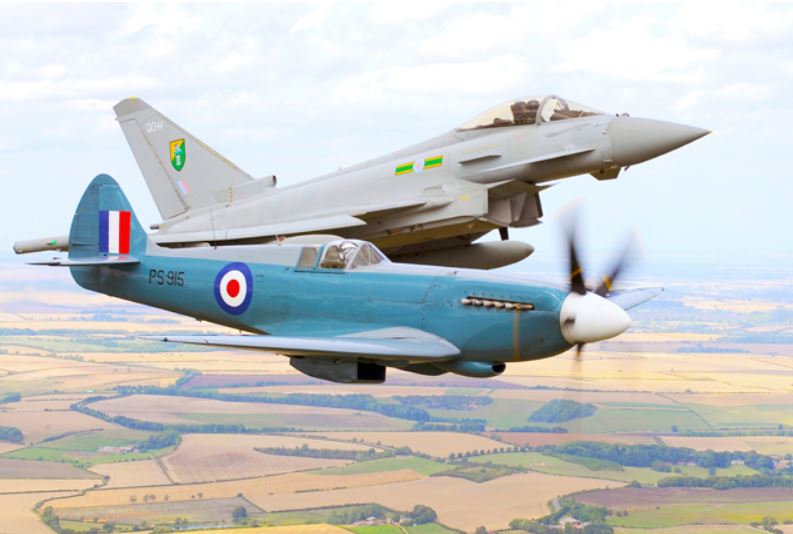
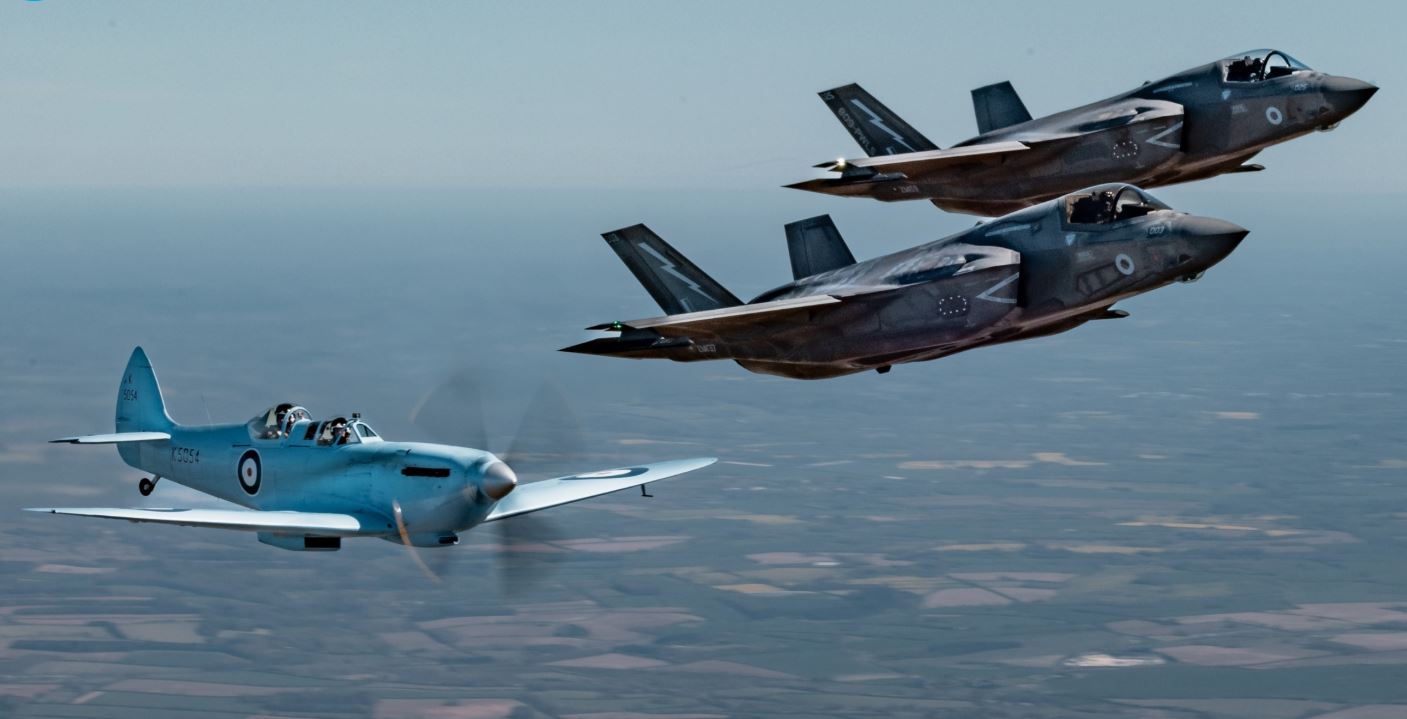
To commemorate that first flight, on April 7, a Spitfire, painted blue and serial numbered K5054, took off from its birthplace of Southampton Airport to RAF Coningsby in Lincolnshire, and flew in formation with another preserved Spitfire and two Royal Air Force F-35B Lightning-II fighter jets.
However, the blue Spitfire is actually a Mk IX, BS410, which crashed in May 1943, was recovered and rebuilt in the 2000s, and was converted into a two-seater, allowing for a passenger. It is currently privately owned.
The other Spitfire, a Mk Vb, AB910, also saw combat in World War II, including the D-Day landings in Normandy, one of the war’s most consequential battles.
90 years of aviation evolution in one frame. 🇬🇧
Celebrating 90 years since the Spitfire’s first flight — with the F-35 honoring British airpower across generations. pic.twitter.com/UBlVoYmHR8
— F-35 Lightning II (@thef35) April 13, 2026
Notably, the UK’S F-35Bs, the RAF’s most advanced fighter jet, just scored its first ‘aerial kill’.
During the Iran War, the RAF’s F-35Bs shot down hostile drones over Jordanian airspace.
On March 6, the RAF announced that a F‑35 pilot carried out the aircraft’s first combat shoot-down for the UK, intercepting and destroying two hostile drones during an operation over Jordan.
“The pilot, flying alongside two Typhoons from RAF Akrotiri, detected the drones on radar and engaged them with two ASRAAM missiles,” the RAF said in its statement.
Thus, a first-generation propeller-driven fighter aircraft that shot down German airplanes during World War II, and a fifth-generation fighter jet that shot down enemy drones during the current Iran War, flew together in formation over the UK sky.
For the second leg of the commemorative flights, the Spitfires flew in formation with Royal Air Force Red Arrows Hawks and a Phenom T1 trainer.
Joining up with a British aviation legend – great to share the skies today with Spitfire K5054 on its UK tour, marking the 90th anniversary of the aircraft type’s first flight and supporting the Mark Long Trust and RAF Benevolent Fund. #Spitfire90 #Spitfire #RedArrows #RAF pic.twitter.com/qdgyGNCoTg
— Red Arrows (@rafredarrows) April 8, 2026
The third flight, out of RAF Leuchars, on April 9, involved a RAF P-8 Poseidon maritime patrol aircraft.
For the fourth flight, on April 10, a Spitfire flew with a pair of Royal Air Force Typhoon fighters from Scotland’s RAF Lossiemouth.
For the fifth flight, on April 13, Spitfires teamed up with the RAF Hawk T2 trainer and flew out of Prestwick Airport.
Flight six, on April 14, out of RAF Valley, Wales, involved the Spitfire and two current RAF training types – a Texan T1 turboprop and a Jupiter HT1 helicopter.
For flight seven, on April 15, the Spitfires teamed up with two QinetiQ Pilatus PC-21 trainers.
Flight eight, on April 16, out of MOD St Mawgan, involved a Royal Air Force A400M transport.
For the ninth and final flight, on April 17, the Spitfire flew alongside the WWII-era Dakota transport planes, which were extensively used by Allied forces during the war.
The Spitfire flights over the UK skies once again reminded people of the iconic fighter’s unparalleled contributions during the Second World War in turning the tide of the conflict and helping Allied forces establish air superiority over the Luftwaffe.
Spitfire and the Second World War
The Supermarine Spitfire is one of the most iconic and most beloved aircraft of all time.
Between 1937 and 1947, over 20,000 of them were built, and in those 10 years, Spitfires changed dramatically from the Mk 1 to the Mk 24.
More powerful engines, new wing shapes, different armaments, and more were added to the Spitfire in an attempt to maintain its edge over enemy aircraft. The Supermarine Spitfire was the only Allied frontline fighter in complete and continuous development all the way through the Second World War.
Its sleek design, exceptional performance, and pivotal role in World War II have cemented its place in the hearts and minds of aviation enthusiasts and historians alike.
The Spitfire’s design was groundbreaking for its time. Whilst the Hurricane Hawker was also an excellent design, the Spitfire was much more innovative and radical.
Key features included a sleek, elliptical wing with an extremely thin airfoil, enabling exceptional maneuverability and speed, especially at high altitudes. Its all-metal, stressed-skin aluminum structure and retractable landing gear were cutting-edge technologies that set it apart from its contemporaries.
The Merlin-powered Spitfires, especially the Mk I and Mk II variants, played a pivotal role in the Battle of Britain due to their excellent performance.
However, by the end of the war, Spitfires were powered by the Rolls-Royce Griffon engines.
This 12-cylinder, liquid-cooled engine had a larger displacement than the Merlin, producing 1,990 to 2,350 horsepower. Griffon-powered Spitfires, such as the Mk XIV, offered improved high-altitude performance and speed.
During World War II, the Spitfire served in multiple roles, including fighter, interceptor, bomber escort, and reconnaissance aircraft.
By thwarting German attempts to gain air superiority, the Spitfire helped protect British cities from devastating aerial bombardment. This was a critical aspect of the battle, as the Luftwaffe’s failure to establish air dominance over Britain led to the abandonment of Operation Sea Lion, the planned invasion of Britain.
After the Battle of Britain, the Spitfires also played a critical role in the D-Day landing in Normandy on June 6, 1944, which began the process of German defeat on the continent.
Apart from Europe, the Spitfires also saw action in North Africa, the Pacific theatre, and in Burma.
During the war, the Soviet Union and China also received Spitfires as part of Allied efforts to boost resistance against Japan and Germany.
After World War II, the Spitfire continued to serve in various air forces around the world, including Belgium, France, Greece, Norway, and the Netherlands.
The Israeli Air Force (IAF) used Spitfires during the 1948 Arab-Israeli War. These aircraft were instrumental in securing air superiority over the region.
For the UK, the Spitfire was more than an aircraft. It became an enduring symbol of British resilience and determination during the war.
The legendary aircraft had its last operational flight in 1954 in Malaya; however, the aircraft remains popular among aviation enthusiasts.
Numerous Spitfires have been preserved and are displayed in museums all around the world. However, to see these beasts flying over the skies of the UK alongside some of the RAF’s latest fighter jets, trainers, and transport aircraft must have been a sight to behold.
- Sumit Ahlawat has over a decade of experience in news media. He has worked with Press Trust of India, Times Now, Zee News, Economic Times, and Microsoft News. He holds a Master’s Degree in International Media and Modern History from the University of Sheffield, UK.
- VIEWS PERSONAL OF THE AUTHOR.
- He can be reached at ahlawat.sumit85 (at) gmail.com