When Russia launched its full-scale invasion in February 2022, Ukraine’s air force consisted almost entirely of aging Soviet-era aircraft. Over four years later, it now operates a diverse and rapidly modernizing fleet that blends legacy Soviet platforms with Western-supplied jets, including the Su-27, MiG-29, F-16 Fighting Falcon, and Mirage 2000-5.
The Ukrainian Air Force is also on track to integrate more advanced fighters. Sweden has agreed to donate older Gripen C/Ds and support Ukraine’s acquisition of newer Gripen E/F models, and now France has announced that Kyiv will soon receive the multi-role Rafale fighter jets.
French Ambassador to Sweden, Thierry Carlier, said on May 30 that Rafale fighters are expected to join Ukraine’s growing fleet of Western combat aircraft.
While each of these Western fighter jets, the F-16, Mirage 2000, and Gripen, has added a distinct capability to the Ukrainian Air Force, the potential addition of multi-role Rafale fighters could be the real game-changer.
👏👏 Congratulations to 🇸🇪 and 🇺🇦 for this huge step ! Gripen is a fantastic fighter. With 🇨🇵 Mirage 2000-5, and Rafale also coming soon, 🇺🇦 Air Force to win in 🇺🇦 sky !@FranceinSweden https://t.co/veiH7GPQeA pic.twitter.com/yAgFDa0UiD
— Carlier Thierry (@CarlierThierr11) May 30, 2026
Ukraine’s Modernizing Air Force
When the war started, the Ukrainian Air Force fleet consisted of nearly 90 fighter jets, all of them of Soviet origin.
According to FlightGlobal’s World Air Forces 2022 report, Kyiv had no Western aircraft and its force consisted of legacy Soviet aircraft, including 43 MiG-29s, 12 Su-24s, 17 Su-25s, and 26 Su-27s.
All of these fighters were nearing their retirement age.
In 2023, Ukrainian Air Force pilots started training on the F-16 jets at Morris Air National Guard Base in Tucson, AZ, after many European nations decided to donate their F-16 jets to Ukraine.
Most of these were F-16AMs, midlife upgrades further modernized with improved electronic warfare capabilities and countermeasures to enhance survivability against S-300 and S-400 air defense systems.
By early 2024, Ukraine started receiving its first F-16s.
To date, Ukraine has received nearly 39 F-16 jets, while the European nations have committed to donating 85 F-16s in total.
These F-16s were used for air defense, strikes, and drone intercepts.
The integration of the F-16s allowed the Ukrainian Air Force to deploy US AIM-9 Sidewinder and AIM-120 AMRAAM air-to-air missiles as well as precision guided weapons, including the GBU-39/B SDB (small diameter bomb).

In late 2024, Ukraine announced that its air force would soon receive Mirage 2000-5F jets, a modified version of the air-defense fighter that now includes air-to-ground capability, precision-guided munitions (PGMs), and enhanced electronic warfare capabilities.
Deliveries started in February 2025, and to date, Kyiv has received six Mirage 2000 fighters.
Notwithstanding the small number of Mirages, these French-made fighter jets boosted Ukraine’s air defense and deep-strike capabilities.
Using these Mirages, the Ukrainian Air Force was able to fire the Storm Shadow, MICA, and Scalp missiles, one of the deadliest weapons in the Ukrainian arsenal.
The Mirage-2000-5 is also equipped with the ICMS Mk 2 electronic warfare (EW) system, which includes radar warning receivers, jammers, and chaff and flare dispensers. This system is designed to detect, prioritize, and counter radar threats, offering some level of protection against radar detection.
Then, in October last year, Ukraine signed a letter of intent (LOI) with Sweden to acquire up to 100-150 Saab JAS 39 Gripen E multirole fighter jets.
🇺🇦Ukraine signs LoI with 🇸🇪Sweden for 100–150 Saab Gripen-E jets! 🛩️
Kyiv could be biggest operator of the Aircraft.🛩️
Why should 🇷🇺Russia worry?🧵#RussiaUkrainewar #gripen pic.twitter.com/1h9nDWcnxu
— EurAsian Times (@THEEURASIATIMES) October 23, 2025
First deliveries are targeted for 2027-2028, with full rollout by 2035-2040.
SAAB is also considering opening a local production plant in Ukraine to enable faster deliveries.
Sweden has also announced it will donate up to 16 JAS 39 Gripen C/D fighter jets to Ukraine.
Explaining how the Gripens will boost the capabilities of the Ukrainian Air Force, Zelensky said their advantages include low maintenance costs, the ability to land on highways, and the ability to use all available missiles in Ukraine.
“Maintenance of Gripen is the cheapest, because the smallest number of people must be involved. For our pilot with expertise and experience, it is not a year and a half of training, as, for example, we had with the F-16, but 6 months.”
“All the take-off and landing technical capabilities of Gripen are also advantageous, you know – they can take off and land on runways,” Zelensky said.
He also noted that the Gripens are compatible with all the missiles and weapons Ukraine already uses, and therefore, there will be no interoperability issues.
“When we didn’t have the F-16 yet, we already started finding tools to use Western weapons on our Ukrainian Soviet-made aircraft. It took us months; we couldn’t use the existing missiles because there were no such suspensions. And it was difficult.”
“But our engineers worked on it together with the engineers of those countries. So, as for Gripen, everything is hooked on it. Probably, almost everything that Ukraine uses – missiles and other weapons – can all be hooked on it,” Zelensky explained.
However, Ukraine’s Vision 2035 for its Air Force also envisions over 100 Rafale fighter jets in its fleet.
Ukraine’s Vision 2035 for its Air Force underscores that Kyiv fears a long-term threat to its nationhood from Russia, and even if a ceasefire is achieved in the coming years, it cannot let its guard down.
Speaking with the Ukrainian media platform Ukrinform last year, Zelensky said Ukraine needs up to 250 new fighter jets to modernize its Air Force’s combat aviation.
In addition to 100-150 Gripen E/F fighters, Kyiv is also aiming to purchase 100 Rafale aircraft.
In November last year, Ukraine and France signed a Letter of Intent (LoI) to purchase the SAMP/T next-generation air defense system and up to 100 Rafale jet fighters.
Now, the statement by the French envoy to Sweden suggests that soon the Ukrainian Air Force will also be flying the Rafale F4 fighter jets.
However, it is the Rafale that could prove a game-changer to Ukraine for various reasons.
Why Rafale Could Be A Game Changer For Ukraine?
The Rafale is one of the most advanced and capable Western multirole fighter jets, capable of air-to-air combat, long-range precision air-to-ground strikes, strikes on maritime targets, surveillance, and electronic warfare missions.
Rafale also provides sensor fusion, digital architecture, data-link 16, and networked operations.
There is also a marked difference in aircraft size, range, and payload capacity.
Rafale is a twin-engine heavy fighter jet with 14 hard points and a maximum take-off weight of 24.5 tons.
In comparison, the F-16 has a maximum take-off weight of 19 tonnes, the Mirage 2000 has a maximum take-off weight of roughly 17 tonnes, and the Swedish Gripen E has an approximate maximum take-off weight of 16.5 tonnes.
External payload capacity reaches 9.5 tonnes for the Rafale, compared with roughly 7 tonnes for the Gripen E and 7.7 tonnes for the F-16.
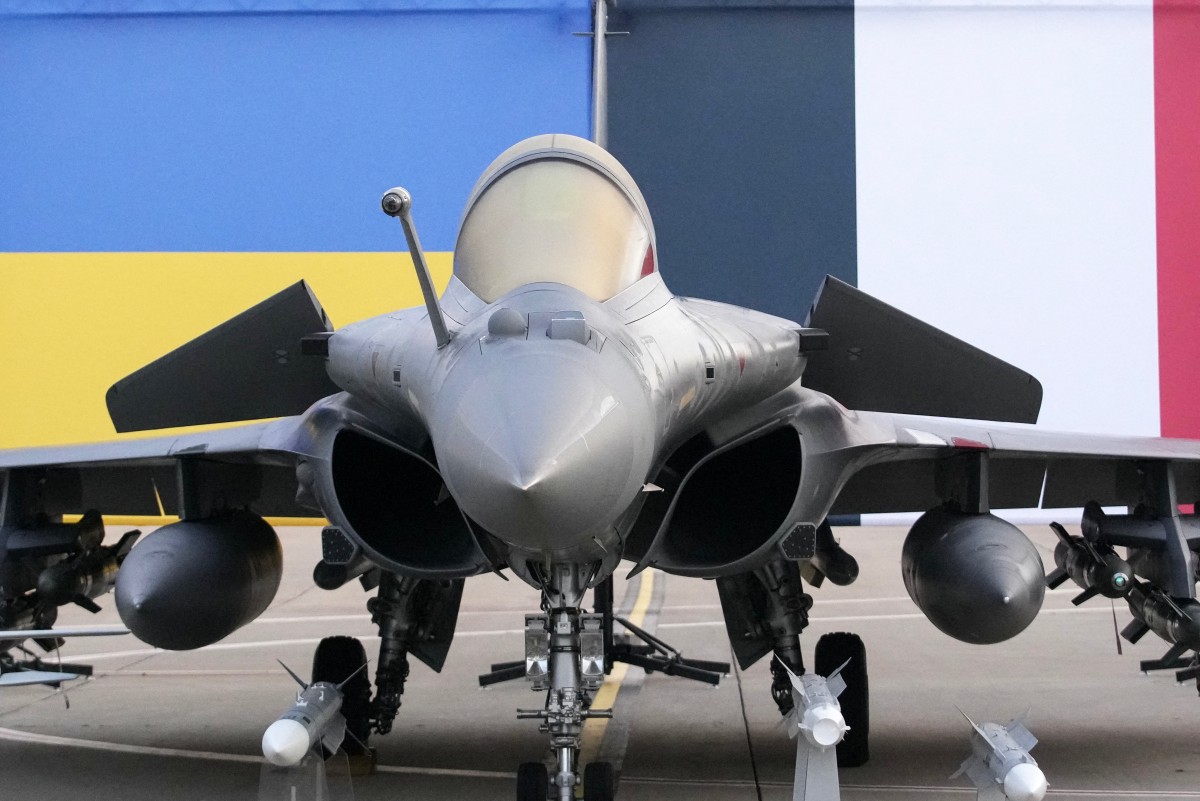
The 14 hard points and 24.5 tonnes maximum take-off weight mean that Rafale could carry more missiles and munitions on it in a single mission.
The Rafale also leads in internal fuel capacity, carrying more than 4.7 tonnes compared to approximately 3.4 tonnes in the Gripen E and roughly 3.1 tonnes in the F-16.
This greater internal fuel capacity and increased external payload capacity allow the Rafale to execute various missions that would otherwise require tanker support or additional sorties. Rafale’s combat radius can exceed 1,000 km depending on loadout.
The 14 hardpoints mean that the Rafale could carry multiple air-to-air and air-to-ground missiles, targeting pods, and external fuel tanks.
Rafale could also carry long-range precision-strike weapons, such as Storm Shadow and SCALP-EG cruise missiles, as well as MICA and Meteor air-to-air missiles.
The Meteor missile — with its ability to engage aerial targets at ranges exceeding 200 kilometers and speeds beyond Mach 4 — could offer Ukraine a genuine game-changer weapon to fight Russian jets. Designed as a technological leap forward, the Meteor was developed specifically to outperform the US AIM-120 AMRAAM, long considered the gold standard in beyond-visual-range air-to-air missile (BVRAAM) technology.
In fact, on May 28, President Zelensky had commented on the lethal Meteor missiles.
“Meteor missiles that destroy targets at distances exceeding 200 kilometers – will help us push Russian jets away so that they can’t use glide bombs en masse anymore,” Zelensky had tweeted.
Meteor is known for its outstanding kinematic performance, achieved through its distinctive ramjet propulsion system—solid-fuel, variable-flow, ducted rocket.
MBDA emphasizes that this “ramjet” motor creates the greatest No-Escape Zone of 60 km, within which there is a high kill probability against a target. This is believed to be the largest no-escape zone among air-to-air missiles.
Rafale could also carry Hammer, which is a rocket-assisted bomb, already employed by Ukraine. Notably, Ukraine is already using MICA, Scalp, Storm Shadow, and Hammer, and there is a possibility of Meteor missiles integrating with Gripens.
All these missiles could also be carried by Rafales.
The Rafale’s SPECTRA (Self-Protection Equipment Countering Threats to Rafale Aircraft) is a highly advanced, fully integrated electronic warfare (EW) suite developed by Thales and MBDA. It is specifically designed to significantly enhance the aircraft’s survivability against both enemy aircraft and ground-based air defense systems, such as the Russian S-300/S-400.
These features will significantly boost the deep strike capabilities of the Ukrainian Air Force.
The unique combination of a large fleet of both Gripens and Rafales will also provide Ukraine with unparalleled capabilities. While the Gripen fighters are specifically designed for distributed (or dispersed) operations from highways, with low maintenance costs, can be managed by small teams, and have quick turnaround times, the Rafale will provide Kyiv with heavy, deep-strike capabilities in contested airspace.
By the mid-2030s, Ukraine could have one of the largest, most advanced, and most diversified air forces in Europe, a remarkable turnaround for a country that had an outdated air force just four years ago.
- Sumit Ahlawat has over a decade of experience in news media. He has worked with Press Trust of India, Times Now, Zee News, Economic Times, and Microsoft News. He holds a Master’s Degree in International Media and Modern History from the University of Sheffield, UK.
- VIEWS PERSONAL OF THE AUTHOR.
- He can be reached at ahlawat.sumit85 (at) gmail.com