Russia has reportedly struck the 1,000-year-old Dormition Cathedral, a UNESCO World Heritage Site in Kyiv, during a heavy aerial assault on the capital, even as Ukrainian experts reported that Moscow has upgraded its ballistic missiles to evade air defenses.
The latest attack reportedly triggered a massive fire at the Dormition Cathedral within the UNESCO-listed Kyiv-Pechersk Lavra monastery complex, which boasts a vast network of underground caverns spanning more than 600 meters and has been a popular destination for Christian pilgrims for hundreds of years.
Notably, the director general of the Kyiv-Pechersk Lavra National Preserve, Maksym Ostapenko, told Ukrainian official channel Suspilne that a Russian kamikaze drone struck the roof of the church directly, engulfing about 800 square meters in flames.
The attack was described as “Russia’s most serious crimes against Christian culture to date” by Ukrainian President Volodymyr Zelenskyy, who shared comprehensive details about the attack on X. Meanwhile, the Metropolitan Epiphanius I, the head of the Orthodox Church of Ukraine, condemned the attack, calling it “a crime against humanity, against history, and against Christianity.”
Russia has now denied attacking the UNESCO-listed Cathedral, and has instead alleged that the site was hit by a Patriot air-defense missile that “malfunctioned” during the attack.
“According to confirmed reports, the Kyiv-Pechersk Lavra complex was hit by a missile from an American Patriot anti-aircraft missile system. One of the reasons for the system’s malfunction could have been that Western countries supplied the Kyiv regime with expired missiles,” the Russian Ministry of Defense said in a statement.
Russian military forces reportedly launched ballistic missiles, cruise missiles, and attack drones that sparked fires across nearly all of Kyiv’s districts, including in residential buildings, cultural institutions, and other civilian infrastructure. The strikes killed at least 11 people, according to Ukrainian officials, and largely resembled the massive June 2 strikes on the capital Kyiv that claimed many lives.

However, the only difference between the two airstrikes was that the latest attack used the Iskander-K cruise missile instead of the Kalibr cruise missile, as noted by Yurii Ihnat, head of communications for the Ukrainian Air Force.
“Probably it differs in that there were no Kalibr cruise missiles, but instead there were Iskander-K cruise missiles… In total, 70 missiles and 611 UAVs of various types. Among them, the already well-known anti-ship Zircon missiles, which attacked from Crimea, 34 Iskander-M missiles,” Ihnat stated.
Ihnat claimed Ukrainian air defenses managed to shoot down 100% of the Russian cruise missiles.
Meanwhile, the air defenses shot down 15 of the 34 Iskander-M/S-400 missiles on ballistic trajectories, a number the Air Force Spokesperson described as comparatively high for an attack of this kind. Similarly, he described the intercept of five of the six hypersonic Zircon missiles—which likewise follow a ballistic profile—as one of the best outcomes ever seen against that kind of missile.
A video attributed to the interception of a Zircon hypersonic missile by a Patriot has since surfaced and gone viral on social media.
Footage of a Ukrainian PATRIOT SAM system successfully shooting down an incoming Russian Zircon/Kinzhal hypersonic missile over Kyiv overnight. pic.twitter.com/Ag83IT3dyl
— OSINTtechnical (@Osinttechnical) June 15, 2026
The use of ballistic missiles was potentially intended to inflict maximum damage, as they are among the hardest to intercept, as acknowledged by the Ukrainian Air Force.
The latest attack comes amid reports that Russia has modified its Kinzhal and Iskander-M missiles to make them even harder to intercept, even as it already faces a shortfall of advanced Patriot interceptors.
Russian Ballistic Missiles Harder To Intercept Now
Russia has modified its Iskander short-range ballistic missiles to enhance their penetration of Ukrainian air defense systems and significantly reduce interception, according to Ukrainian officials and experts.
This assertion was made by Colonel Oleksandr Zaruba, chief research fellow at the State Scientific Research Institute of Armament and Military Equipment Testing and Certification, during an event titled “The Russian Federation’s Use of Air Attack Weapons Against Civilian Infrastructure: Technical and Humanitarian Aspects.”
The expert revealed that the missile has been equipped with an updated 9B899 module, which makes the missile harder to detect by employing decoys, dipole reflectors, and heat traps during the terminal phase of flight.
Succinctly put, the new 9B899 module uses a radar jammer to interfere with RF [radio frequency]-guided interceptors and distributes decoy submunitions, such as heat traps and dipole reflectors, to create false targets during the terminal phase of flight to confuse RF- and IR-homing interceptor missiles. The Iskander-M, for example, can release up to six dart-shaped modules with fins.
Colonel Zaruba further disclosed that Russia has upgraded onboard systems on the Iskander to allow the missile to operate in active-scanning mode and to identify blind spots in the radar coverage of air defense systems. Notably, the algorithm or software used to detect blind spots or weak signals can be consistently updated.
Furthermore, Colonel stated that the new missiles manufactured in 2023–2024 use a faster processor to process images from the optical homing head, thereby maximizing the target recognition, detection, and destruction.
The missile’s more powerful CPU enables it to process target-area photos from the optical seeker more quickly, thereby increasing accuracy.
According to Colonel Zaruba, the upgrades are meant to increase resistance to modern air defense systems, especially the Patriot system; increase the missile’s range; and scale up production despite sanctions.
“It has been claimed that the missile’s range can be increased to 1,000 kilometers in the latest modernization. This means the missile could strike targets anywhere in Ukraine,” the Colonel emphasized.
Further, he added that components and technological solutions from North Korea’s KN-23 missiles were being incorporated into the Iskander manufacturing process to streamline production and bypass international sanctions.
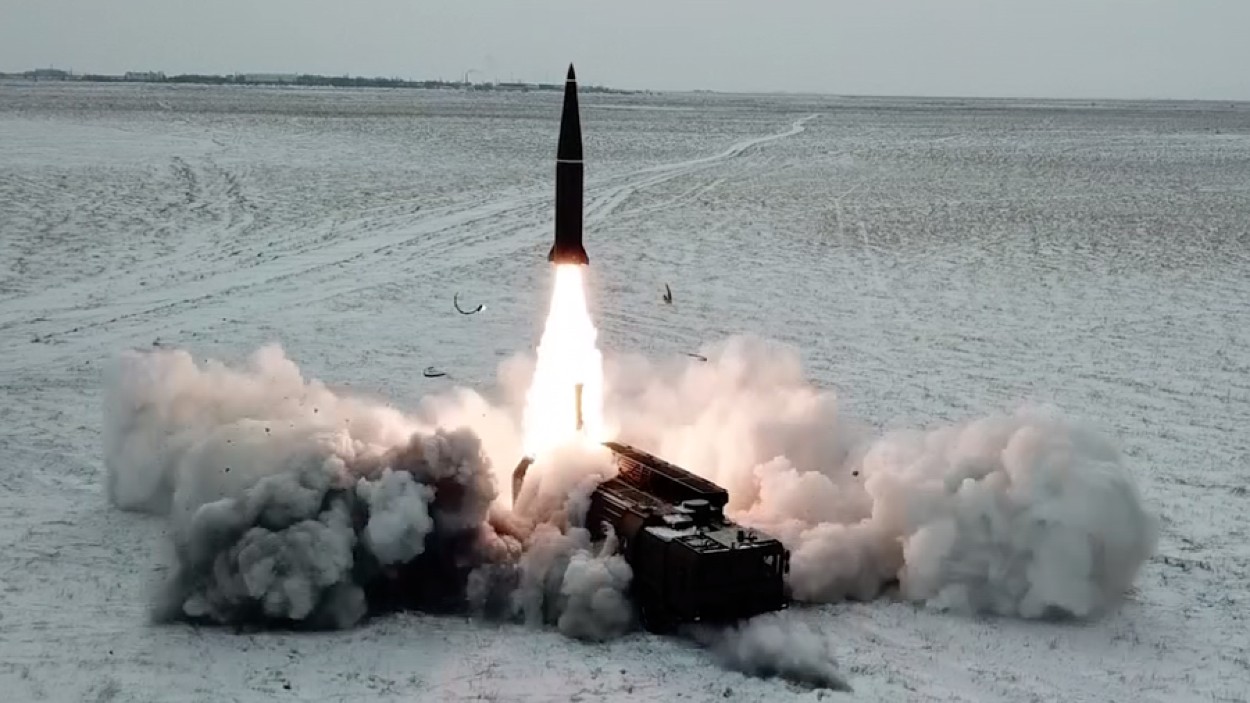
“Production has reached 60-70 units per month. The share of Russian-made electronic components in the missile has increased to 90%, while Western components remain present. There are seven warhead variants, including penetrating and bunker-busting versions, which are being used against airfields to target our tactical aviation. Particular efforts are being made to locate F-16 aircraft,” the expert said at the event.
Colonel Zaruba concluded his address by stating that the Iskander-M has evolved into a complex, quasi-ballistic system that is being actively programmed to counter air defense systems during combat operations.
Meanwhile, Indian Air Force veteran and popular military commentator Squadron Leader Vijainder K. Thakur noted that the overall interception rate for missiles such as the Iskander and Kinzhal has dropped. Citing data aggregated from Ukrainian sources, the expert noted that Ukraine intercepted only 227 of the 939 total Iskander and Kinzhal launches between September 2022 and October 2025, for an interception rate of 24%.
“It is likely that the interception rate increased steadily over the period as the number of deployed Patriot systems grew. Not just the number of Patriots deployed, but also the missiles’ interception tactics and algorithms were refined to counter the speed and maneuvering advantages of the Russian missiles. As a result, by the summer of 2025, the interception rate had increased to 37 percent,” the expert noted.
“However, in September–October 2025, the interception rate dropped sharply to 6–17 percent. The decline could be attributed to limited availability of Patriot interceptors, improved survivability of Russian missiles, or a combination of both,” he added.
While Russia’s ballistic-missile attacks against Ukraine have grown in magnitude and volume amid enhanced tensions between the two sides, Ukraine is staring at depleted Patriot stockpiles, which are the country’s only reliable counter to the incoming barrage of ballistic missiles like Iskander and Kinzhal.
Notably, the US has been sending Patriot missiles to Ukraine, among other weapons and munitions—including through the Prioritized Ukraine Requirements List (PURL), a new system wherein NATO nations pay for the transfer of weapons from the US. However, Zelenskyy has warned that the current delivery pace under the PURL program is not keeping up with the threats facing the country as Russia intensifies aerial attacks.
Last month, Zelenskyy told the White House and Capitol Hill in a letter that Ukraine urgently needs additional Patriot missile systems as Russia intensifies ballistic missile attacks on Ukrainian cities. Patriot systems continue to be the “most-effective defense against every type of Russian ballistic missile,” since “the fate of many lives” is being decided in the conflict, the President said in the letter.
Zelenskyy has since offered to set up Patriot production under license in Ukraine amid global shortages and production-related constraints, as recently reported by EurAsian Times. Moreover, Ukraine is developing its own indigenous version of the Patriot to eliminate the risk of supply disruptions.
Even if they were to materialize, both these efforts will take time.
- Contact the author at sakshi.tiwari13 (at) outlook.com
- Follow EurAsian Times on Google News