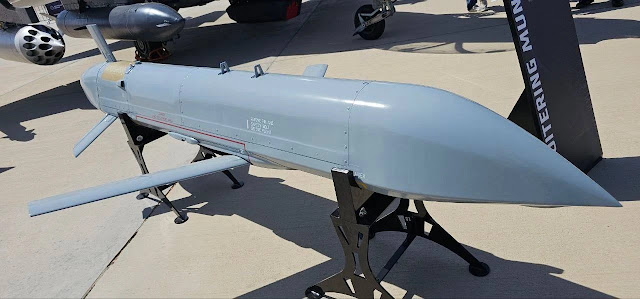
The world premiere of the Dan-T loitering munition by Rostec at the El Alamein International Airshow 2026 has drawn considerable interest. Some would say it has cleared the air around a new Russian weapon system that has demonstrated an uncanny ability to penetrate Ukrainian air defenses. Others contend it has only added to the confusion about the weapon’s actual capabilities.
In its statement, Rostec says: The “Dan-T” munition operates on the “fire-and-forget” principle and is adapted for launch from Russian and foreign aircraft and helicopters.
The product is equipped with a small jet engine and can hit targets hundreds of kilometers away.
The “Dan-T” has a special flight mode designed to bypass enemy air-defense systems.
Hundreds of successful launches against enemy targets in the special military operation zone have confirmed the loitering munition’s high effectiveness.
Rostec’s description of the weapon as “fire-and-forget” implies it is a cruise-missile-like weapon designed to strike a pre-programmed target based on coordinates or optical imagery. The question that arises, therefore, is: how then is it a loitering munition?
And what exactly is the “special flight mode designed to bypass enemy air-defense systems”?
The weapon does not appear to have an optical aperture for an infrared or TV seeker, making it unlikely to support machine-vision-based terminal navigation.
Under the circumstances, its ability to bypass enemy air-defense systems may derive from a combination of low-observable characteristics—including its small size and low radar cross-section—and the use of 12- or 16-channel jam-resistant satellite navigation.
Dan-T Antecedents
The Dan-T is reportedly derived from the Dan-M target drone, which was first operationally tested for combat use in May 2025.
The Dan-M’s reported flight-performance capabilities include a cruise altitude of 50 to 9,000 meters, a cruise speed of 300 to 750 km/h, and an endurance of approximately 70 minutes. Its take-off weight is 350 kg.
Dan-M History
The existence of the Dan-M was first publicly reported in August 2004.
The Dan-M was developed from the Dan target drone, designed for air-defense training and testing, which first flew in 1993.
The Dan-M program aimed to provide greater endurance and range, with production reportedly expected around 2005. Later public reporting on a further-updated Dan-M, featuring a new engine and avionics, appeared around 2020.
Dan-T Loitering Munition at El Alamein 2026. Photo courtesy Rostec
Stealth Characteristics
All three Dan variants share essentially the same aerodynamic layout.
The differences appear internal and mission-related rather than the result of a fundamental airframe redesign.
While the Dan and Dan-M were target drones that likely carried a Luneberg lens to modify their radar signatures, the Dan-T does not appear to have a Luneberg lens. Another significant difference is that the Dan and Dan-M were designed for parachute recovery, whereas the Dan-T is an OWA (one-way attack) drone.
Banderol Similarity
The Banderol S8000, a jet-powered cruise-missile-like drone, looks remarkably similar to the Dan-T. Russia has been using the Banderol, launched from its Orion MALE drone, extensively in its ongoing systematic campaign against Ukraine’s logistics, weapons-manufacturing, energy, and export infrastructure.
However, while the Banderol is attributed to Kronstadt, which also developed the Orion drone, the Dan-T is believed to be an upgrade of the Dan-M target drone.
Banderols usually cruise at low altitudes, particularly when routed over the sea for strikes on targets in Odesa, avoiding radar detection right up to the moment they pop up to gain altitude and strike the target at an angle best suited for maximum damage.
The use of composites, besides stealth shaping and small size, adds to the low observability of the weapon, reducing detection range.
Launch-Platform Versatility
Using a helicopter as a launch platform makes the weapon particularly versatile. Air launch increases the drone’s effective range, while helicopter carriage allows it to be launched without the early warning that could accompany the radar detection of a fighter aircraft.
The drone is likely programmed to operate mostly outside the engagement envelope of Ukraine’s MANPADS and SHORAD systems.
By leveraging the Dan-T’s superior flight performance, Russia could compel Ukraine to engage these drones with medium-range air-defense systems such as NASAMS, IRIS-T and SAMP/T. Not only are these systems available to the AFU in limited numbers, but their missile stocks are also scarce—both in Ukraine and among their original manufacturers.
Additionally, despite its improved performance, the Dan-M is likely to be a relatively affordable platform. Its unit cost is probably considerably lower than that of a medium-range air-defense missile.
By forcing Ukraine to expend its limited and expensive interceptor stocks against comparatively inexpensive drones, Russia could further erode the country’s already strained air-defense capabilities.
Conclusion
The Banderol is known to be inexpensive, allowing Russia to ramp up production relatively easily. In mid-August 2026, HUR (Defense Intelligence of Ukraine) told Militarnyi that Russia can produce up to about 80 S8000 Banderol missiles per month. Plants are described as working three shifts.
Serhii “Flash” Beskrestnov, an adviser to Ukraine’s defense minister, stated in July that Russia’s planned rate for 2026 was 120 per month (roughly four a day if fully used). Later, in August, Beskrestnov said Moscow was trying to raise jet-powered munition output and that Banderol production could be pushed toward 300–400 per month.
The increased use of the Banderol bears testimony to its cost-effectiveness, if not its sophistication. Assuming the Banderol and the Dan-T are similar weapons, if not the same, Russia’s El Alamein pitch to sell the missile could have many takers.
- Vijainder K Thakur is a retired IAF Jaguar pilot, author, software architect, entrepreneur, and military analyst. Views Personal of the Author
- Follow the author @vkthakur