Even as the US is engaged in a military conflict with Iran over its nuclear program, the world’s nine nuclear-armed states have expanded the number of nuclear warheads deployed on missiles and other delivery systems – the first such increase in several years.
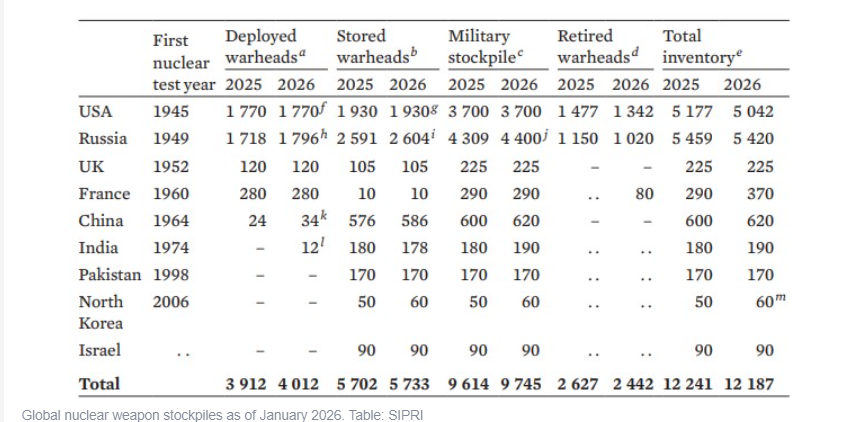
According to the latest data from the Stockholm International Peace Research Institute (SIPRI), an estimated 4,012 warheads were deployed on missiles and at bomber bases.
This is an increase of around 100 deployed warheads compared with the estimate for January 2025, mainly based on a reassessment of Russian nuclear warhead deployments and SIPRI’s assessment of new Chinese and Indian nuclear warhead deployments during 2025.
SIPRI estimates that between 2100 and 2200 deployed warheads were kept on high operational alert on ballistic missiles. Nearly all of these alert warheads belonged to Russia and the USA, with smaller numbers maintained by France
and the UK.
The SIPRI report also said China and India may have started deploying warheads on high operational alert.
Therefore, three out of the nine nuclear-armed states – Russia, China, and India – have expanded the number of their deployed warheads.
Russia recorded the greatest increase in its deployed nuclear arsenal.
In January 2026, Russia had 1,796 deployed warheads, 78 more than last year, when it had 1,718.
This is Russia’s highest figure since 2017 and the fourth consecutive year in which Moscow has increased the number of deployed warheads.
Russia has approximately 5,420 nuclear warheads in total, the highest in the world.
Similarly, India had 12 deployed nuclear warheads, whereas in 2025, it had none.
China also increased its deployed warheads from 24 in 2025 to 34 this year.
Of the total global inventory of an estimated 12,187 nuclear warheads in January 2026, about 9745 were in military stockpiles for potential use, which is roughly 130 more than SIPRI’s estimate for January 2025.
Meanwhile, the total number of nuclear warheads continues to decline due to the gradual retirement and dismantling of older warheads.
In 2025, the global nuclear inventory stood at 12,241 warheads, which declined to 12,187 in 2026.
The total figure keeps falling only because the United States and Russia are dismantling retired weapons faster than they build new ones.
Still, two countries expanded their total nuclear inventory over the past year.
China’s nuclear inventory increased from 600 warheads in 2025 to 620 this year.
Similarly, India also witnessed a modest increase. It added 10 new nuclear warheads in one year.
According to SIPRI, both India and China will continue to expand their nuclear inventories in the coming years.
While the UK is not expected to have increased its nuclear weapon arsenal in 2025, its warhead stockpile will likely grow in the future, based on the British government’s 2021 announcement that it was raising the stockpile’s upper limit from 225 to 260 warheads.
US and Russia together hold about 89 percent of deployed warheads (3,566 of 4,012) and nearly 86 percent of the global inventory. They account for about 83 percent of warheads in military stockpiles available for potential use.
The data clearly suggests that after a hiatus of several years, nuclear weapons are again in vogue, with countries expanding the total number of warheads, as well as deployed warheads on missiles.
Focus on India’s Nuclear Modernization
The SIPRI report said that India increased its stockpile by 10 warheads and, for the first time, deployed 12 warheads on missiles.
However, another report by the Bulletin of the Atomic Scientists, released last week, said that India continues to modernize its nuclear arsenal, with several new weapon systems fielded in recent years and several more under development to complement or replace existing nuclear-capable aircraft, land-based delivery systems, and sea-based systems.
The report warned that while India has already assembled 190 warheads, it might have produced enough military plutonium for 140 to 225 new nuclear warheads.
“We estimate that India may have produced enough military plutonium for 140 to 225 nuclear warheads and might have assembled up to 190. With more weapon systems in development, the country’s warhead stockpile will likely increase further,” it said.
The report said the International Panel on Fissile Materials estimated India produced approximately 730 kg (plus/minus about 170 kg) of weapon-grade plutonium.
“Assuming approximately four kilograms of plutonium per warhead, this would theoretically be sufficient for producing anywhere between 140 and 225 nuclear warheads,” it said.
However, it said the calculation comes with some caveats due to several uncertainties, such as the warhead designs India has produced.
The article also noted that the size of India’s nuclear stockpile depends on the number and types of launchers that can deliver them, as it is unlikely India would produce significantly more warheads than these systems can launch.
It noted that out of India’s estimated 190 nuclear warheads, India already has 160 warheads for operational launchers, and additional warheads for new missiles are in production.
The article noted that India has 48 nuclear-capable aircraft, 32 Mirage 2000H and 16 Jaguar IS. It further noted that India’s Rafale fighter jets (36 bought in 2015) are also nuclear-capable, but they have still not taken a nuclear role.
“It is possible that the new Rafale at some point will take over the nuclear role from one of the older aircraft, but there is no official information that it has already.”
India also operates 88 land-based nuclear-capable missiles, including 24 Prithvi-II (Range 250 km), Agni-I, II, III, IV, V, and Agni-P (range 700 to 5000 km), and sea-based missiles, including K-15 and K-4, completing India’s nuclear triad.
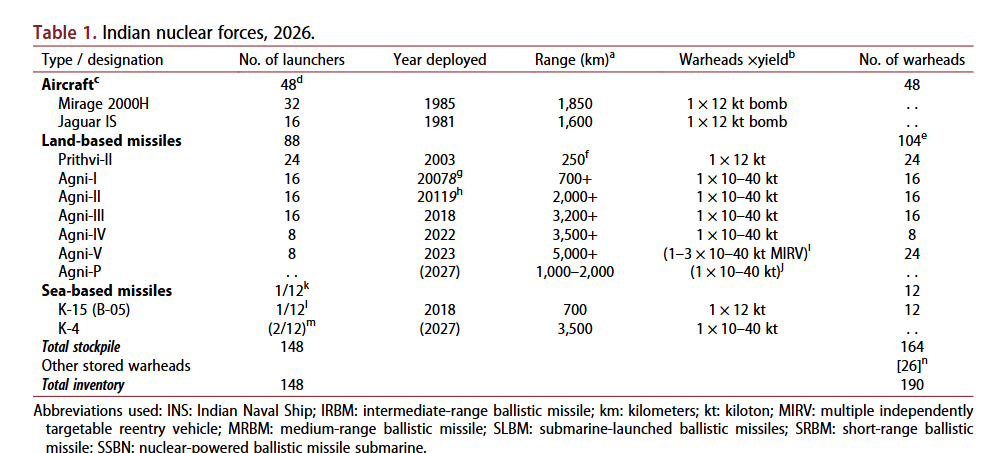
It said that while India’s nuclear deterrent policy has historically focused on Pakistan, the ranges of India’s latest nuclear-capable Agni missiles (up to 5,000 km) suggest that China is its primary target.
“The expected expansion of India’s nuclear forces, increasingly focused on a militarily superior China (in terms of both conventional and nuclear forces), will result in new capabilities being deployed over the next decade,” it said.
Along with adding new nuclear weapons, deploying more warheads, and developing new nuclear delivery platforms, there is also a rush towards nuclear-powered submarines, nuclear-powered aircraft carriers, nuclear-powered missiles, and deploying nuclear reactors in orbit and on the Moon.
Nuclear-Powered Submarine Race Expands
Last week, IAEA (International Atomic Energy Agency) Director General Rafael Grossi revealed that South Korea “has formally notified the Secretariat of its intention to start consultations with the Agency on an arrangement pursuant to Article 14 of its comprehensive safeguards agreement (CSA).”
Article 14 of the CSA allows a country to use nuclear material for non-nuclear military purposes, such as nuclear-powered naval propulsion, under an arrangement with the IAEA.
Seoul has set a goal of launching its first nuclear-powered submarine in the mid-2030s and deploying it with the Navy in the late 2030s.
Similarly, Australia is partnering with the United States and United Kingdom as part of the AUKUS initiative to acquire conventionally armed, nuclear-powered attack submarines (SSNs).
Calls are also growing in Japan for developing nuclear-powered submarines.
In South America, Brazil is building Latin America’s first nuclear-powered submarine.
So far, only nuclear-powered states have maintained nuclear-powered submarines; however, nuclear-powered submarines are now appealing even to non-nuclear states.
Analysts worry that this could lead to nuclear proliferation.
Meanwhile, China is reportedly working on a nuclear-powered aircraft carrier.
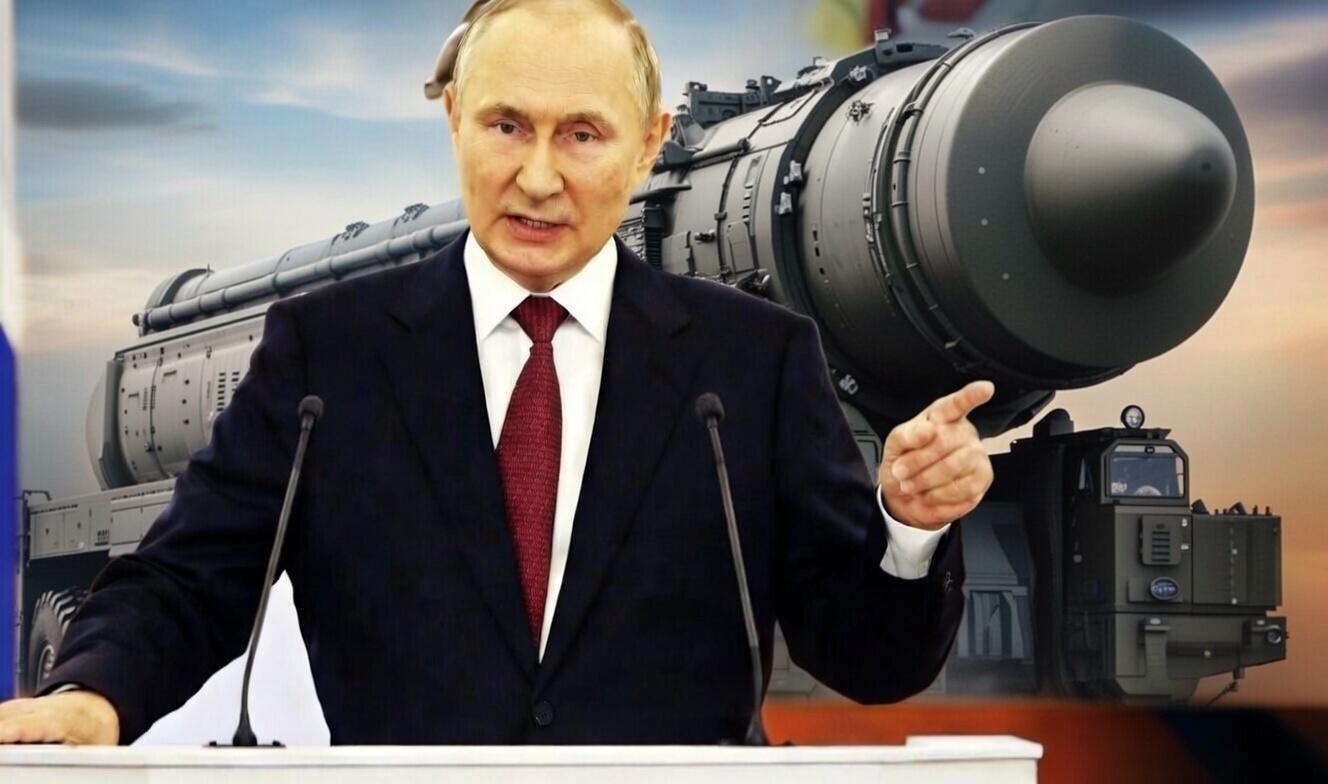
Russia, on the other hand, has claimed to have successfully tested a new nuclear-powered and nuclear-armed missile, Burevestnik, which translates as “Storm Petrel”, calling it “a unique weapon that no other country possesses.”
Because of its onboard nuclear power, the weapon has, in principle, a nearly unlimited range. Putin claimed that the test lasted around 15 hours, with the missile traveling more than 14,000 kilometers.
Nuclear Power in Space
Similarly, under the ‘National Initiative for American Space Nuclear Power,’ the US wants to deploy a nuclear reactor in orbit by 2028 and on the lunar surface by 2030.
In April this year, the White House issued a six-page directive to the Pentagon and NASA: deploy nuclear reactors into Earth’s orbit by 2028 and to the lunar surface by 2030.
“The United States will lead the world in developing and deploying space nuclear power for exploration, commerce, and defense,” the memo said.
Last week, US company Antares won a U.S. Air Force competition to develop a space nuclear reactor demonstrator and will receive US$161 million for the project.
Under the program, the company will conduct a ground demonstration of the R1-S nuclear reactor, then integrate it with a spacecraft for flight certification before a possible launch.
This marks the largest current Department of War award in space nuclear power.
“On June 4, 2026, Antares’ Mark-0 microreactor achieved initial criticality at Idaho National Laboratory under Department of Energy authorization, making Antares the first private company to bring an advanced reactor to criticality under the DOE Reactor Pilot Program. The company’s Mark-1 reactor is scheduled to operate for more than six months in 2027, integrated with its nitrogen closed Brayton cycle power conversion system,” the company said in a statement.
Notably, China and Russia are also planning to deploy nuclear reactors on the lunar surface. However, they are targeting a 2036 timeline for the project.
Deploying a nuclear reactor on the lunar surface would meet the constant energy needs of a human base on the Moon.
The Moon experiences 14 Earth days of continuous sunlight followed by 14 days of darkness (lunar night). Solar power plus batteries, therefore, struggles during the long night.
Nuclear-powered spacecraft will make deep space exploration missions to Mars and beyond feasible.
However, it can also lead to nuclear proliferation and a new arms race in space.
Clearly, nuclear is back in vogue.
On one side, non-nuclear-armed countries are moving towards nuclear-powered submarines, carriers, nuclear-powered cruise missiles, and aiming to place nuclear microreactors in orbit and on the Moon; on the other hand, nuclear-armed countries are expanding their inventory, deploying more warheads on missiles, and developing newer means of delivering nuclear weapons.
It remains to be seen how this will affect nuclear non-proliferation efforts.
- Nitin J Ticku holds a double master’s degree in Journalism and Business Management from the University of Glasgow. He has over 20 years of global experience in MARCOM, Journalism, and Digital Marketing, and has worked & traveled widely across Europe, the Americas, and Asia. Nitin is the Editor of the EurAsian Times.
- He can be reached at editor (at) eurasiantimes.com