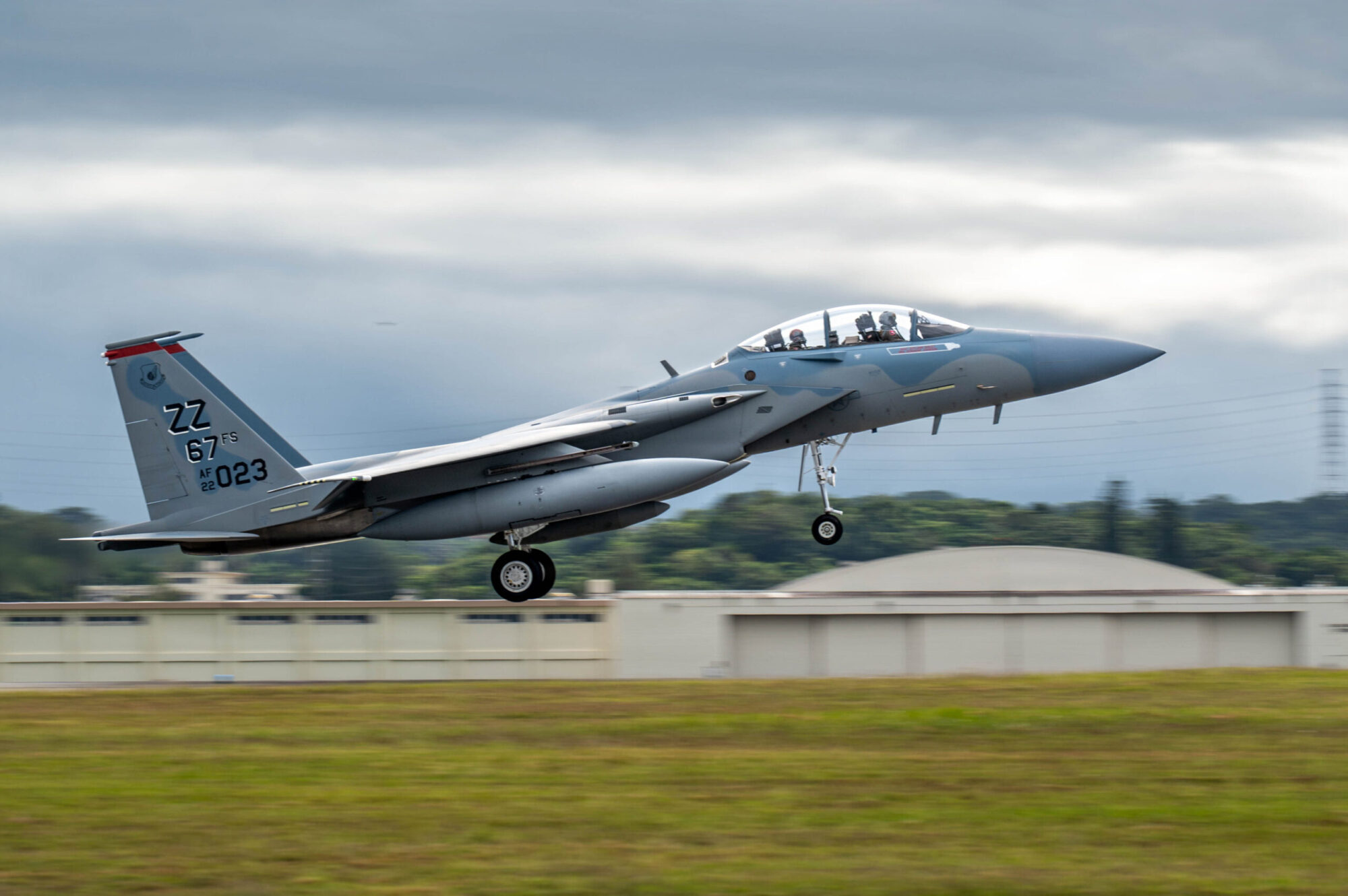
The U.S. Air Force’s cutting-edge F-15EX Eagle II fighter jets arrived at Kadena Air Base, Japan, on Nov. 15, 2026. The permanent deployment is set to boost American firepower in the Indo-Pacific region.
“The arrival of the F-15EX at Kadena marks a significant milestone for American airpower in the Pacific,” said Brig. Gen. John Gallemore, 18th Wing commander.
“These aircraft strengthen our ability to deter aggression, respond to emerging threats, and defend Japan alongside our allies and partners. Their permanent presence at Kadena reinforces our commitment to the U.S.-Japan alliance and ensures we continue to bring advanced combat capabilities to one of the most strategically important regions in the world.”
The jets are part of a 2024 plan to station 36 F-15EX fighters at Kadena to replace 48 F-15C/D Eagles.
Both the 44th and 67th Fighter Squadrons at Kadena are slated to operate the F-15EX. The newer Eagles are armed with advanced avionics, modernized electronic warfare systems, and greater weapons-carrying capacity, the Air Force said.
The Air Force expects all 36 F-15EX jets to arrive in the coming years as the 18th Wing continues its modernization ahead of its 2027 centennial.
Rotational deployments of U.S.-based fighters—including F-22 Raptors, F-35A Lightning IIs, F-15E Strike Eagles, F-16 Fighting Falcons and remaining F-15Cs—have maintained a continuous presence at Kadena since late 2022 and will continue through the transition, the 18th Wing said.
Lt. Col. Ajay Dua, 67th Fighter Squadron commander, said the unit now focuses on integrating the new aircraft into operations. “Getting the F-15EX to Kadena is just the beginning,” he said. “Now our focus shifts to integrating the aircraft into our flying operations, building experience as a squadron, and learning how to get the most out of its capabilities.” Pilots from the squadron completed qualification training at Eglin Air Force Base in Florida and at Portland.
The 18th Wing said the jets will expand Kadena’s ability to conduct counterair operations, complement fifth-generation fighters like F-35 and F-22, and operate in tandem with Japan’s warplanes.
In August 2024, as EurAsian Times reported at that time, Kadena marked the departure of one of its F-15C Eagles, tail number A5095, with a ceremonial final flight. However, the base’s final F-15C did not make its last flight until January 24, 2025, ending the aircraft’s 45-year history at Kadena.
The F-15C/D Eagles served at Kadena for more than four decades, with the 44th and 67th Fighter Squadrons. After deciding to withdraw the F-15C/D Eagles, the U.S. Air Force began deploying F-35s, F-22s, and other jets to Kadena as part of a rotational force. This measure was largely seen as a stopgap until the F-15EXs arrived.
In July 2024, the Pentagon unveiled a modernization plan to introduce 36 new F-15EX jets to Kadena; however, it represents a 25% reduction from the base’s previous permanent fighter presence of 48 F-15C/Ds.
The 25% reduction demonstrates a notable shift in the USAF’s approach. Instead of replacing every older jet one-for-one, the USAF is deploying a relatively smaller but much more powerful fleet.
The F-15EX is far more advanced than the aging F-15C and F-15D jets it is replacing. It keeps the F-15’s strong combat record while adding cutting-edge technologies like modern avionics and an AESA radar.
While the F-15C and F-15D jets were becoming harder to operate and less reliable, the brand-new F-15EX is designed for 20,000 hours of service. Inside the cockpit, the enhancements are more evident.
The older jets relied on a mix of old-gen instruments and early digital systems. The F-15EX replaces them with a full glass cockpit built around large, high-resolution displays and powerful modern computers. Pilots see more information more clearly, and the open architecture of the computers means new software and weapons can be added far more easily than on the legacy jets.
The radar is one of the biggest upgrades. Instead of the older mechanically scanned or early electronic radars, the F-15EX is armed with AN/APG-82 AESA radar. It can see farther, track many more targets at once, and resist enemy jamming better than the old jets.
The new jets also feature the Eagle Passive Active Warning Survivability System (EPAWSS), which can detect, identify, and locate hostile radar threats and uses electronic countermeasures to help protect the warplane in heavily contested environments.
In terms of weapons payload, the F-15EX can carry up to twelve air-to-air missiles, or a heavy mix of air-to-ground weapons, giving it more firepower than the old C and D models.
In a nutshell, the F-15EX retains the strong combat performance of the F-15s but is heavily modified with advanced tech, helping the USAF keep its fighter fleet ahead of regional threats and challenges.
According to the USAF, the regional challenge is none other than China.
In December 2024, then-Commander Brig. Gen. Nicholas Evans said the new jets will help counter China’s influence in the region. Integrating the F-15EX at Kadena is also expected to strengthen cooperation with Japan’s Air Self-Defense Force, particularly with Japan’s F-15Js stationed at Naha Air Base. The two forces will work closely together to increase interoperability.
Evans further highlighted that the F-15EX jets would be instrumental in challenging China’s controversial air defense identification zones, particularly in the East China Sea and South China Sea.
- Mail is at: editor (at) eurasiantimes.com
- Follow EurAsian Times on Google News