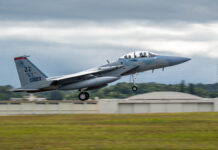


An Irishman wielding an axe is accused of destroying a $60 million US military transport aircraft at Shannon Airport in an incident that supporters have linked to long-running anti-war protests in the country.
US prosecutors have disclosed that the attacker broke through a security barrier and destroyed a parked US Air National Guard C-130 Hercules transport aircraft in April 2026.
Prosecutors state the aircraft was rendered inoperable and will not return to active flight status.
An indictment unsealed this week by a New York grand jury charges Daithi O’Corrain, 48, with one count of destruction of government property. He remains outside US custody and faces related criminal damage and trespass charges in Ireland, where he was arrested at the scene by An Garda Síochána, the national police and security service of the Republic of Ireland. If convicted in the United States, he faces up to 10 years in prison.
Notably, supporters have characterized O’Corrain as an independent peace activist and linked his sabotage operation to the opposition to the US wars in the Middle East, as well as its support for Israel’s military action in Gaza.
In fact, an online crowdfunding campaign organized by people describing themselves as the “friends and comrades” of O’Corrain framed the incident as “an inspiring act of direct action” to “resist the unwanted presence of the US Military in Ireland in the face of their illegal war & support of Israel’s genocide.”
It is worth noting that several people in Ireland have openly rallied in support of the Palestinians, and against Israel. Earlier this month, for instance, around 1,000 people gathered in Dublin for a Palestine solidarity protest during a European Political Community summit, calling for sanctions on Israel and an end to trade with the country. Similarly, last month, more than 10,000 people marched through Dublin in support of Palestine, marking the 21st such demonstration since October 2023.

Shannon Airport has long served as a stopover and refueling site for US military planes and personnel and has seen several security breaches amid ongoing protests against US military transits and related policies.
Prosecutors also cited three previous security breaches at Shannon Airport over the past year.
On May 1, 2025, three people allegedly drove a van through the airport’s perimeter fence. Sixteen days later, three others allegedly breached the runway and sprayed a US military aircraft with paint, temporarily rendering it inoperable.
In November 2025, another group allegedly drove through the perimeter in a van and reached a restricted area where a US military C-40 aircraft was parked.
It is worth mentioning here that millions of US troops have transited through the civilian facility in connection with operations in the Middle East and elsewhere since the early 2000s.
Successive Irish governments maintain that permitting American military aircraft to transit Shannon does not compromise Ireland’s policy of neutrality. Critics, however, argue that facilitating the movement of troops and military equipment to conflict zones undermines Ireland’s pledge.
Groups such as Shannonwatch and political voices within Sinn Féin have repeatedly challenged the US military’s use of the airport, portraying Shannon as a symbol of Ireland’s alleged complicity in foreign conflicts.
These activists have repeatedly depicted Shannon as a symbol of alleged complicity.
The attack by O’Corrain comes amid heightened regional tensions, including a sustained US conflict involving Iran and ongoing Israeli operations in Gaza and the West Bank.
It must be noted that Irish people’s anti-war or anti-intervention sentiment is rooted in Ireland’s historical experience of colonialism, its formal neutrality, and its anger over Gaza. However, whether all these factors together motivated O’Corrain is a viewpoint advanced by supporters, and not established in the indictment.
On the contrary, the US prosecutors’ indictment did not assign any political motive to the sabotage attempt, and instead described it as a national security attack. Manhattan US Attorney Jamie McDonald said the charge “sends a clear and powerful message that attacks on US military assets – and thus our national security – will not be tolerated.”

A Carefully Planned Attack
“As alleged, Daithi O’Corrain carried out a deliberate, planned attack against a US military aircraft, causing tens of millions of dollars in damage and jeopardizing critical military operations,” prosecutors said in a court filing.
Prosecutors said the suspect had a thorough strategy for the April 11, 2026 raid, as shown by the demolition tools he carried.
Prosecutors said O’Corrain had planned the sabotage for months. He looked up material online on the C-130’s structure, a quad-engine turboprop primarily used to transport personnel and equipment, as well as coordinates for breaking into the airport.
“This was not an act of spontaneous vandalism,” FBI Assistant Director in Charge James Barnacle Jr. said, adding he “spent months researching the aircraft, acquiring tools and materials, and preparing to maximize the destruction he could inflict.”
The indictment revealed that the accused person ordered capsules of gallium, a metallic element that can corrode steel and break down aluminum, the main material used to manufacture the C-130, and subscribed to a smartphone app that offered live flight tracking, including for military aircraft.
He also tried to contact someone allegedly involved in a similar breach at Shannon Airport before him.
When he broke into the airport on April 11, 2026, O’Corrain covered the plane’s windows with the crew’s hammocks while leaving the cockpit windshield uncovered, according to the indictment. After that, he locked himself inside the aircraft by fastening the doors with straps, brackets, and screws, and by installing ball bearings mixed with epoxy in the door tracks to prevent the doors from opening or closing.

Over the next few hours, O’Corrain destroyed the aircraft by removing, cutting, and otherwise damaging its essential parts. He broke every gauge in the cockpit, pierced air ducts, cut wire bundles, and crimped a liquid oxygen connection. Notably, prosecutors claimed O’Corrain would have risked blowing up the jet if he had cut the oxygen supply.
When the C-130 crew returned to the site, they saw O’Corrain through the open cockpit and notified security. According to the indictment, which contained pictures from video footage showing a guy standing on the plane’s roof, crew members then witnessed him escaping via a roof hatch and swinging an axe outside of the aircraft.
Before being taken into custody, O’Corrain dumped materials, including ball bearings, into the fuel tanks as his last act of vandalism of the plane.
The episode underscores the friction between Ireland’s self-image as a neutral state and the practical realities of hosting US military logistics. It also illustrates how sustained public opposition to foreign military use of Shannon, amplified by the Gaza conflict, creates an atmosphere in which some activists view disruptive action as legitimate protest.
More importantly, though, it exposes the vulnerability of US military assets overseas. Earlier, for instance, five British men in their early 20s were arrested in the UK amid suspicion of a planned attack on RAF Fairford, which hosted B-1B bombers, as the EurAsian Times reported earlier.
Separately, the US withdrew more than 12 KC-135 refueling aircraft from RAF Mildenhall in Suffolk, UK, and relocated them to other US bases in Europe and Scotland earlier this month amid a sustained security threat from Iran.
The attack highlights the vulnerability of US military assets operating from overseas facilities, even those located at civilian airports in countries considered friendly. It also raises difficult questions for Ireland, where the use of Shannon Airport by the US military has become increasingly contentious amid protests over Washington’s involvement in Middle East conflicts.
- Contact the author at sakshi.tiwari13 (at) outlook.com
- Follow EurAsian Times on Google News